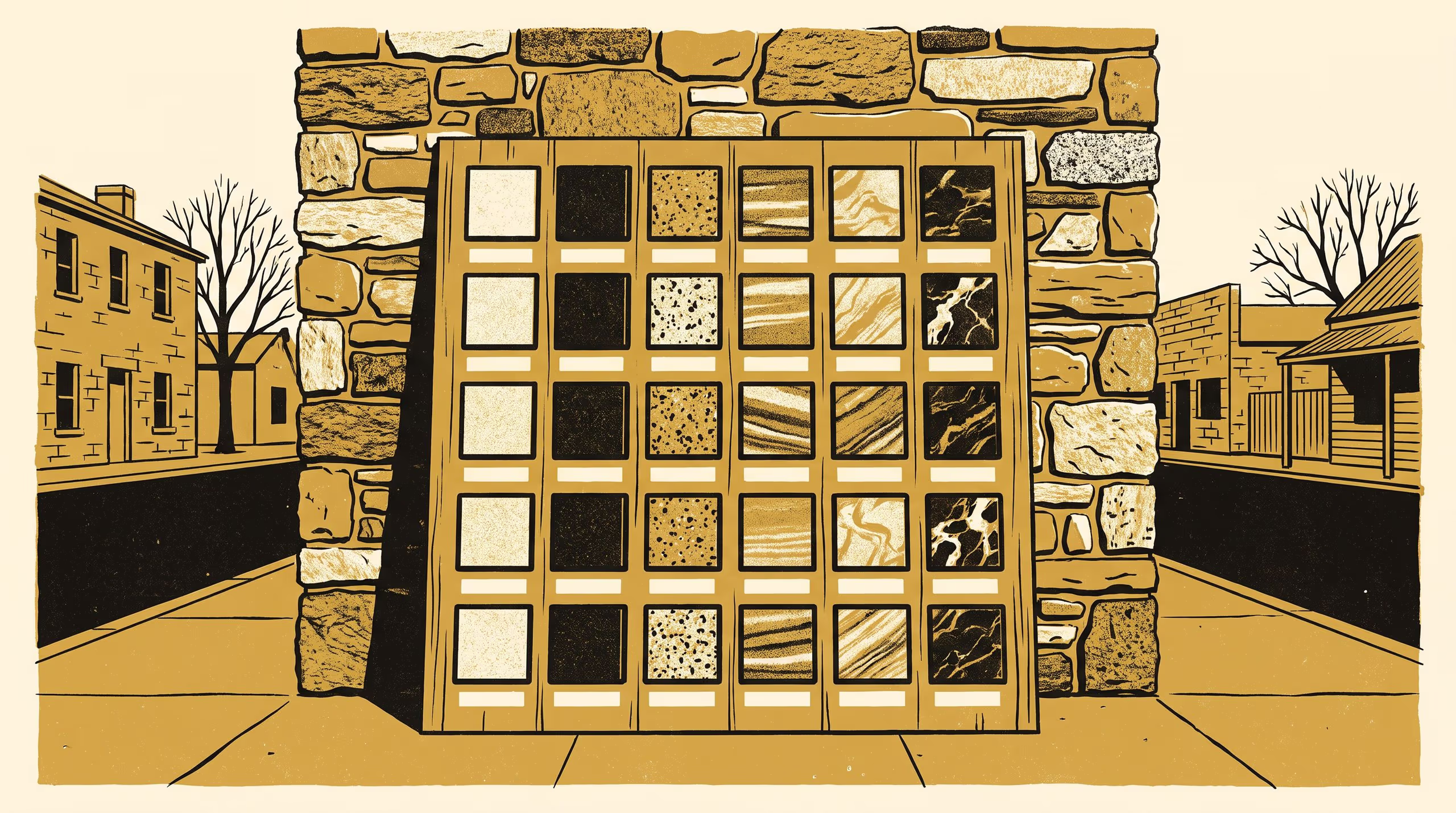
A paper from the School of Emergent Priorities and the School of Underlying Conditions treats a stone merchant's sample boards as ex situ geoheritage, and traces their tiles into the walls of a country market town along a new urban geotrail.
Sample boards from a stone merchant's papers become the reference collection for seventeen building stones whose quarries have gone
Most of a country market town turns out to have been built from stone its own merchant never chose to put on display. That is one finding of The Best Bed on the Board, a new paper from Ms Sunniva Balogun, Doctoral Candidate in the School of Emergent Priorities, and Associate Professor Ragnhild Uzoma, Lead of the Basement Relations Group in the School of Underlying Conditions.
The paper starts from nine timber sample boards that reached a state library with a stone merchant’s trade papers. For seventeen of the district’s building stones, the quarries have since been flooded, filled or lost, and the boards’ small dressed tiles are now the only samples whose source is certain. The authors set those tiles against 186 walls, kerbs, plinths and roofs across the town, and from the matches they build a twelve-stop walking route. At each stop the tile is shown beside the wall, so that a visitor sees both the stone as it was sold and the stone as it was used.
A sample board was made to be looked at closely, and for a long while nobody did. We would be glad to have the town look again, and to tell us what it finds in its own walls.
— Ms Sunniva Balogun, Doctoral Candidate, School of Emergent Priorities
Associate Professor Uzoma said the Basement Relations Group had “always found that the ground keeps better company with its paperwork than people expect”, and welcomed a collaboration that began on a library shelf rather than at an outcrop.
The paper brings geoheritage assessment, trade-literature cataloguing and urban interpretation together across two Schools. The University counts this kind of patient, place-bound scholarship among the things it is most glad to have its name on.
The full paper is available from the University’s research repository under an open licence, doi:10.5555/slop.65op68.