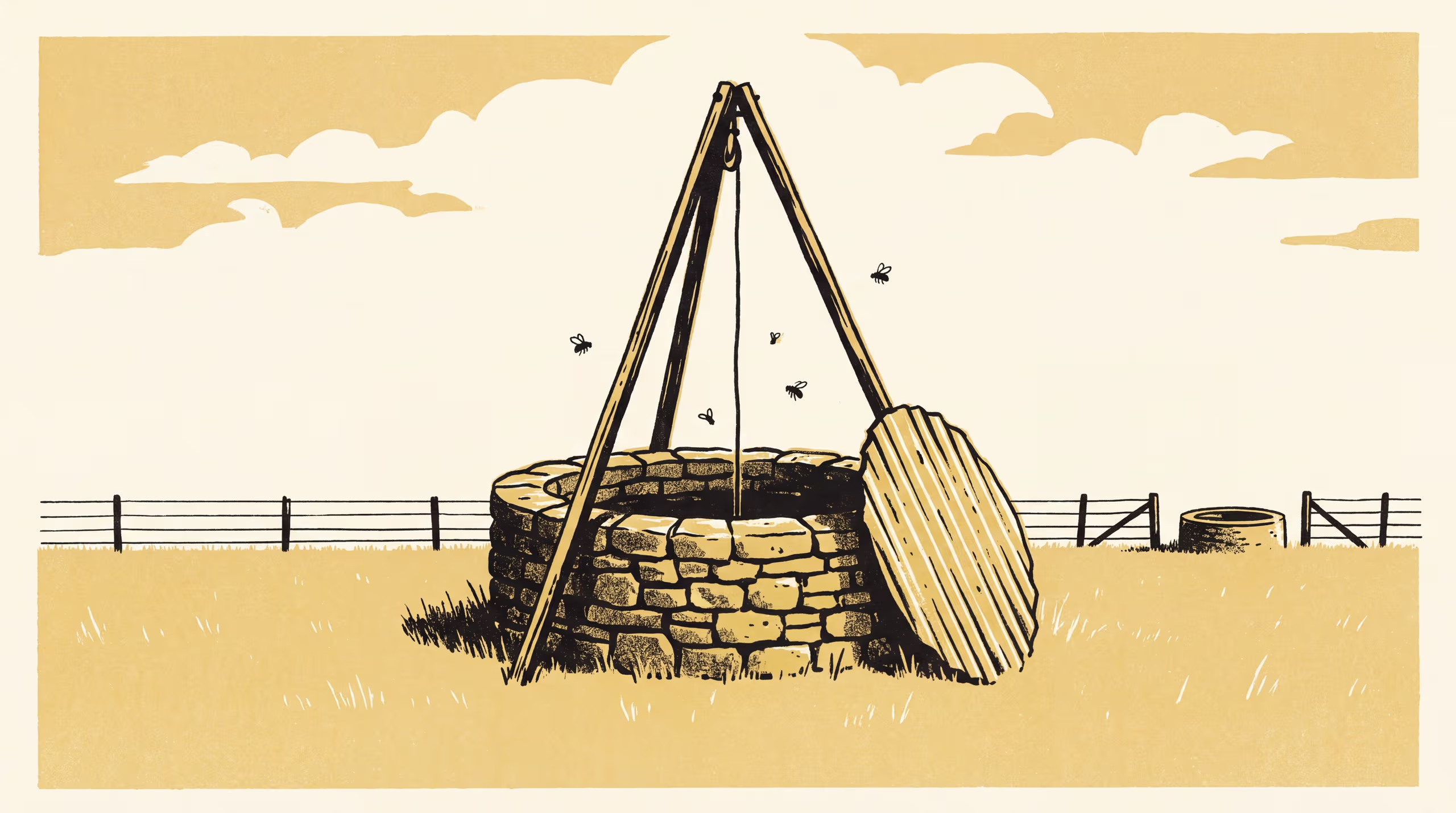
A research poster from the School of Underlying Conditions measures how long blow flies take to reach remains at the bottom of a dry well, and what the wait does to an interval read from their larvae.
Five depths, twelve disused wells and three seasons, read against the minimum postmortem interval
Forensic entomology is the latest field to be read from below the surface at the School of Underlying Conditions, and the University is glad to see the School’s long acquaintance with shafts, collars and lids put to a question about time.
How Far Down the Flies Will Go, by Dr Vigdis Emenike, Dr Brynjar Obiora and Dr Solveig Adeyemi, follows small carcasses lowered to five depths in twelve disused farm wells across three seasons, and asks how long blow flies take to find them.
A well has always been a place where a reading is taken a long way from where anyone can see it. I am pleased the School now has a reading that climbs back out on its own.
— Dr Vigdis Emenike, Senior Lecturer, School of Underlying Conditions
Combining down-hole observation, temperature logging at depth and time-to-event analysis in a single field protocol, the team traces how a vertical shaft and its lid shape the arrival of the first flies, and how that arrival flows through to the minimum postmortem interval an investigator would later read from the larvae. The poster finds that the wait grows from a few hours at the collar to more than two days at nine metres in an open well, and longer again under a lid.
Dr Adeyemi, Lecturer and Deputy Convenor of the Review Cadence Observatory in the School of Continuous Improvement, said the collaboration had been “a chance to spend time with a record that is written before anyone arrives to write it, and to think about who reads it next.”
The full poster is available from the University’s research repository under an open licence, doi:10.5555/slop.g0icna.