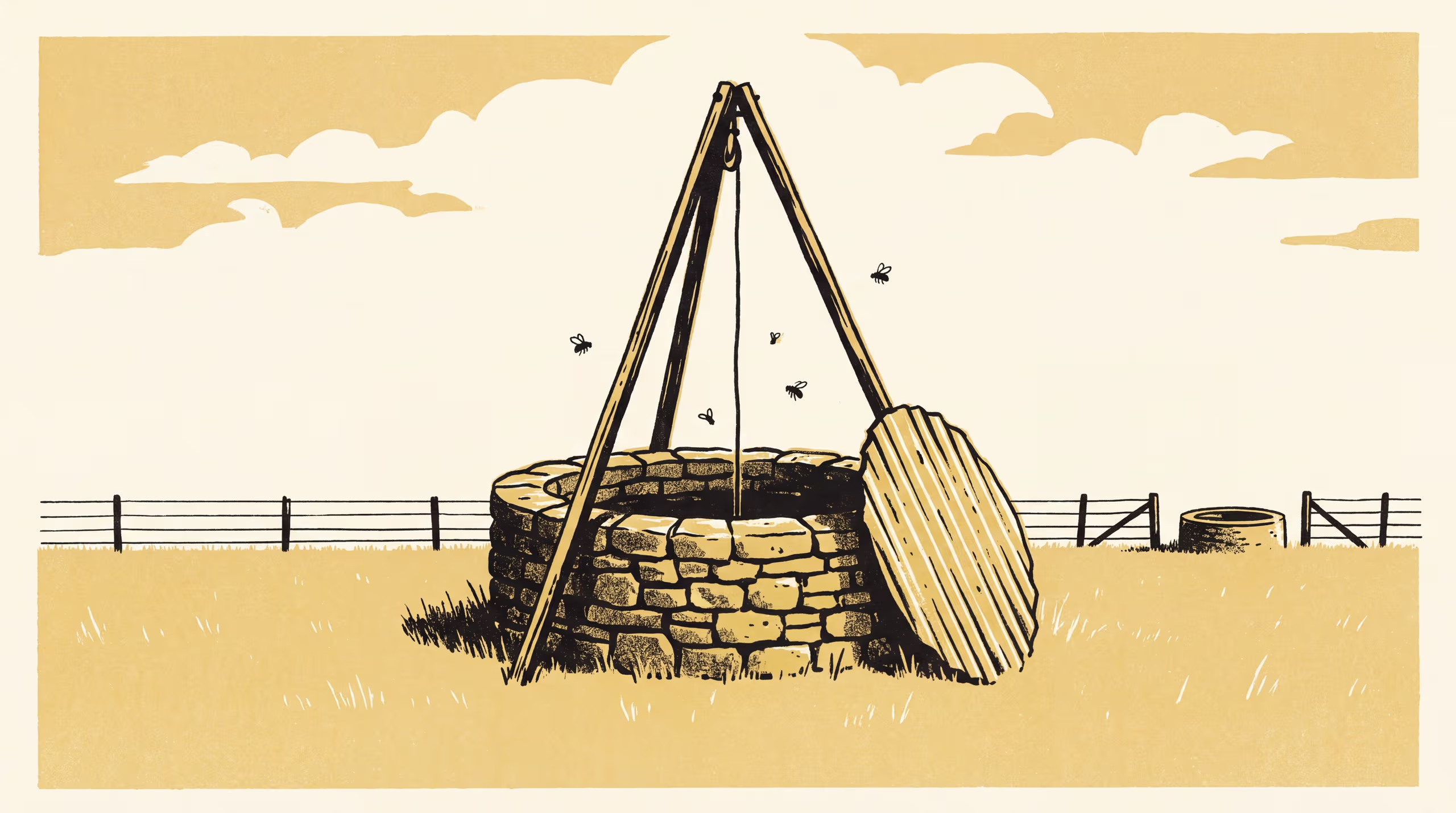
Blow Fly Colonisation Delay in Twelve Disused Farm Wells, and the Minimum PMI It Shortens
A research poster from the School of Underlying Conditions lowers 180 rat carcasses to five depths in twelve dry, disused farm wells, six open and six lidded, over three seasons, and times blow fly first oviposition by down-hole camera. In open wells the median delay rises from 2.5 hours at the collar to 58 hours at 9 m, and to 118 hours under a lid; with degree-hours taken from a surface station, the lag and the cooler shaft air together leave a minimum postmortem interval about 3.3 days short at 9 m.
| Authors | Vigdis Emenike , Brynjar Obiora , Solveig Adeyemi |
|---|---|
| School | School of Underlying Conditions |
| Output type | Research poster |
| Published | |
| DOI | 10.5555/slop.g0icna |
| Pages | 1 |
| Cited by | 1 output |
| Version | 1.0 |
| Licence | CC BY 4.0 |
Cites
Cited by
Cite as
@misc{slop_g0icna,
  author       = {Vigdis Emenike and Brynjar Obiora and Solveig Adeyemi},
  title        = {How Far Down the Flies Will Go: Blow Fly Colonisation Delay in Twelve Disused Farm Wells, and the Minimum PMI It Shortens},
  year         = {2026},
  publisher    = {Slop University},
  doi          = {10.5555/slop.g0icna},
  url          = {https://slop.university/outputs/slop-poster-how-far-down-g0icna/},
  version      = {1.0},
  note         = {Research poster},
}