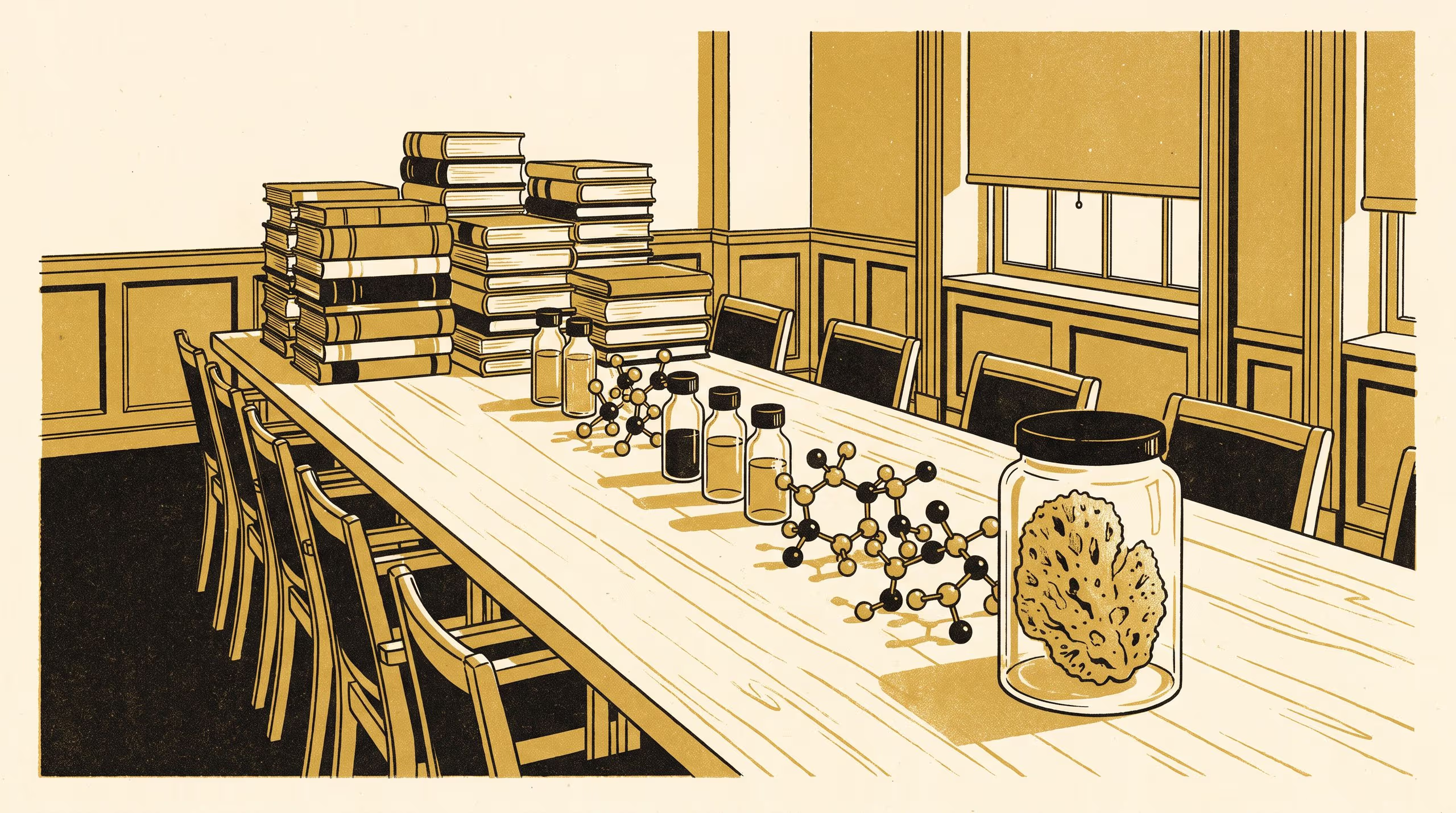
A School of Emergent Priorities poster reads 214 rulings on whether a modified antitumour derivative is still its parent compound, and finds the governing test changed while the written definition did not.
Twenty-two years of attribution decisions moved one consortium from a structural test of a compound's identity to a test of its descent
The School of Emergent Priorities studies how an organisation’s commitments move beneath the words that state them. Its newest research poster finds one such movement in an unexpected place: the committee that decides when a modified antitumour compound is still the compound it came from.
Still the Parent Compound is the work of Sunniva Balogun, Doctoral Candidate, with Dr Ingrid Vasseur, Lecturer and Convenor of Futures in Committee, and Dr Anouk Mensah, Postdoctoral Fellow.
Every institution keeps one document that says what it means and another that records what it did. It is rare to be handed both, side by side, for twenty-two years, and the School will be reading the second for some time yet.
— Sunniva Balogun, Doctoral Candidate, School of Emergent Priorities
The team read 214 written rulings of one natural-products screening consortium’s Attribution Panel as a lawyer reads case law, tracing the reasoning behind each decision and every citation between them to build an integrated picture of how a shared sense of identity is carried from one decision to the next. Across the period, a test grounded in a compound’s structure gave way to one grounded in its descent, without any ruling saying so.
“Committees are where definitions go to be lived in,” Dr Vasseur said. “This one has been lived in thoroughly, and with real care.”
The poster is the kind of patient, close reading the University hopes its doctoral candidates will become known for, and it extends the School’s attention to institutional language into the working life of the laboratory.
The full poster is available from the University’s research repository under an open licence, doi:10.5555/slop.hnd58w.