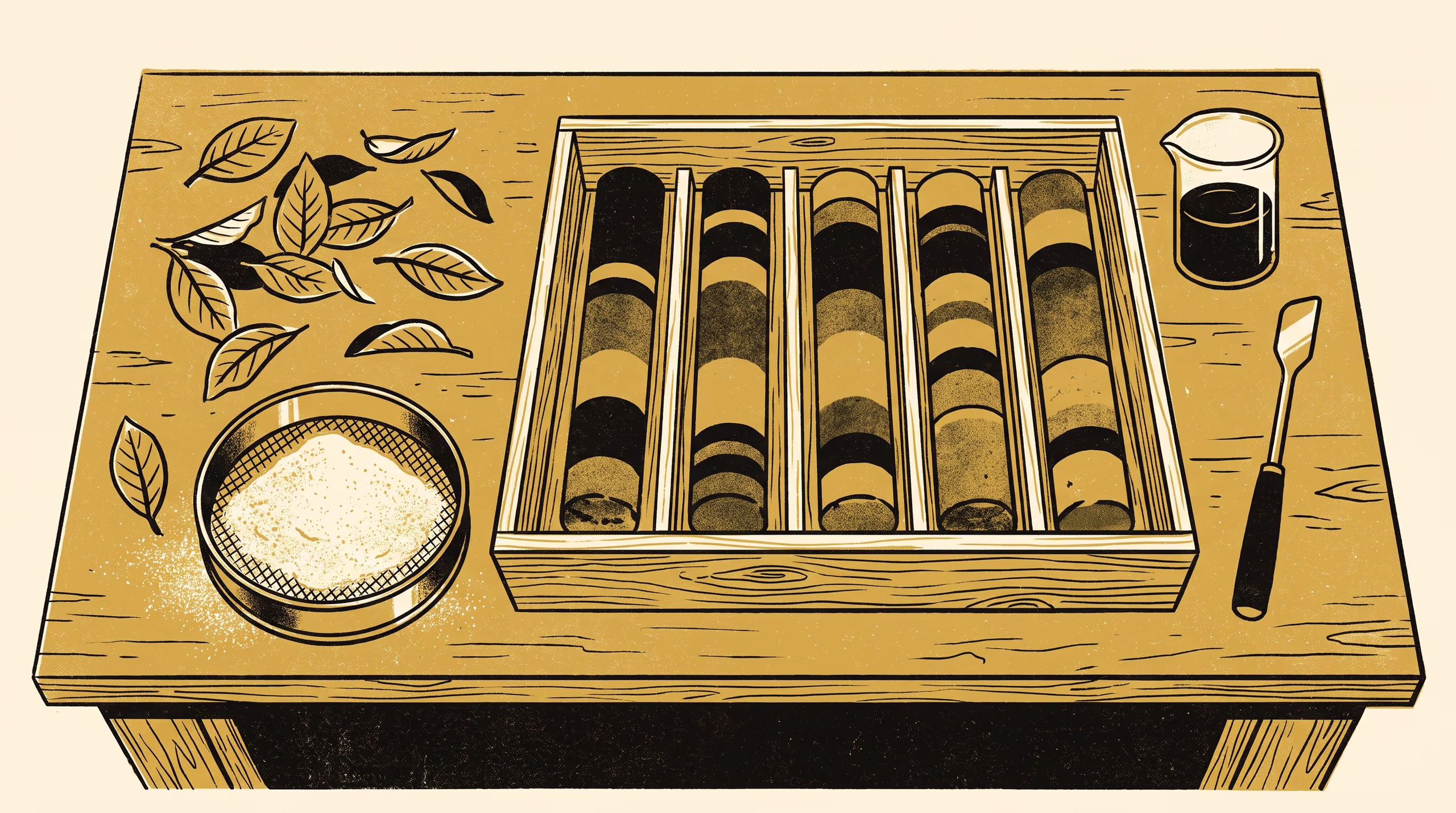
A School of Underlying Conditions poster loads one guava-leaf extract onto six reference subsoil clays and finds that which clays can stand in for one another follows their mineral, not their field texture.
Six subsoil clays from the University's profile collection sort by mineral, not by how they feel in the hand
A soil profile card records a great deal about a horizon: its colour, its structure, and how its clay feels when worked between finger and thumb. A new research poster from the School of Underlying Conditions asks what that card can tell someone who wants to use the clay for something else.
Same Texture, Different Hold is led by Dr Brynjar Obiora, Senior Research Fellow, with Dr Vigdis Emenike, Senior Lecturer in the School, and Associate Professor Casimir Beng, Lead of the Adaptive Metrics Lab.
The reference collection has always been kept for the next surveyor. It is a quiet pleasure to learn that it was also being kept for people we had not yet met.
— Dr Brynjar Obiora, Senior Research Fellow, School of Underlying Conditions
The team took clay from the subsoil of six described profiles, loaded each with the same plant extract, and followed how readily each let it go again. The comparison brings field description, laboratory mineralogy and formulation-science practice into a single line of inquiry, and finds the six clays settling into two interchangeable families defined by their mineral rather than by the texture recorded in the field.
Associate Professor Beng said the study showed “the value of asking a familiar record a question it was never written to answer, and of listening carefully to what it says back.”
The poster extends the School’s steady investment in its collection of described profiles as a living resource for the whole University, and draws on support from an Indicator Stewardship Seed Fund award for the collection’s reference shelf of known textures.
The full poster is available from the University’s research repository under an open licence, doi:10.5555/slop.bggw52.