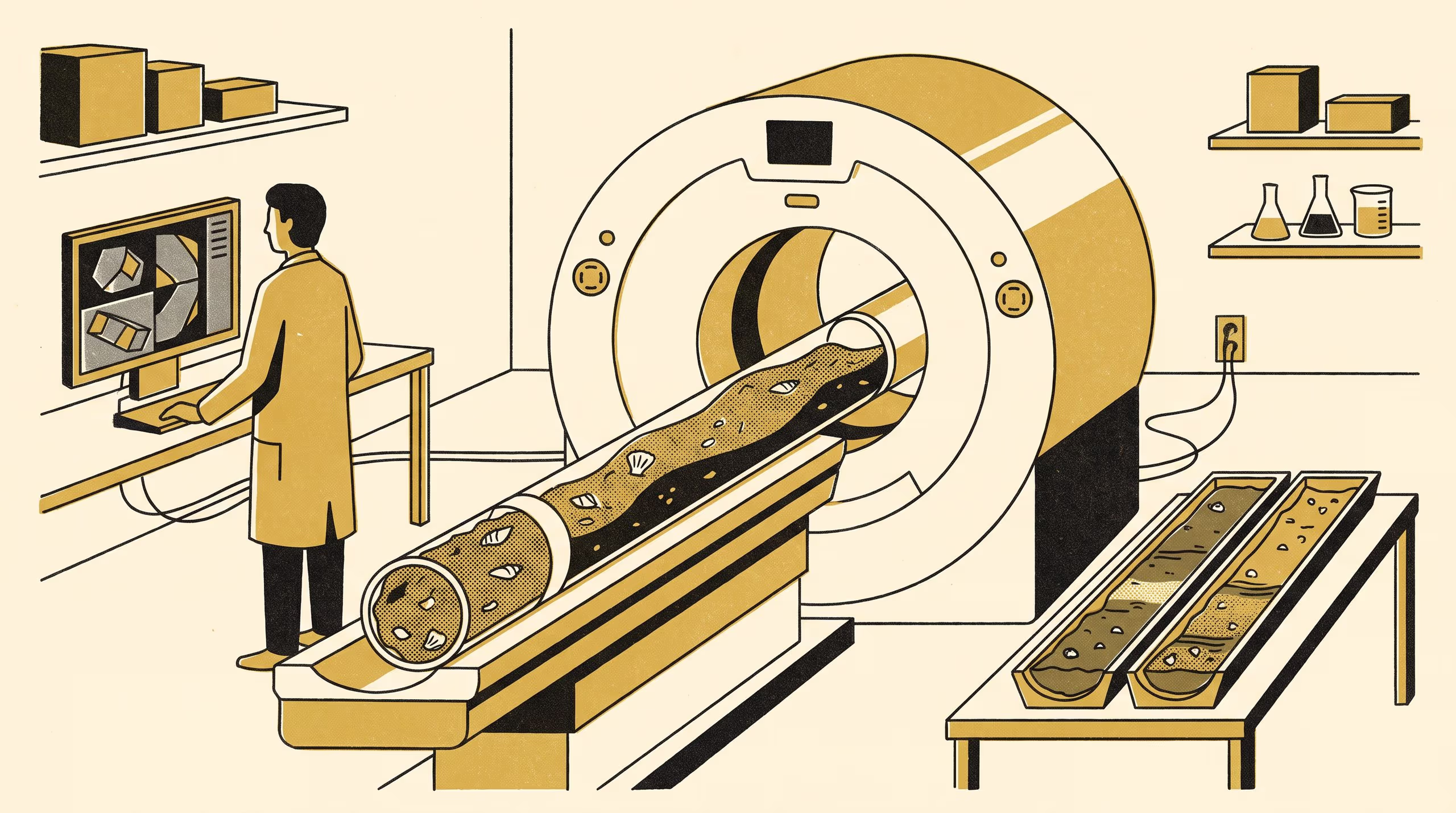
A new research poster from the School of Underlying Conditions reads which way up the shells lie in four scanned lagoon cores, and traces storm overwash layers into mud where no sand survives to mark them.
CT scans of four unsplit cores follow past overwash events beyond the reach of their sand
Four lengths of lagoon mud, passed whole through a medical scanner and left unopened until every shell inside them had been counted, are the evidence behind Which Way the Valves Landed, a new research poster from the School of Underlying Conditions. It is led by Associate Professor Ragnhild Uzoma, Lead of the Basement Relations Group, with Dr Vigdis Emenike, Senior Lecturer in the School.
The Group has spent years keeping careful account of what the drill fails to bring up. It is a real pleasure to report on something a core kept for us that we had never thought to ask it for.
— Associate Professor Ragnhild Uzoma, Lead, Basement Relations Group
The poster leverages non-destructive imaging to surface an orientation-based event signal across a barrier-to-shore transect, positioning shell attitude as a complement to the sand-led approaches that have long anchored the reading of coastal storm histories. Of 3,412 valves, those lying convex-up cluster in seven horizons near the barrier, and the signal carries landward well after the sand that marks it has thinned away. One short interval the corer did not recover is recorded as lost rather than filled in.
The work adds a quietly distinctive strand to the School’s widening attention to the coast, and extends its long-standing interest in what lies underneath to ground that happens to be underwater. Dr Emenike said the study had been “a welcome invitation to keep asking the lagoon what else it has been holding on to, and to stay patient while it answers.”
The full poster is available from the University’s research repository under an open licence, doi:10.5555/slop.9qbeww.