Convex-up Bivalve Orientation as a Late Holocene Washover Record in CT-Scanned Lagoon Cores
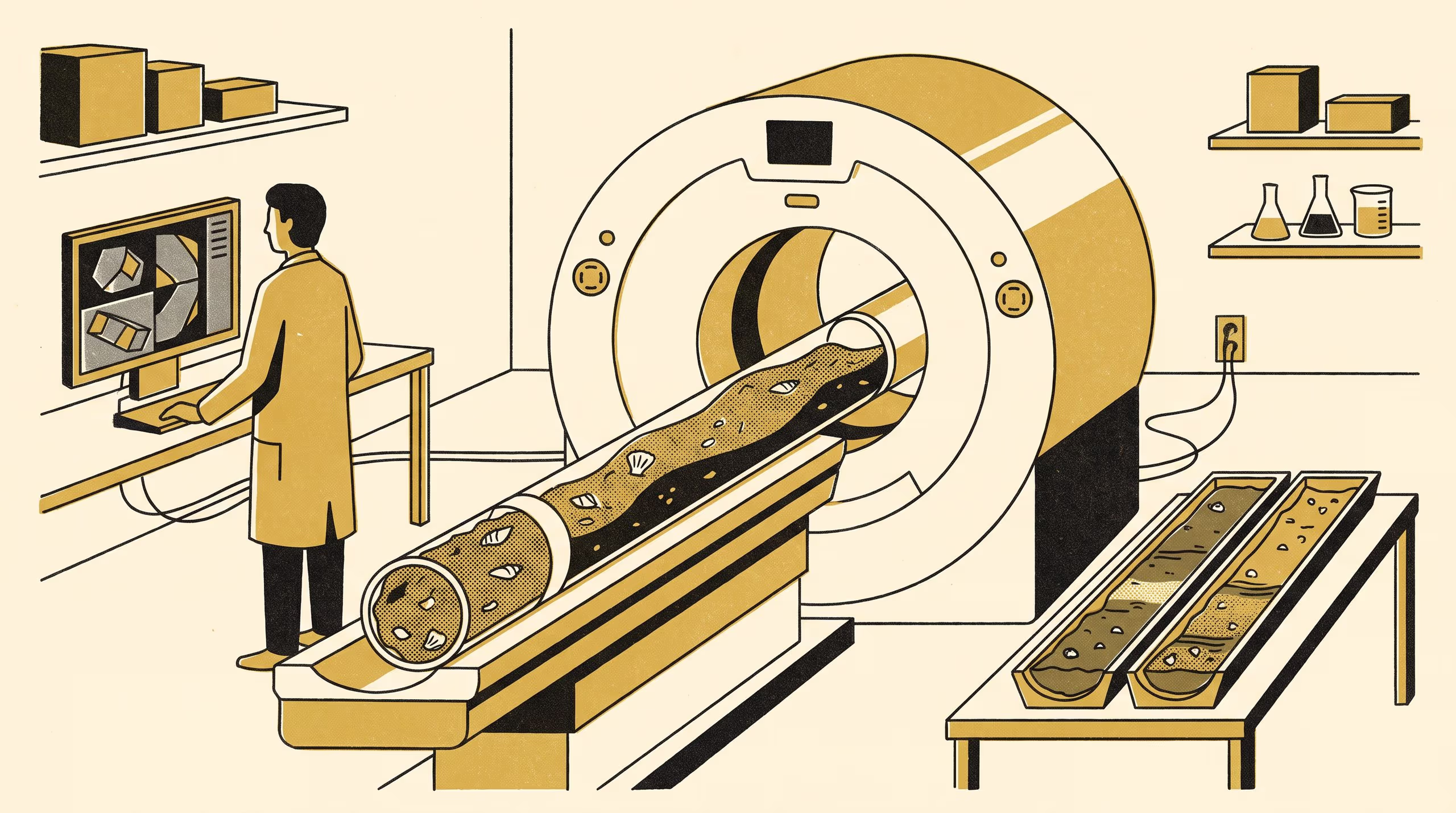
A research poster from the School of Underlying Conditions reads the orientation of 3,412 disarticulated bivalve valves by X-ray CT in four unsplit cores laid across a back-barrier lagoon, and calls a washover horizon wherever half or more of a 2-cm interval's valves lie convex-up. The barrier core holds seven such horizons, each above a visible sand bed; the count falls to five, three and one landward, where four of the horizons lie in mud with no sand at all, and an unrecovered 8 cm of one core is left as lost.
| Authors | Ragnhild Uzoma , Vigdis Emenike |
|---|---|
| School | School of Underlying Conditions |
| Output type | Research poster |
| Published | |
| DOI | 10.5555/slop.9qbeww |
| Pages | 1 |
| Cited by | 1 output |
| Version | 1.0 |
| Licence | CC BY 4.0 |
Cites
Cited by
Cite as
@misc{slop_9qbeww,
  author       = {Ragnhild Uzoma and Vigdis Emenike},
  title        = {Which Way the Valves Landed: Convex-up Bivalve Orientation as a Late Holocene Washover Record in CT-Scanned Lagoon Cores},
  year         = {2026},
  publisher    = {Slop University},
  doi          = {10.5555/slop.9qbeww},
  url          = {https://slop.university/outputs/slop-poster-convex-up-bivalve-valves-9qbeww/},
  version      = {1.0},
  note         = {Research poster},
}