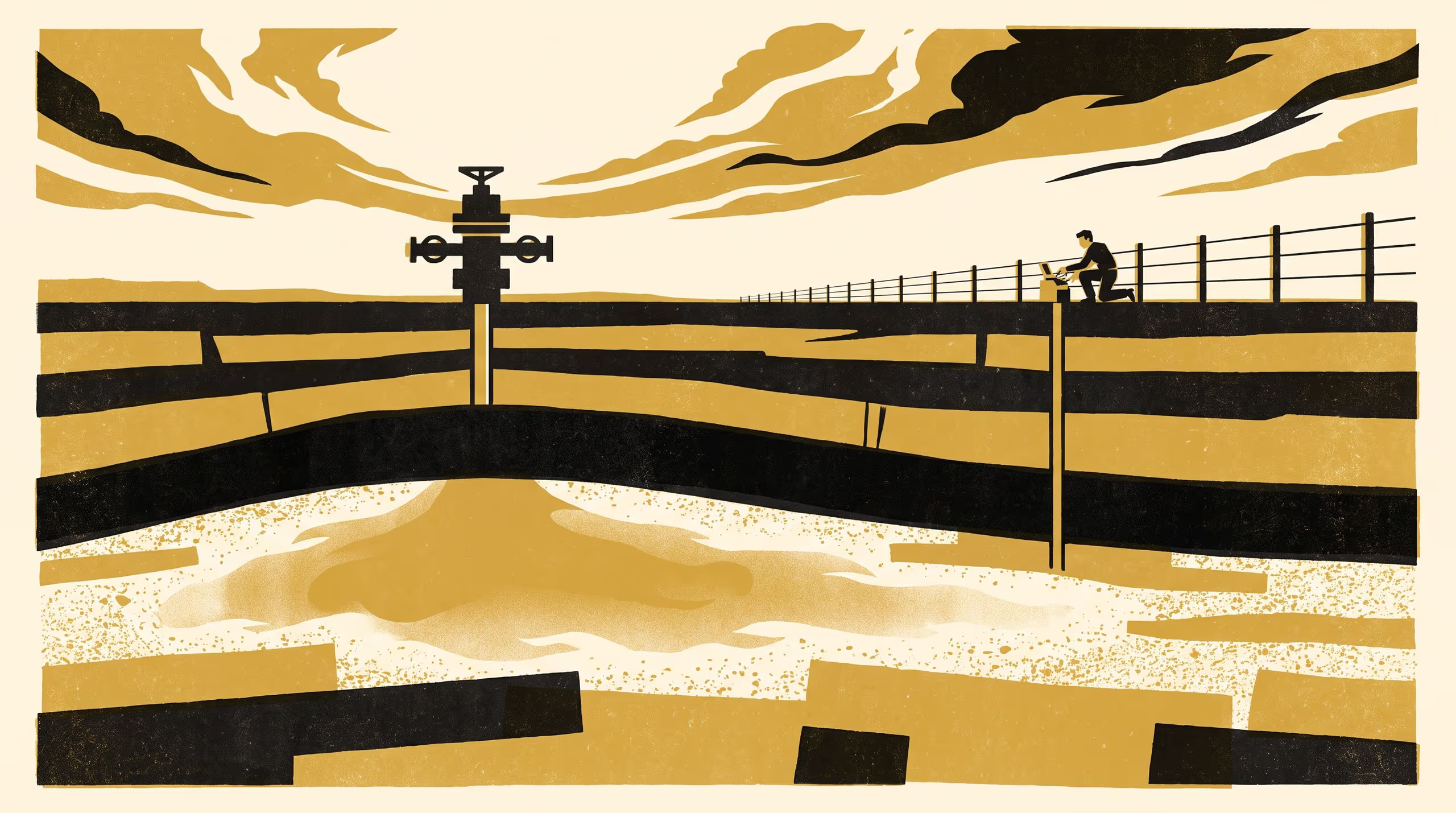
A new paper from the School of Underlying Conditions models who bears the cost of a leak from a geological carbon store once the green bond that paid for it has matured, and proposes an escrowed tranche to carry that cost.
A model of carbon storage finance finds the larger shortfall in how an operator discounts the early decades, not in the hand-over
A bond raised to store carbon underground is usually repaid long before the stored carbon has finished needing a custodian. A new paper from the School of Underlying Conditions asks what that gap does to the choices an operator makes before the first tonne goes down.
Who Holds the Plume After the Bond Matures? is led by Associate Professor Ragnhild Uzoma, Lead of the Basement Relations Group, with Associate Professor Kwame Lindqvist, Director of the Master of Priority Studies, and Dr Vigdis Emenike, Senior Lecturer.
Anyone who has kept a monitoring round going knows what it is to inherit someone else’s promise. I hope the paper is some small company for the people who keep those promises after everyone else has moved on.
— Dr Vigdis Emenike, Senior Lecturer, School of Underlying Conditions
The team brings the economics of limited liability and long-horizon discounting into conversation with the practical realities of characterising a store, building a compact model of how responsibility for a sealed formation passes from operator to steward. Its central result relocates the shortfall: in an illustrative setting, the operator’s ordinary discounting of the store’s early decades outweighs the hand-over itself roughly sevenfold. The paper also sets out a stewardship perpetual, an escrowed tranche sold alongside the bond, and the conditions under which it helps.
Associate Professor Lindqvist said the collaboration had taught his own School “a good deal about horizons, mostly by standing beside people whose horizons are measured in strata”.
The paper adds a patient voice to the University’s widening engagement with the long-lived obligations that research and finance alike tend to hand on.
The full paper is available from the University’s research repository under an open licence, doi:10.5555/slop.hl6hlq.