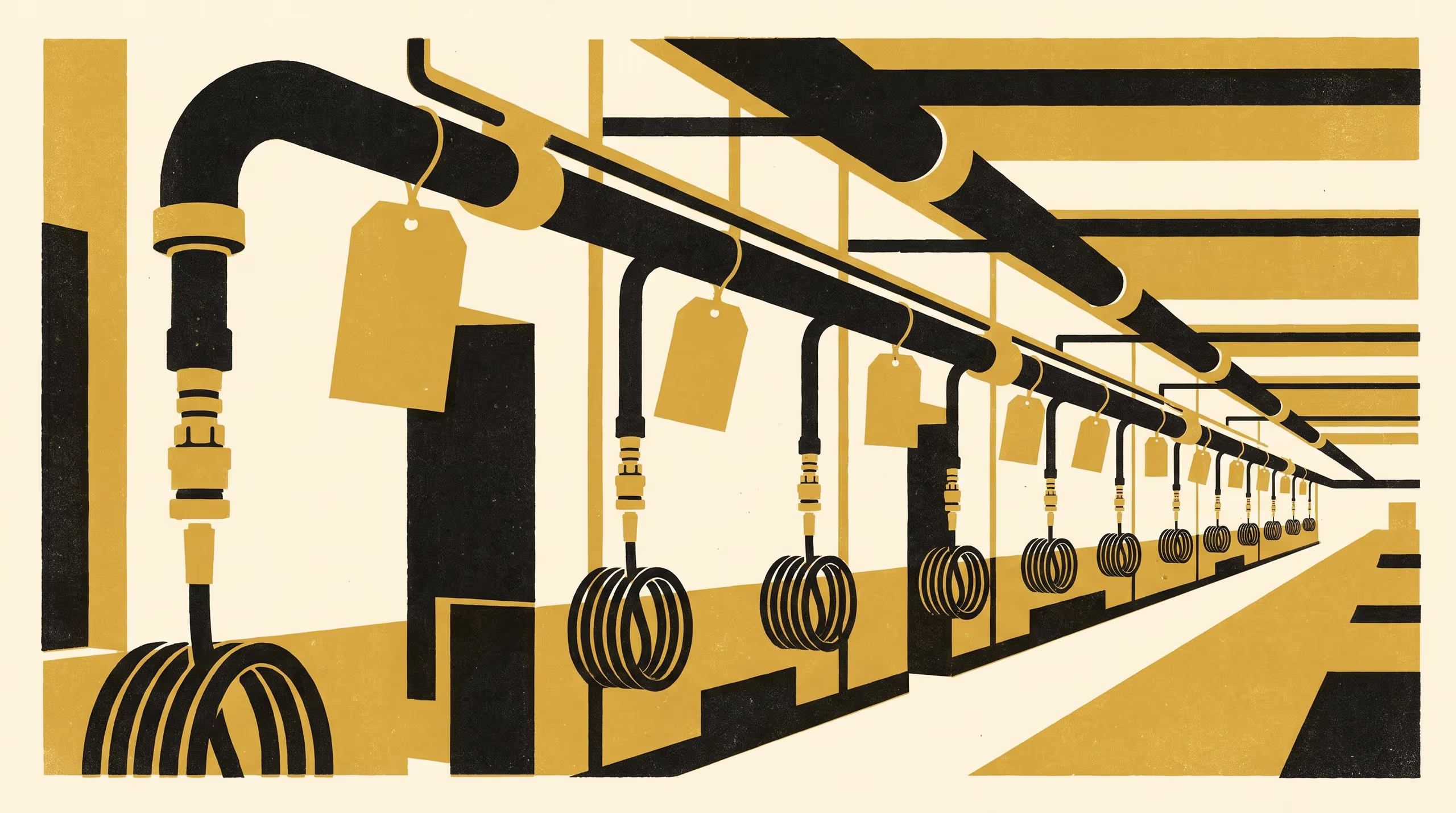
A new research poster from the School of Continuous Improvement listens to every fitting on a bottling plant's air network and finds that most of what escapes leaves through couplings fitted during past improvement events.
An ultrasonic census of one plant's compressed-air network, taken during a single shutdown
Improvement is usually measured by what it adds. The School of Continuous Improvement has now taken stock of what it leaves behind, in Every Kaizen Leaves a Coupling, a new research poster by Eivind Onwuka, Doctoral Candidate, with Dr Marit Osayande, Lecturer and Convenor of Living Dashboard, and Dr Bram Ntuli, Lecturer and Convenor of Improvement Grand Rounds.
Every improvement leaves something in the building. I am glad to belong to a School that is prepared to walk the line afterwards and listen for it.
— Dr Bram Ntuli, Lecturer and Convenor, Improvement Grand Rounds
The team brought a handheld listening instrument and a supply of paper tags to one bottling plant’s compressed-air network during a planned shutdown, and followed each of the 263 leaks they tagged back to the paperwork that put its fitting there. The picture that emerges aligns the plant’s own improvement history with its everyday energy footprint: of the 34 improvement events on record, 29 left at least one coupling on the main, and those couplings carry most of what the network loses.
The study proposes a modest addition to the close-out of every future event, and the School regards it as a natural next step in its broader conversation about what sustained improvement asks of a site. “We went in expecting to find wear,” said Mr Onwuka. “We found a history instead, and the plant was remarkably open about letting us read it.”
The work is the kind of patient, close-to-the-floor inquiry the University counts among its quieter strengths.
The full poster is available from the University’s research repository under an open licence, doi:10.5555/slop.1zb3ee.