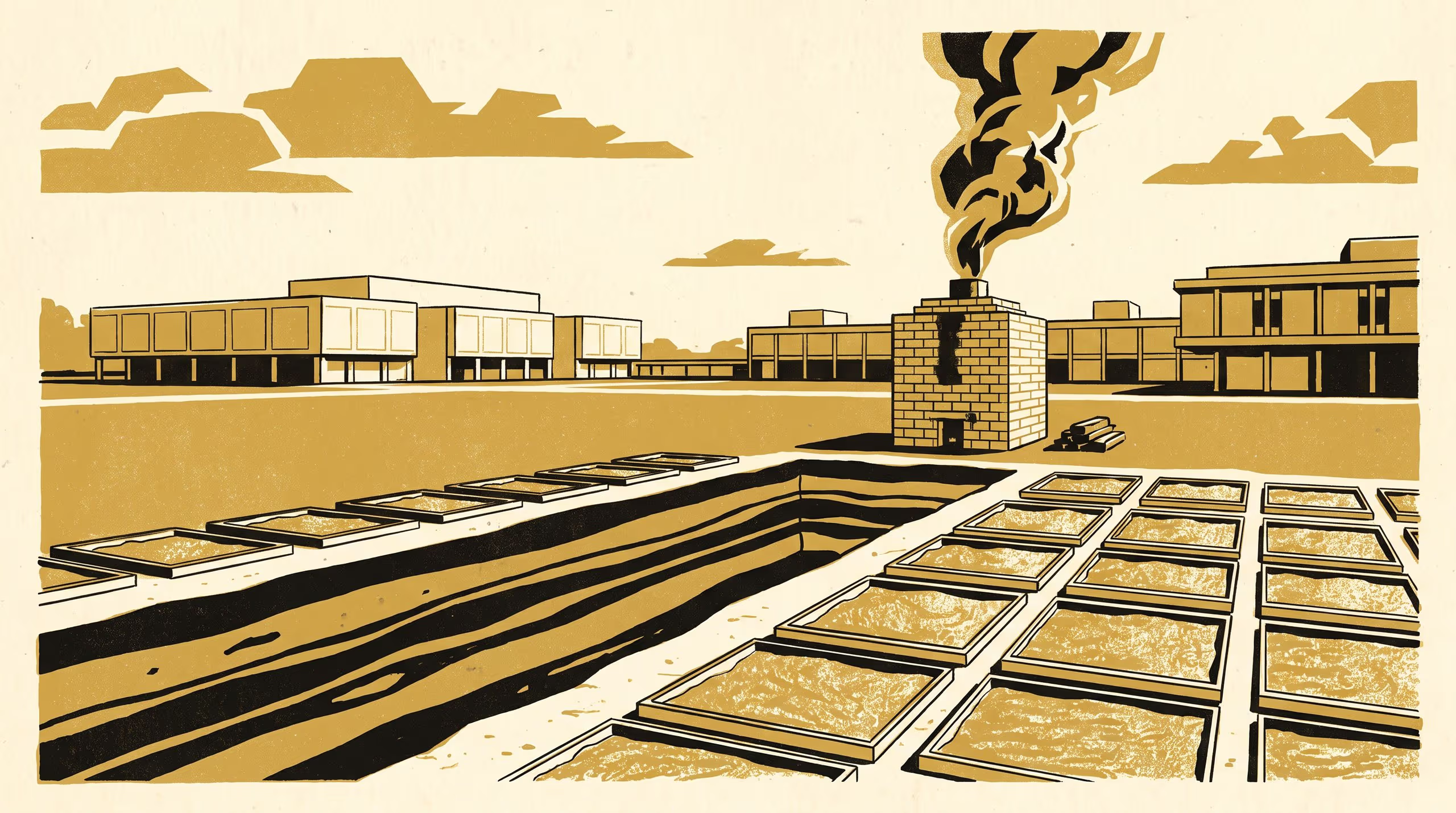
Slop University's Strategic Plan 2026-2031 commits the University to making the gold of its identity from clay surveyed and stewarded beneath its own grounds, from the first auger hole to the printed crest.
The Strategic Plan 2026-2031 commits the University to surveying, firing and printing the clay beneath its grounds
By 2031, the gold on every Slop University testamur is to be dug, washed and fired within walking distance of the hall where it is conferred. That is the central commitment of An Ochre of Our Own, the University’s Strategic Plan 2026-2031, prepared by Dr Ingrid Vasseur, Lecturer and Convenor, Futures in Committee, with Associate Professor Ragnhild Uzoma, Lead of the Basement Relations Group, and Ylva Onyekwere, Doctoral Candidate in the School of Emergent Priorities.
Somewhere in the minutes of a meeting nobody has scheduled yet, someone will ask whether the gold on the agenda is the gold in the ground. The plan is written so that the answer can be yes.
— Dr Ingrid Vasseur, Lecturer and Convenor, Futures in Committee
The plan sets out four focus areas, moving from a survey of the grounds through a pigment-synthesis capability and a framework of colour standards to the teaching and succession arrangements that will carry the work beyond the plan period. Its approach aligns stewardship, provenance and consistency across the full extraction-to-application pathway, anchored in a reference gold held by the Office of the Vice-Chancellor and in research published across all three of the University’s Schools.
Few institutions have chosen to ground their identity quite so literally, and the University regards the plan as a measure of how seriously it takes the question of where things come from.
“The clay has been under the lawns the whole time,” Associate Professor Uzoma said. “We are simply the first to have written it into the plan.”
The full plan is available from the University’s research repository under an open licence, doi:10.5555/slop.b35nq3.