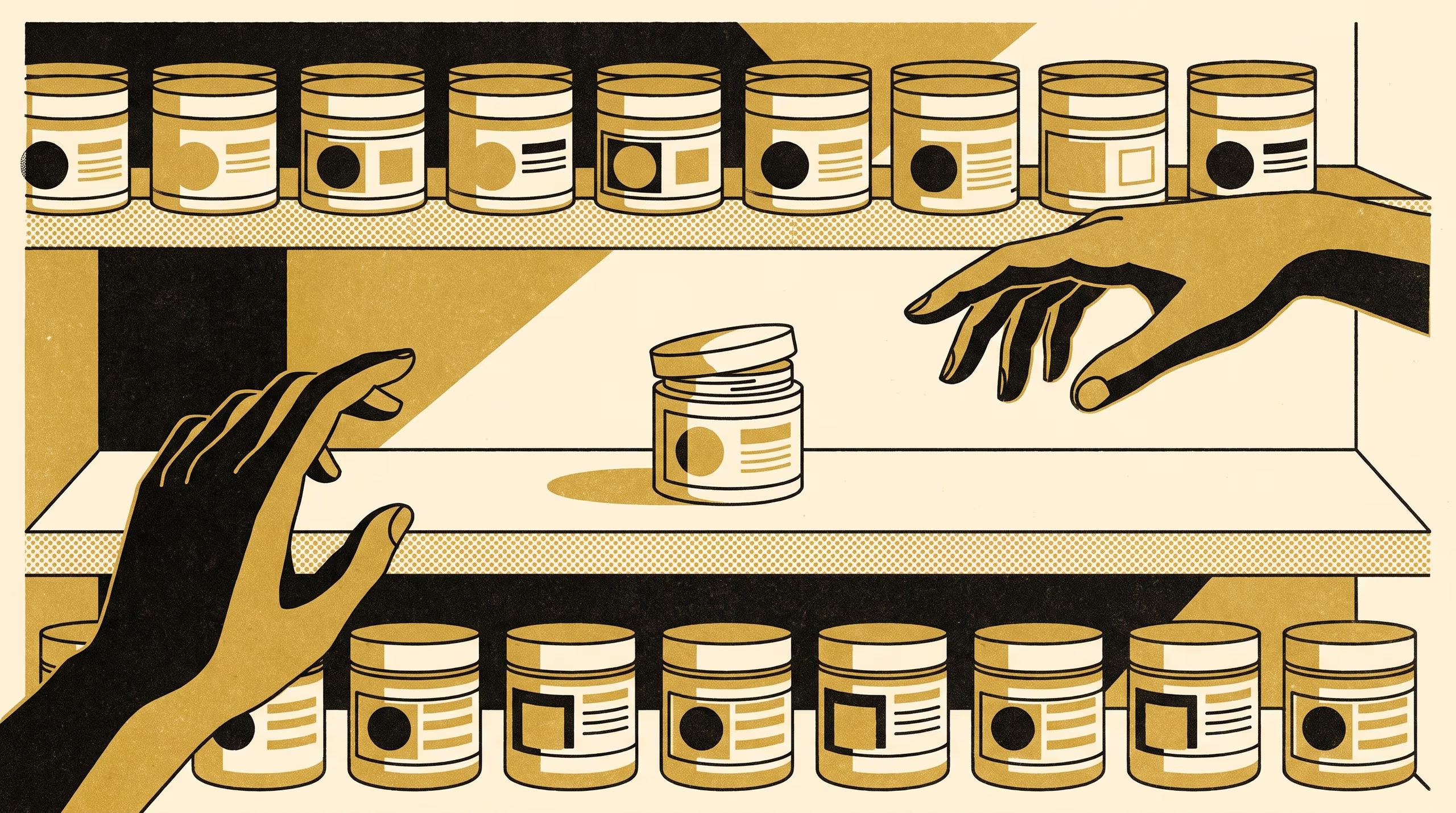
Dr Torun Ezeigwe, Edda Nwafor and Signy Okpara find that a lone sealed jar outsells a full shelf, and that once it looks handled, how close the product goes to the mouth decides whether it sells at all.
A poster sets four skincare lines on one pharmacy fixture to a full shelf, a single sealed unit or a single disturbed one, and follows the till
Shoppers will reach for the last jar on a shelf, and will think again if its carton looks as though someone has already opened it. That is the finding of The Last Jar on the Shelf, a research poster from the School of Continuous Improvement published today, which traces the point at which a single remaining unit stops reading as popular and starts reading as handled.
The work is led by Dr Torun Ezeigwe, Senior Lecturer and Director of the Master of Applied Measurement, with doctoral candidates Edda Nwafor and Signy Okpara.
I spent a long time writing frameworks for what people can be trusted to judge. It has been a real pleasure to spend a semester with a judgement shoppers make in under a second, and to find them making it so carefully.
— Dr Torun Ezeigwe, Senior Lecturer and Director, Master of Applied Measurement, School of Continuous Improvement
Across 1,184 restock episodes on four house-brand lines, a sealed last unit lifted sales every time. A disturbed one held its appeal for foot balm and hand cream, and lost it for face cream and lip balm.
The study brings structured shelf intervention, transaction-level insight and the School’s long engagement with everyday evaluation to bear on the settings in which consumer confidence is formed, and occasionally withdrawn. It sits comfortably within the School’s widening attention to the small, unremarked decisions on which much larger systems quietly depend.
“Every pharmacy counter has its own way of tidying up at the end of a shift,” said Ms Nwafor, Doctoral Candidate. “We hope the people who do that tidying will recognise something of their own care in it.”
The full poster is available from the University’s research repository under an open licence, doi:10.5555/slop.z6idbx.