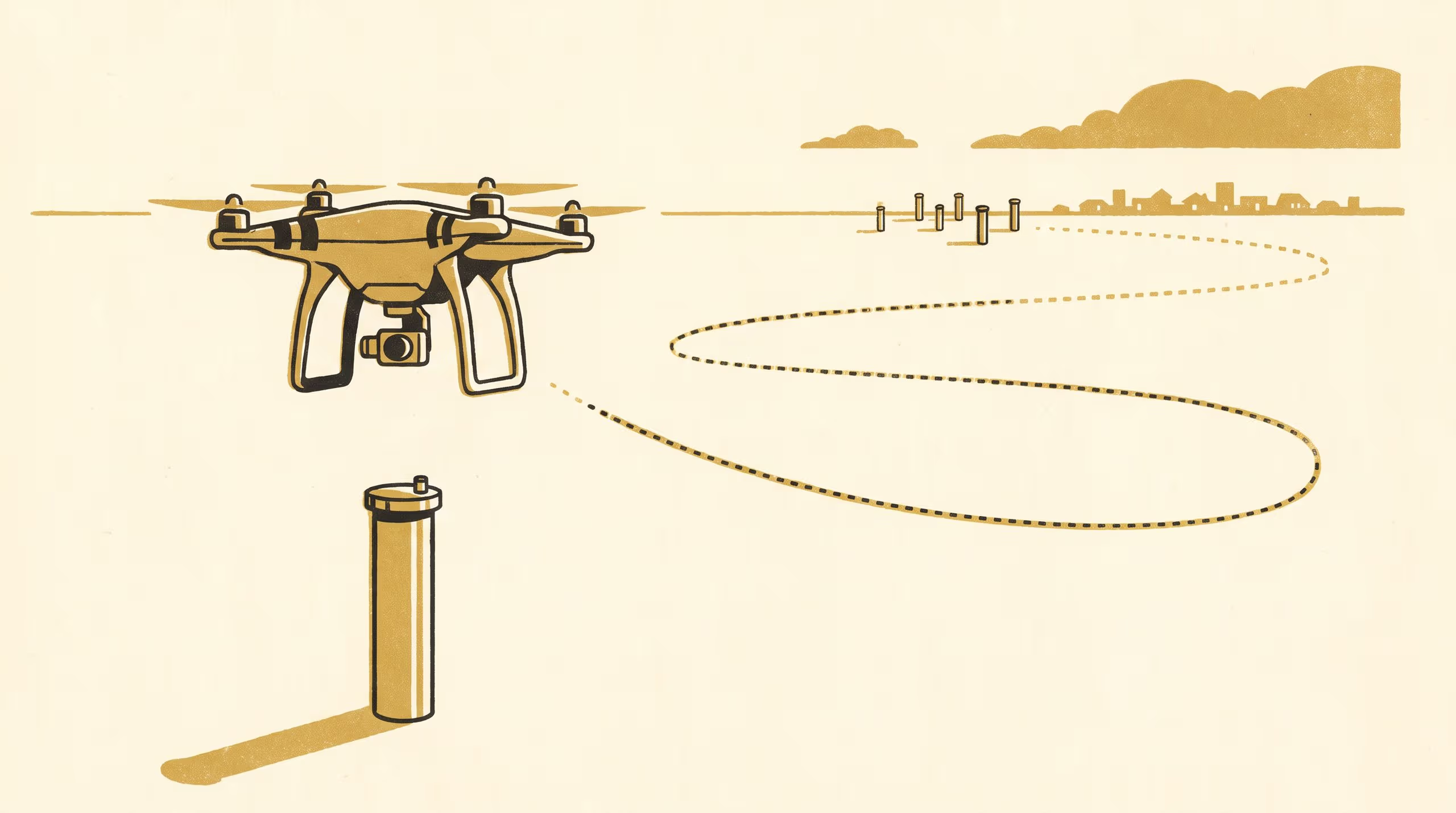
Dr Vigdis Emenike, Dr Bram Ntuli and Dr Osei Vandermeer plan a drone's monthly round of a groundwater monitoring network by how much each bore can tell the rest.
A new paper asks which groundwater bores a drone should visit when it cannot visit them all
Not every bore needs a visit every month, and the one that most needs it may be the one nobody can quite account for. That is the conclusion of Visit the Bore Its Neighbours Cannot Predict, a new paper by Dr Vigdis Emenike, Senior Lecturer in the School of Underlying Conditions, with Dr Bram Ntuli and Dr Osei Vandermeer of the School of Continuous Improvement.
We set out to plan a flight and ended up with a fairly candid account of our own network. It turns out the School has been keeping a bore for decades on instinct, and the instinct was sound.
— Dr Vigdis Emenike, Senior Lecturer, School of Underlying Conditions
The paper brings the School’s groundwater fieldwork together with operations research and the logistics of the aerial round, aligning a monitoring programme’s long memory with a monthly flight budget. Rather than asking how many bores a drone can read, it asks which readings the rest of the network cannot supply on its own, and builds each month’s campaign around those. Across eighteen replayed campaigns on a network of 212 bores, the approach brought the error in the network’s monthly picture down to 3.1 centimetres within a budget of 480 flight-minutes, set against 6.0 for a round that simply reads as many bores as it can.
The collaboration places two Schools’ long-standing interests in the same airspace. Dr Vandermeer described it as “the kind of routing problem where the map keeps asking questions back”, and said the team would be glad to hear from colleagues whose instruments have outlived their paperwork.
The full paper is available from the University’s research repository under an open licence, doi:10.5555/slop.pjev3z.