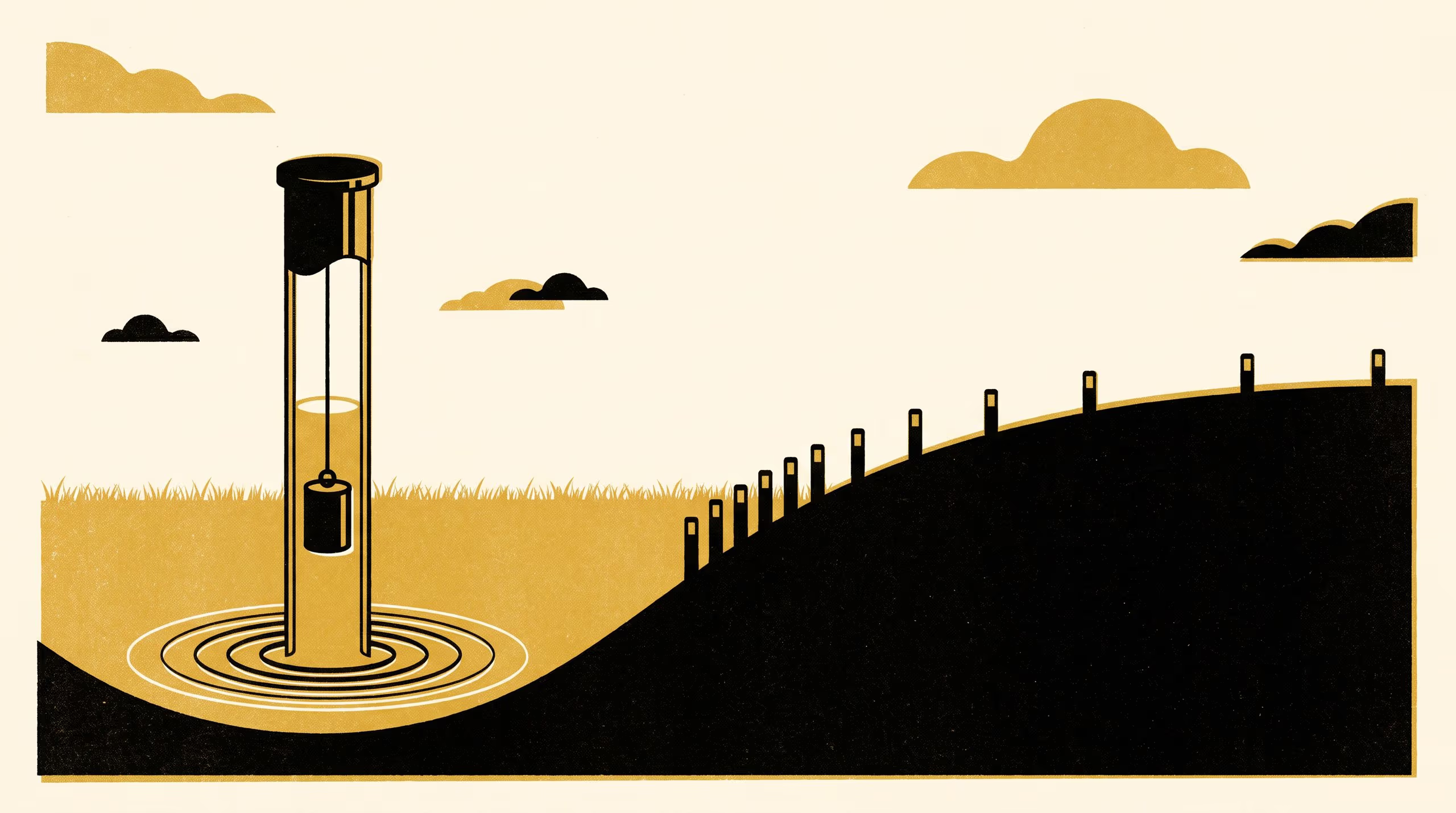
A research poster from the School of Underlying Conditions derives how many logger readings a groundwater slug test needs before further readings add no further resolution, and tests the rule on synthetic and field recoveries.
A mathematics poster finds that a recovery curve stops yielding new detail at about three readings for every tenfold stretch of elapsed time
Mathematics has reached the bottom of a monitoring bore. In Three Readings a Decade, a new research poster from the School of Underlying Conditions, Dr Vigdis Emenike, Senior Lecturer, and Associate Professor Ragnhild Uzoma, Lead of the Basement Relations Group, ask how much of a slug test’s record actually bears on the ground around the bore.
Their answer is a sampling rule. Once a test is logged at about three readings for each tenfold stretch of elapsed time, the poster finds, further readings sharpen the noise estimate but leave the recovered picture of the aquifer where it was.
Every field hydrogeologist has watched a logger fill its memory and felt richer for it. We wanted to say, as kindly as the mathematics allows, how much richer.
— Dr Vigdis Emenike, Senior Lecturer, School of Underlying Conditions
The work recasts the familiar recovery curve through the transform methods of mathematical analysis, aligning a long-standing field practice with a principled account of what the record can and cannot support, and tests that account against both simulated recoveries and the School’s own piezometer nest.
The School regards the poster as a welcome addition to its long conversation about how far down an account of the ground needs to go, now joined by a question about how often to ask it. “There is a great deal of elapsed time ahead of all of us,” said Associate Professor Uzoma. “It is good to have a sense of how closely it is worth watching.”
The full poster is available from the University’s research repository under an open licence, doi:10.5555/slop.xuwi1c.