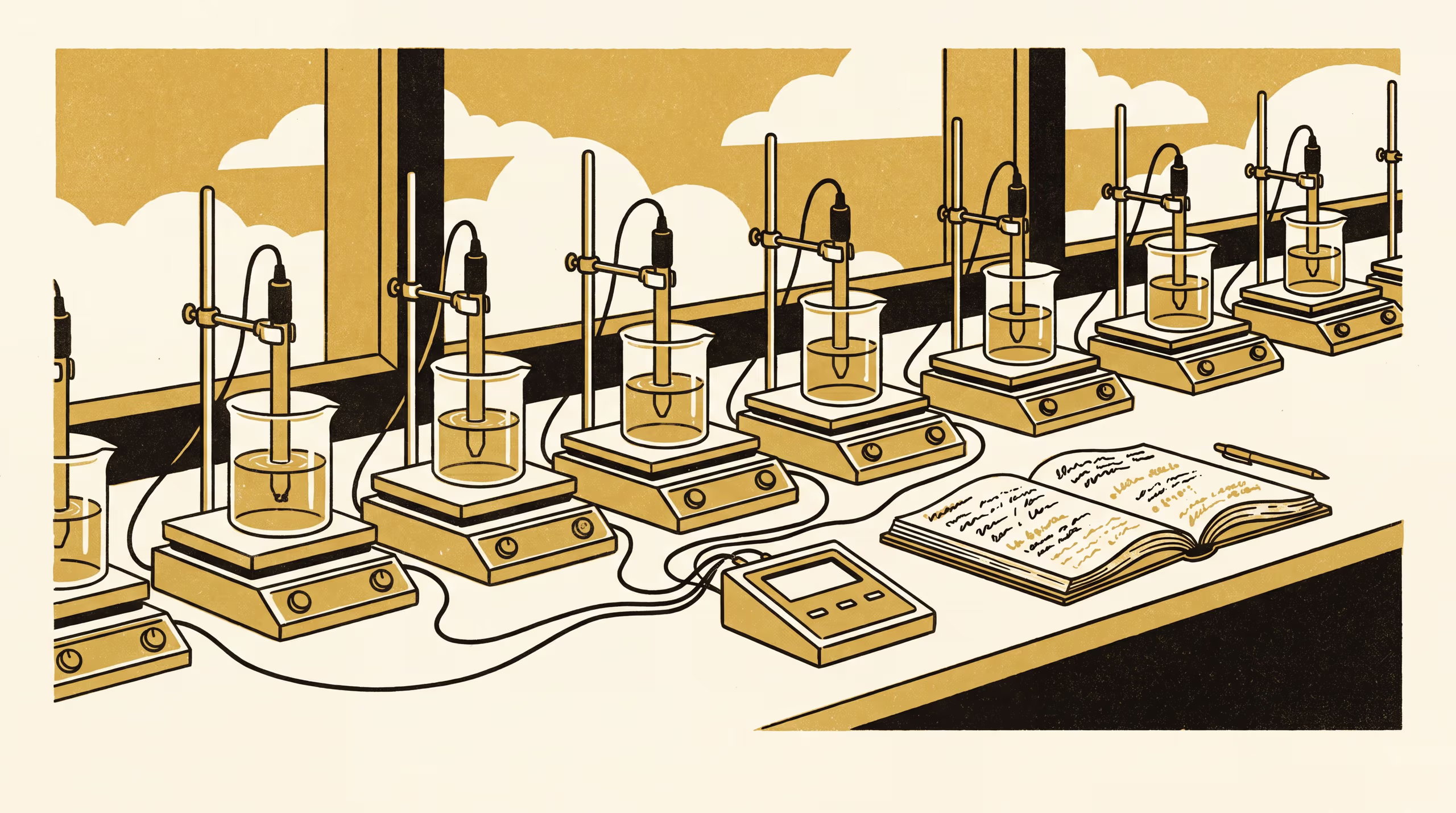
A new research poster from the School of Continuous Improvement reads a water-testing laboratory's bench logbooks through the sociology of theodicy, following how technicians account for electrodes that will not hold their calibration.
The hardware first, then the operator, then a day's patience, then the electrode's temperament
Asked why an electrode will not hold its calibration, laboratory technicians blame the hardware first, themselves second, and the electrode’s temperament only once a day has passed without an answer. A Theodicy of Drift is by Dr Mirela Hanke, Postdoctoral Fellow and Deputy Convenor of the Living Dashboard in the School of Continuous Improvement, with Dr Vigdis Emenike, Senior Lecturer in the School of Underlying Conditions, and Dr Bram Ntuli, Lecturer and Convenor of Improvement Grand Rounds.
The Living Dashboard spends most of its time on instruments that report to us. It was instructive to spend a season with the people who answer for them, and to notice how much patience they extend to an electrode that they would never extend to a spreadsheet.
— Dr Mirela Hanke, Postdoctoral Fellow and Deputy Convenor of the Living Dashboard
Working from the logbooks of a regional water-testing laboratory, alongside time at the bench and conversations with the technicians who keep it, the team sorted 213 episodes of unexplained drift by the kind of account each one received. The resulting picture sets everyday laboratory quality culture alongside a long scholarly tradition of thinking about how communities make sense of disorder in a world they hold to be orderly. Among its observations: when an electrode is finally retired, the logbook tends to revisit its moods and record them, after the fact, as ageing.
The poster adds to the University’s growing body of work on the inner life of the laboratory, a field in which it has lately found itself unusually well represented.
“I spent years writing ‘probe settling’ in a field book without once wondering what I meant by it,” said Dr Emenike. “I am not sure I know now, but I have more company.”
The full poster is available from the University’s research repository under an open licence, doi:10.5555/slop.0rgqcv.