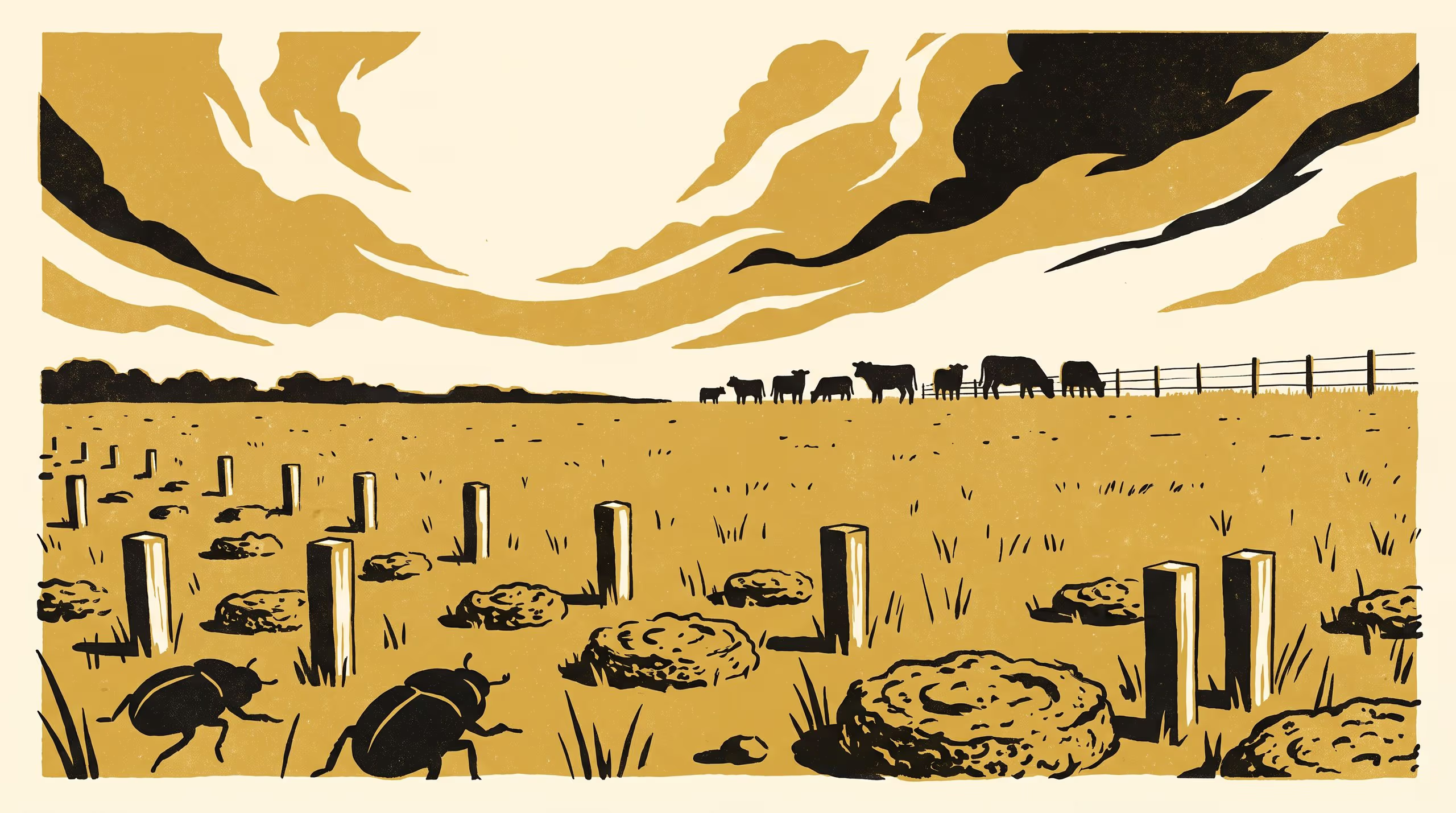
Associate Professor Ragnhild Uzoma and Eskil Nwabueze show that the dung pats left standing on a grazed paddock can place a spring parasite treatment within a week or two, and why an autumn treatment leaves no mark at all.
A year-long field study follows 360 pegged dung pats through a grazing season, and the beetles that came for them
For a full year, a single cattle paddock and several hundred numbered wooden pegs served as one of the University’s more patient research instruments.
Pats That Stayed is by Associate Professor Ragnhild Uzoma, Lead of the Basement Relations Group in the School of Underlying Conditions, and Eskil Nwabueze, Doctoral Candidate in the School of Continuous Improvement. It asks whether the pats still standing at the end of a grazing season remember when the herd was treated for parasites.
None of this happens without a family willing to farm around a field of pegs for twelve months. The paddock was theirs before it was ours, and it still is.
— Associate Professor Ragnhild Uzoma, Lead, Basement Relations Group
The study brings the School’s long engagement with incomplete records into the open air, aligning field ecology, survival analysis and a closely kept herd book within a single, season-long frame. Pats deposited after a spring treatment stood far longer than their neighbours and drew a fraction of the beetles, and a census taken blind found them again months later. A second treatment in autumn, when the beetles had already gone, left nothing to find.
The University counts the work among the clearest signs yet that its two Schools can share a paddock as comfortably as they share a corridor. Eskil Nwabueze, who sorted the beetles, said the project had been “a long lesson in what turns up, and when.”
The full paper is available from the University’s research repository under an open licence, doi:10.5555/slop.6tfc1g.