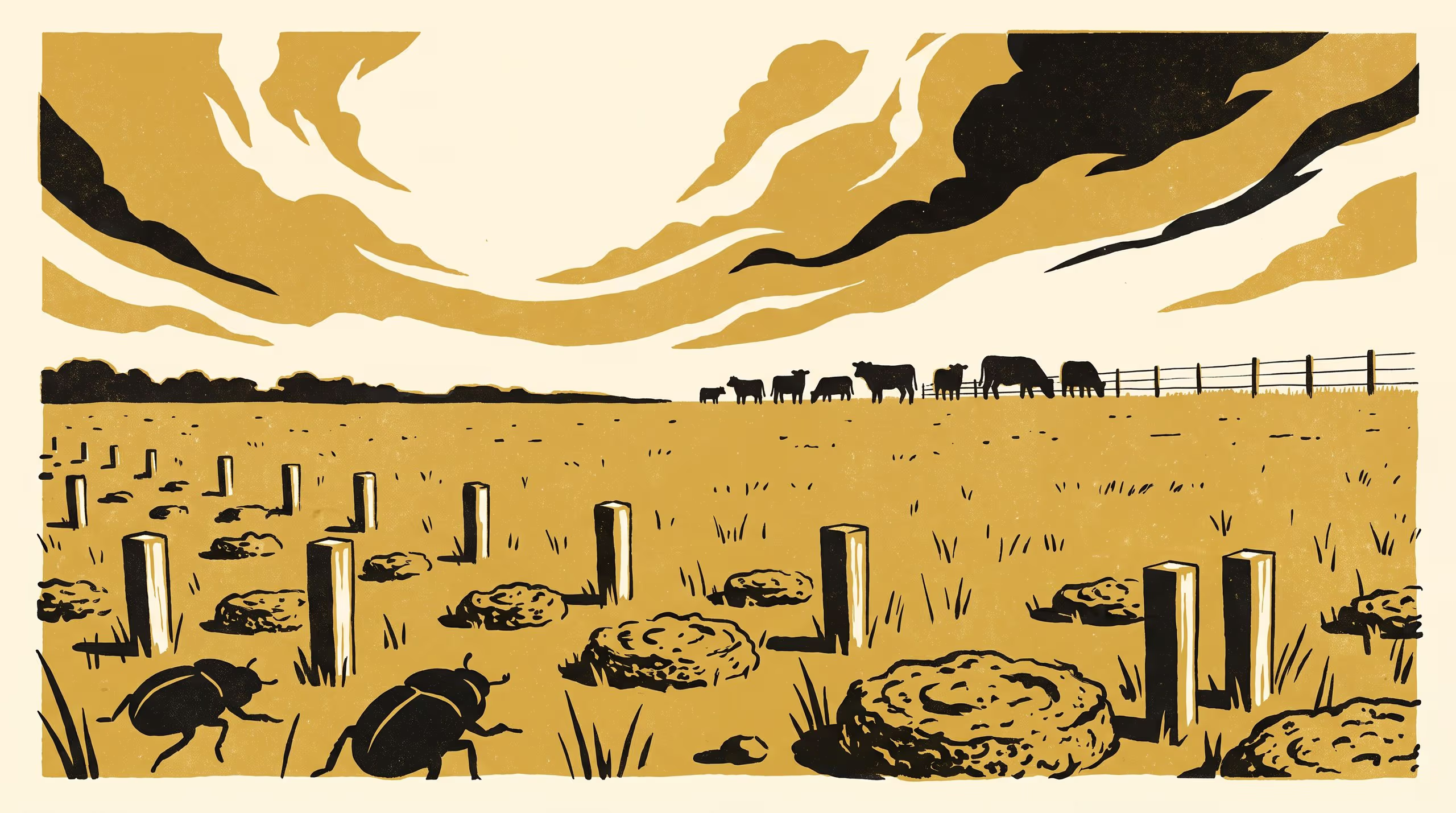
Dung-pat persistence, beetle colonisation and a treatment calendar read back from one grazed paddock
A paper from the School of Underlying Conditions and the School of Continuous Improvement marks 360 fresh dung pats in 30 weekly cohorts on one set-stocked cattle paddock and ages every standing pat on twelve belt transects at the season's end. Pats dropped in the four weeks after a spring pour-on persisted three times as long as summer pats and held a tenth of their beetles, and the end-of-season census found them at 6.8 times the expected number, but the herd's autumn treatment left no trace, because by then beetles were scarce in every pat.
| Authors | Ragnhild Uzoma , Eskil Nwabueze |
|---|---|
| School | School of Underlying Conditions |
| Output type | Research paper |
| Published | |
| DOI | 10.5555/slop.6tfc1g |
| Pages | 6 |
| Cited by | 1 output |
| Version | 1.0 |
| Licence | CC BY 4.0 |
Cites
Cited by
Cite as
@misc{slop_6tfc1g,
  author       = {Ragnhild Uzoma and Eskil Nwabueze},
  title        = {Pats That Stayed: Dung-pat persistence, beetle colonisation and a treatment calendar read back from one grazed paddock},
  year         = {2026},
  publisher    = {Slop University},
  doi          = {10.5555/slop.6tfc1g},
  url          = {https://slop.university/outputs/slop-paper-a-field-census-6tfc1g/},
  version      = {1.0},
  note         = {Research paper},
}