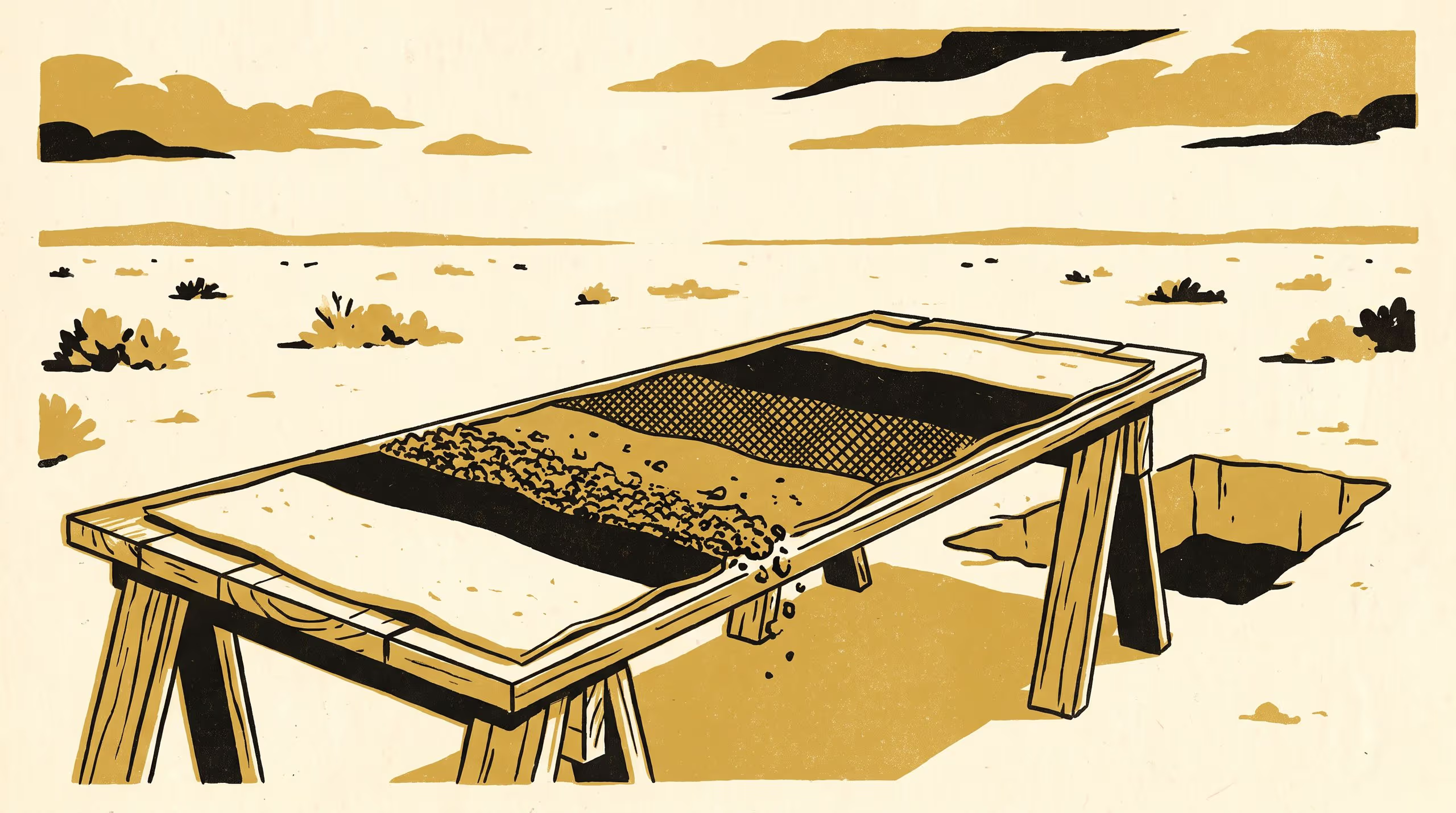
A new research poster from the School of Underlying Conditions charts how deeply a light-cured binder sets in each layer of a soil profile, and finds the iron-stained layer is the one it barely enters.
Four horizons of one sandy pit, one light-cured binder, and a red band that sets only at its surface
A soil peel comes away from a pit face the way a label comes away from a jar: whatever the binder has gripped travels with it, and whatever it has not stays behind. Cured Only at the Skin, a new research poster by Dr Brynjar Obiora, Senior Research Fellow, and Associate Professor Ragnhild Uzoma, Lead of the Basement Relations Group, both of the School of Underlying Conditions, asks how far a binder set by blue light gets into each layer before it stops.
For twelve years I painted these faces by hand and lifted whatever came away. It is a quiet pleasure to learn that what came away was telling us something the whole time, and I expect the next surveyor down a pit will hear it sooner than I did.
— Dr Brynjar Obiora, Senior Research Fellow, School of Underlying Conditions
The team brought four horizons of a single sandy profile into the laboratory and built a working curve for each, aligning photochemical practice with the everyday craft of the field survey. The pale, bleached sand let the light travel almost seven times as deep as the reddened, iron-stained band beneath it, which cured to barely a millimetre and a half and tore when the peel was lifted. A change of initiator, tuned to green light, recovered a good part of that lost depth.
The poster sits within the School’s sustained attention to the ground beneath the record, and the University counts this kind of patient bench inquiry among its quieter strengths.
Associate Professor Uzoma said the Basement Relations Group was “pleased to be working at the surface for a change, and glad of the company”.
The full poster is available from the University’s research repository under an open licence, doi:10.5555/slop.cgaemq.