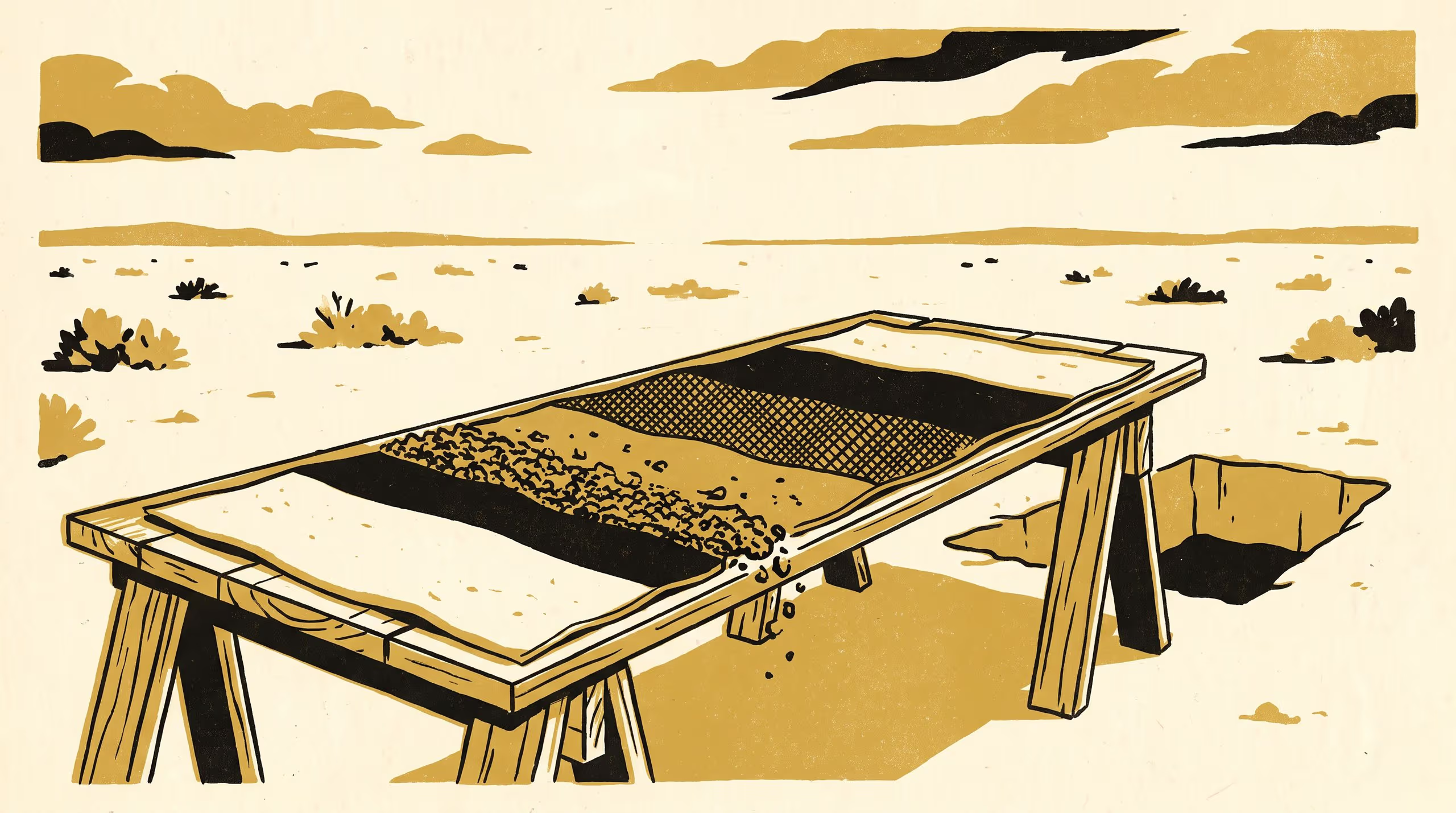
Visible-Light Working Curves for an Acrylate Soil-Peel Binder, Horizon by Horizon down One Sandy Profile
A research poster from the School of Underlying Conditions measures photopolymerisation working curves for a camphorquinone-initiated diacrylate soil-peel binder in four horizons of one sandy profile, finding penetration depth fell from 2.4 mm in the bleached A2 to 0.35 mm in the iron-stained B2, so that at the highest blue-light dose the reddened horizon cured to only 1.5 mm and its peel tore at the red band. A green-absorbing initiator raised the B2 penetration depth to 0.9 mm.
| Authors | Brynjar Obiora , Ragnhild Uzoma |
|---|---|
| School | School of Underlying Conditions |
| Output type | Research poster |
| Published | |
| DOI | 10.5555/slop.cgaemq |
| Pages | 1 |
| Version | 1.0 |
| Licence | CC BY 4.0 |
Cites
Cite as
@misc{slop_cgaemq,
  author       = {Brynjar Obiora and Ragnhild Uzoma},
  title        = {Cured Only at the Skin: Visible-Light Working Curves for an Acrylate Soil-Peel Binder, Horizon by Horizon down One Sandy Profile},
  year         = {2026},
  publisher    = {Slop University},
  doi          = {10.5555/slop.cgaemq},
  url          = {https://slop.university/outputs/slop-poster-how-deep-the-cgaemq/},
  version      = {1.0},
  note         = {Research poster},
}