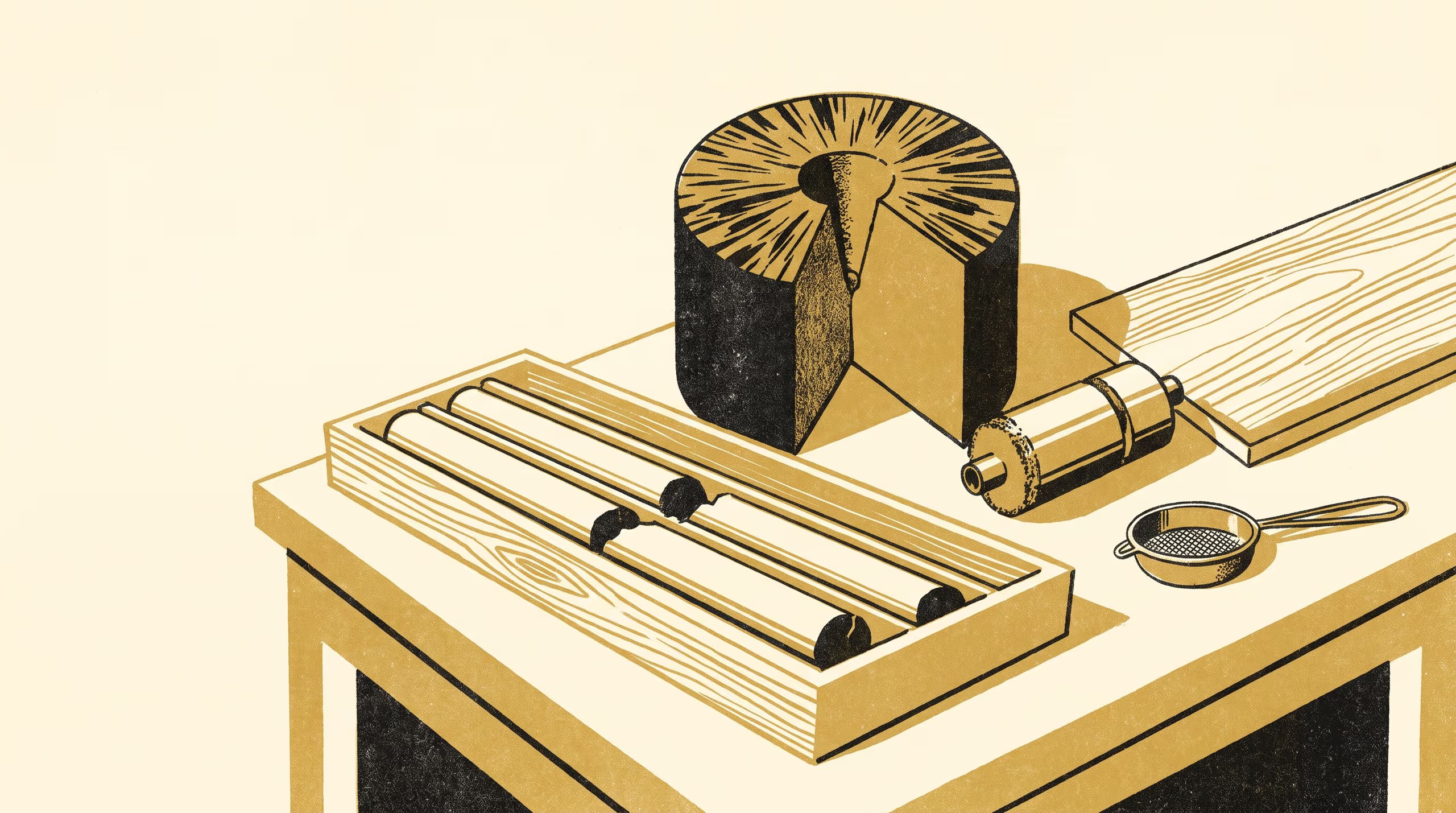
Associate Professor Ragnhild Uzoma and Dr Bram Ntuli drill a laboratory catalyst ingot as they would a borehole, and find its richest material lining the cavity at its centre.
A fused-iron ingot is logged from rim to shrinkage pipe and each of its zones tested once reduced
The richest part of a freshly cast ammonia catalyst lines a hole at its centre, and once reduced it is also the part that does the least work. Radial Zoning in a Cast Fused-Iron Ammonia-Synthesis Catalyst Ingot is by Associate Professor Ragnhild Uzoma, Lead of the Basement Relations Group in the School of Underlying Conditions, and Dr Bram Ntuli, Lecturer and Convenor of Improvement Grand Rounds in the School of Continuous Improvement.
A core tray does not much mind what went into the mould. The School has always suspected its methods would travel, and it is satisfying to watch them make themselves at home somewhere warmer.
— Associate Professor Ragnhild Uzoma, Lead, Basement Relations Group
The team cast a single ingot of promoted magnetite, drilled it through, and logged each core run by run before mapping its composition and testing four of its zones in a reactor. The approach places the earth sciences’ long habit of reading solidified bodies alongside the everyday business of catalyst preparation, and offers a fresh vantage on how a melt’s own cooling shapes what is later crushed. The four zones differed by a factor of 1.8 in activity per gram, yet by only nine per cent once their surface area was taken into account.
The paper extends the Basement Relations Group’s earlier coring of a retired converter bed back to the start of a catalyst’s working life, and the University counts it among the more quietly ambitious contributions to its work on the nitrogen pathway.
“Every casting leaves a few questions in the mould,” said Dr Ntuli. “We would be glad to hear from colleagues who would like to help us ask them.”
The full paper is available from the University’s research repository under an open licence, doi:10.5555/slop.09zr2m.