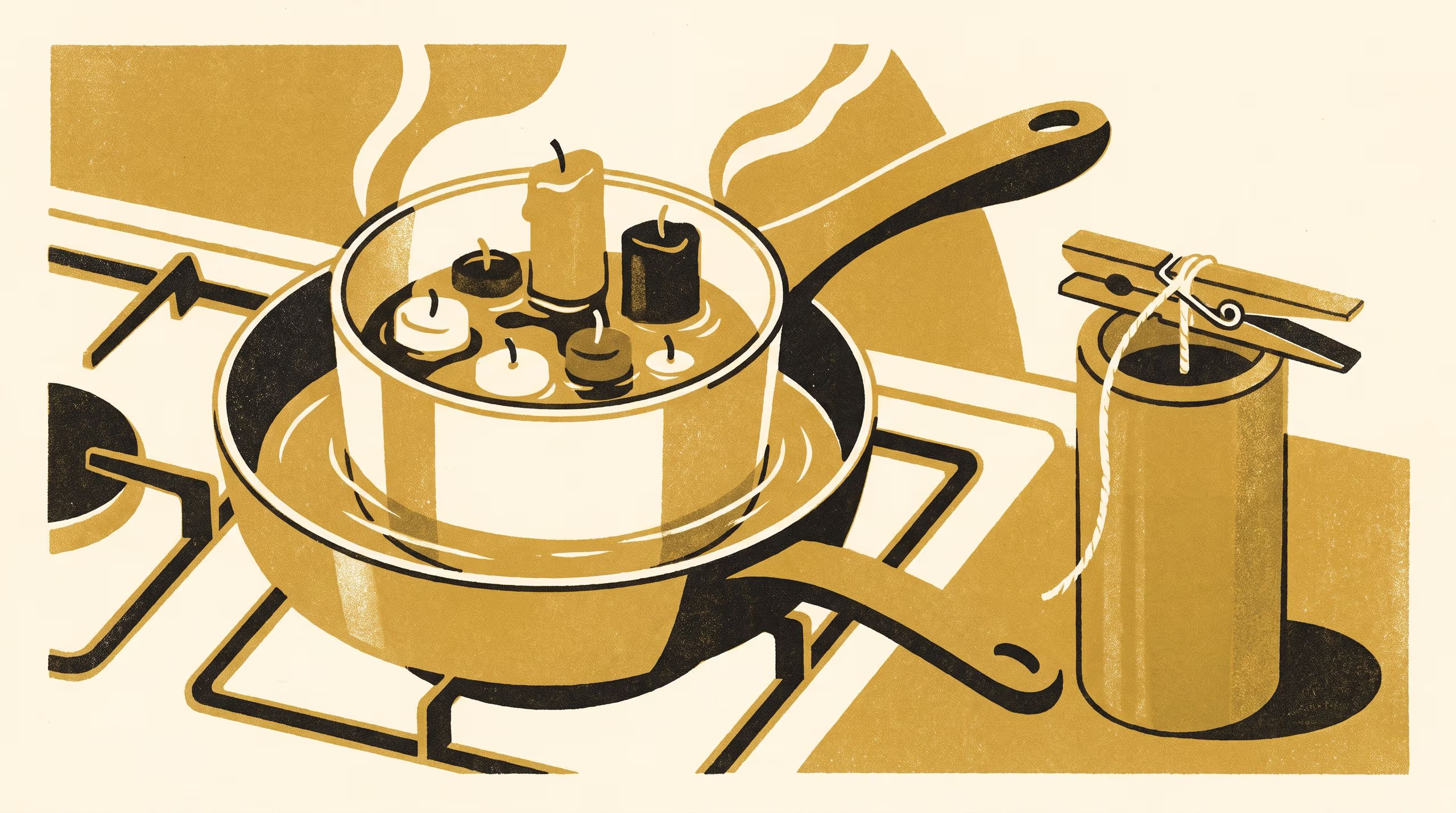
A new research poster measures the phase behaviour of paraffin candle stubs collected from vacated rented houses, alone and after they are melted down together into one candle.
A calorimetry study finds a pooled candle keeps its stubs' stored heat but melts on its own terms
Calorimetry, the end-of-tenancy inspection and the household habit of saving candle ends meet in Second Wick, a new research poster from the School of Emergent Priorities. It is led by Ms Ylva Ogunbanjo, Doctoral Candidate, with Dr Brynjar Obiora, Senior Research Fellow, and Dr Vigdis Emenike, Senior Lecturer, both of the School of Underlying Conditions.
Every one of these stubs was somebody’s evening in a house they no longer live in. I am grateful to the households who left them, and to colleagues in two schools who were prepared to take a saucepan seriously.
— Ms Ylva Ogunbanjo, Doctoral Candidate, School of Emergent Priorities
The poster brings thermal analysis to bear on the materials a rental property gives back at the close of a lease. Stubs gathered at vacate inspections were characterised one by one, then combined into new candles, enabling the team to compare the individual and the collective across the full sweep of a wax’s phase behaviour. The headline finding is that pooling preserves the energy the stubs hold while reshaping how, and over what range, the new candle melts.
The poster is a further sign of the University’s readiness to follow its doctoral candidates wherever their earlier careers lead, and of the quiet traffic between its schools that makes such following possible.
“There is more in a drawer of leftovers than a laboratory tends to assume,” said Dr Obiora, “and we are happy to keep being asked what else is in there.”
The full poster is available from the University’s research repository under an open licence, doi:10.5555/slop.roe2fx.