Dr Vigdis Emenike and colleagues find that a quiz player's skill at reading emotion, not their own sense of it, predicts whether the answer only they know reaches the team sheet.
A School of Underlying Conditions poster follows 38 pub-quiz teams through a season of private answer slips
A team that already holds the right answer still has something to learn about itself. Our players let us watch that learning happen, one slip at a time.
— Dr Vigdis Emenike, Senior Lecturer, School of Underlying Conditions
That learning is the subject of Known at the Table, Lost on the Sheet, a new research poster from the School of Underlying Conditions by Dr Vigdis Emenike, with Dr Ingrid Vasseur, Lecturer and Convenor of Futures in Committee in the School of Emergent Priorities, and doctoral candidate Eskil Nwabueze.
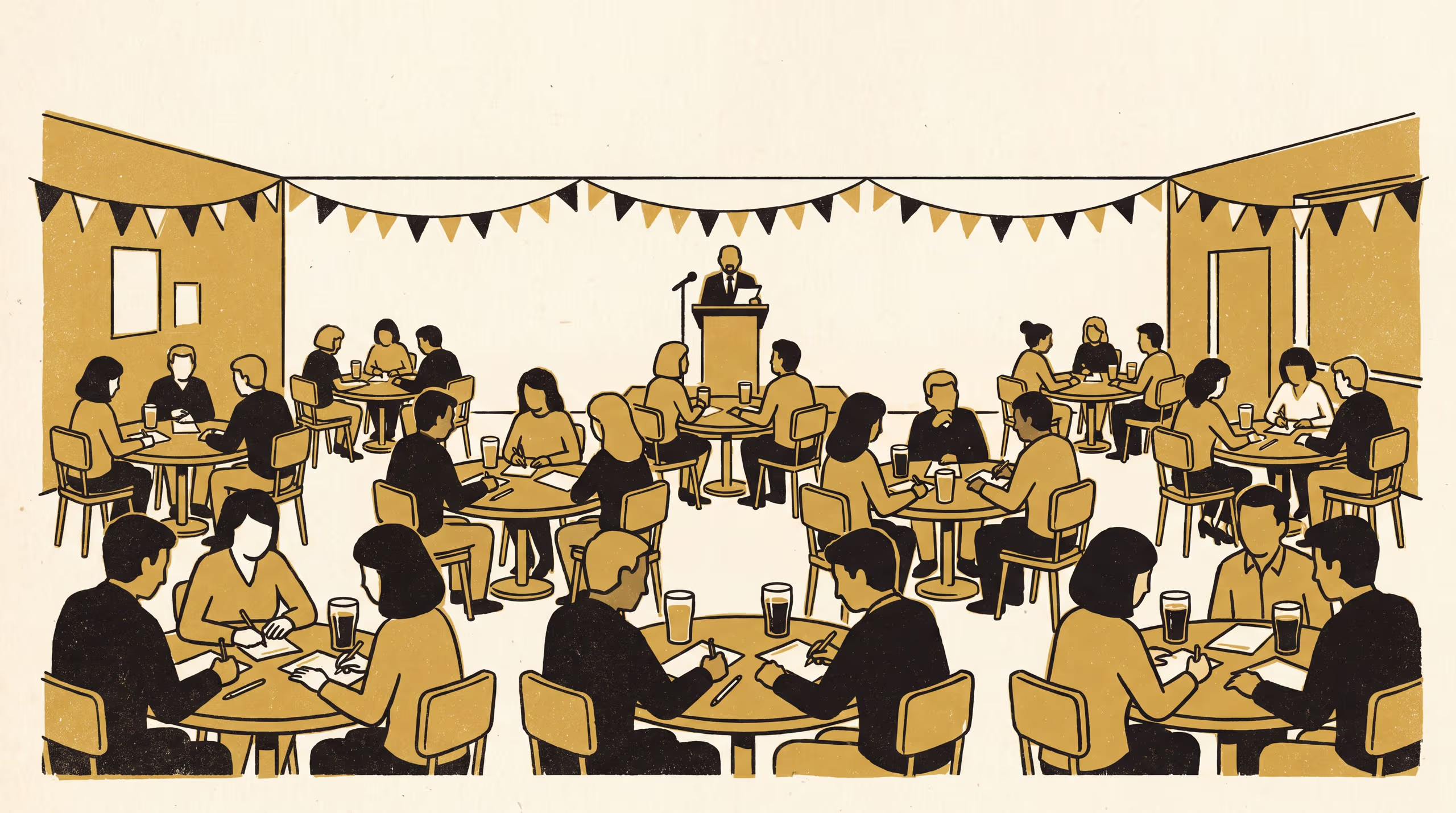
Across a full season of a suburban quiz league, the team brought a private-slip protocol to every table, pairing each player’s own answer with what the team went on to submit, and setting both against a pre-season measure of how well each player reads emotion in faces and voices. The result is a season-scale evidence base for how knowledge travels, or fails to travel, from the person to the group.
Teams submitted 81 per cent of what their members privately knew. Where a single player held the correct answer alone, those who read emotion more accurately saw it written down more often, most of all when the team’s scribe had a rival answer in mind. How emotionally intelligent players rated themselves made no measurable difference.
The poster carries the School’s long interest in what a single reading is asked to stand for into the warmer setting of a weeknight function room, and the University welcomes it as a sociable addition to its thinking on collective judgement. “Every committee I convene has a scribe, and I suspect I will now watch that chair with fresh eyes,” said Dr Vasseur.
The full poster is available from the University’s research repository under an open licence, doi:10.5555/slop.qfhygh.