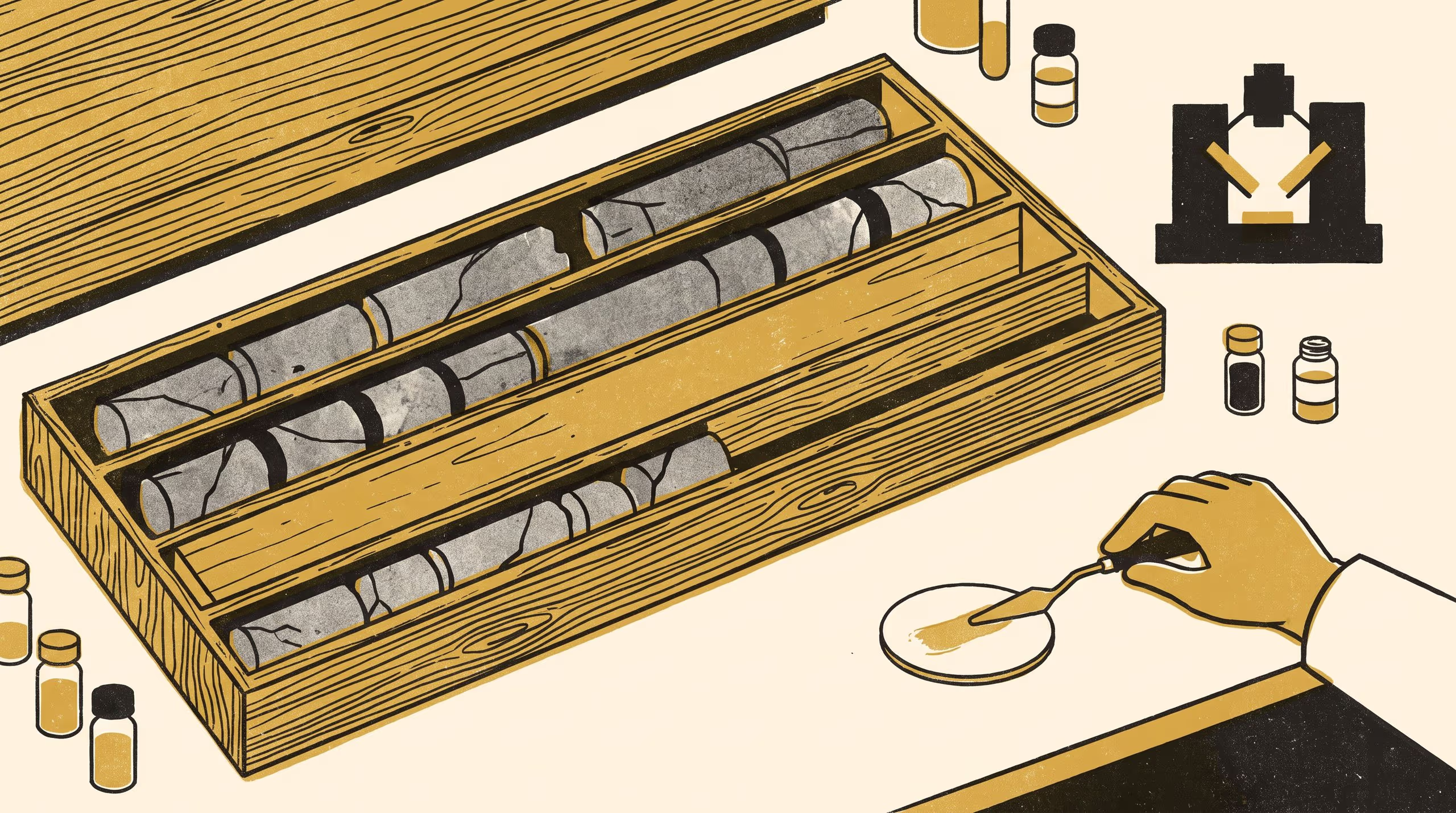
Associate Professor Ragnhild Uzoma and Dr Brynjar Obiora find that nine of the wooden blocks in one archived drill run still carry the clay of the intervals they stand in for.
A School of Underlying Conditions paper tells drilling mud from lost mudstone in the clay left on the end faces of a drill run's wooden spacers
Nine of the twenty-three wooden blocks in one of the University’s archived drill runs have turned out to hold more than a measurement. According to What the Block Kept, a new paper from the School of Underlying Conditions, the thin film of clay on their end faces is the last trace of the rock the drill failed to bring up.
We owe this paper to whoever sealed a jar of the drilling mud and packed it in with the core boxes. Every archive depends on a few people who keep slightly more than they were asked to.
— Associate Professor Ragnhild Uzoma, Lead of the Basement Relations Group
The paper is by Associate Professor Uzoma and Dr Brynjar Obiora, Senior Research Fellow in the School. It repositions the core-loss block, long understood as a placeholder, as a site of material evidence, applying laboratory diffraction and exchange chemistry to the residue on each block and distinguishing what the ground contributed from what the drilling contributed. Where the two could be told apart, the authors report, the block held a swelling clay that neither the mud nor the neighbouring core could account for.
“The School’s trays hold a great many more blocks than this one run,” said Dr Obiora. “We would like to hear what each of them has been keeping.”
Support came from the Anticipatory Capability Fund, and for the University the paper confirms the value of an archive that keeps its spacers as carefully as its stone.
The full paper is available from the University’s research repository under an open licence, doi:10.5555/slop.csytjs.