Separating Drilling-Mud Bentonite from In-Situ Smectite in Clay Residue on Core-Loss Blocks
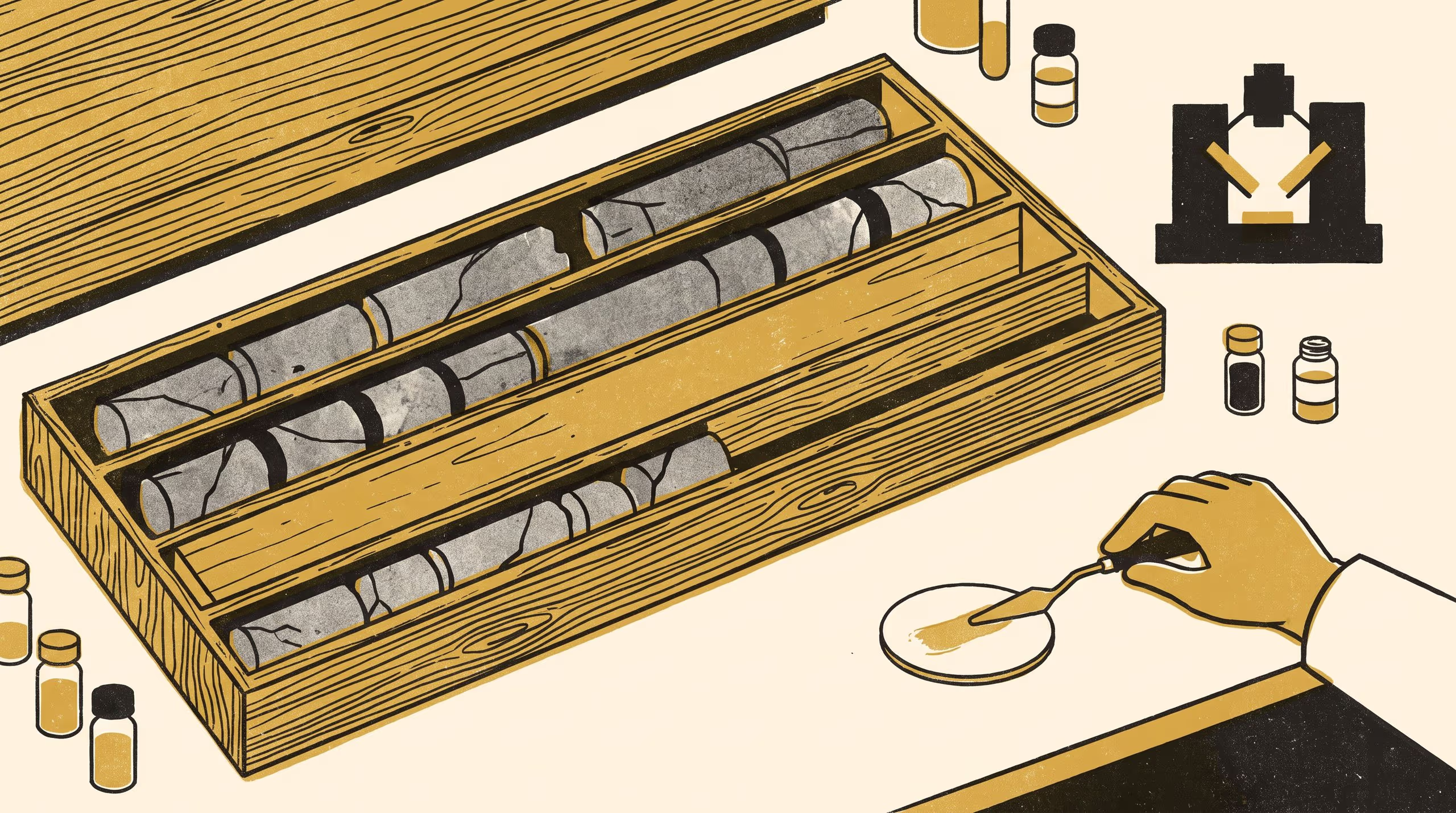
A paper from the School of Underlying Conditions scrapes the clay residue from the end faces of the 23 core-loss blocks in one archived drill run and compares it, by humidity-controlled X-ray diffraction and exchangeable cations, with a sealed sample of the bentonite mud the run was drilled with. Every assessable residue is smectite-bearing, but only the interlayer cation separates rock from mud: eight Na-type residues match the mud and say nothing about the lost intervals, while nine Ca-type residues carry plagioclase and several times the smectite of the core either side, and are read as the only surviving material of the intervals the barrel failed to recover.
| Authors | Ragnhild Uzoma , Brynjar Obiora |
|---|---|
| School | School of Underlying Conditions |
| Output type | Research paper |
| Funding | Anticipatory Capability Fund: Cutting and Shelving a Borehole's Core-Loss Blocks Ahead of the Drill ( $362,417) |
| Published | |
| DOI | 10.5555/slop.csytjs |
| Pages | 6 |
| Cited by | 3 outputs |
| Version | 1.0 |
| Licence | CC BY 4.0 |
Cites
Cited by
Cite as
@misc{slop_csytjs,
  author       = {Ragnhild Uzoma and Brynjar Obiora},
  title        = {What the Block Kept: Separating Drilling-Mud Bentonite from In-Situ Smectite in Clay Residue on Core-Loss Blocks},
  year         = {2026},
  publisher    = {Slop University},
  doi          = {10.5555/slop.csytjs},
  url          = {https://slop.university/outputs/slop-paper-residual-clay-on-csytjs/},
  version      = {1.0},
  note         = {Research paper},
}