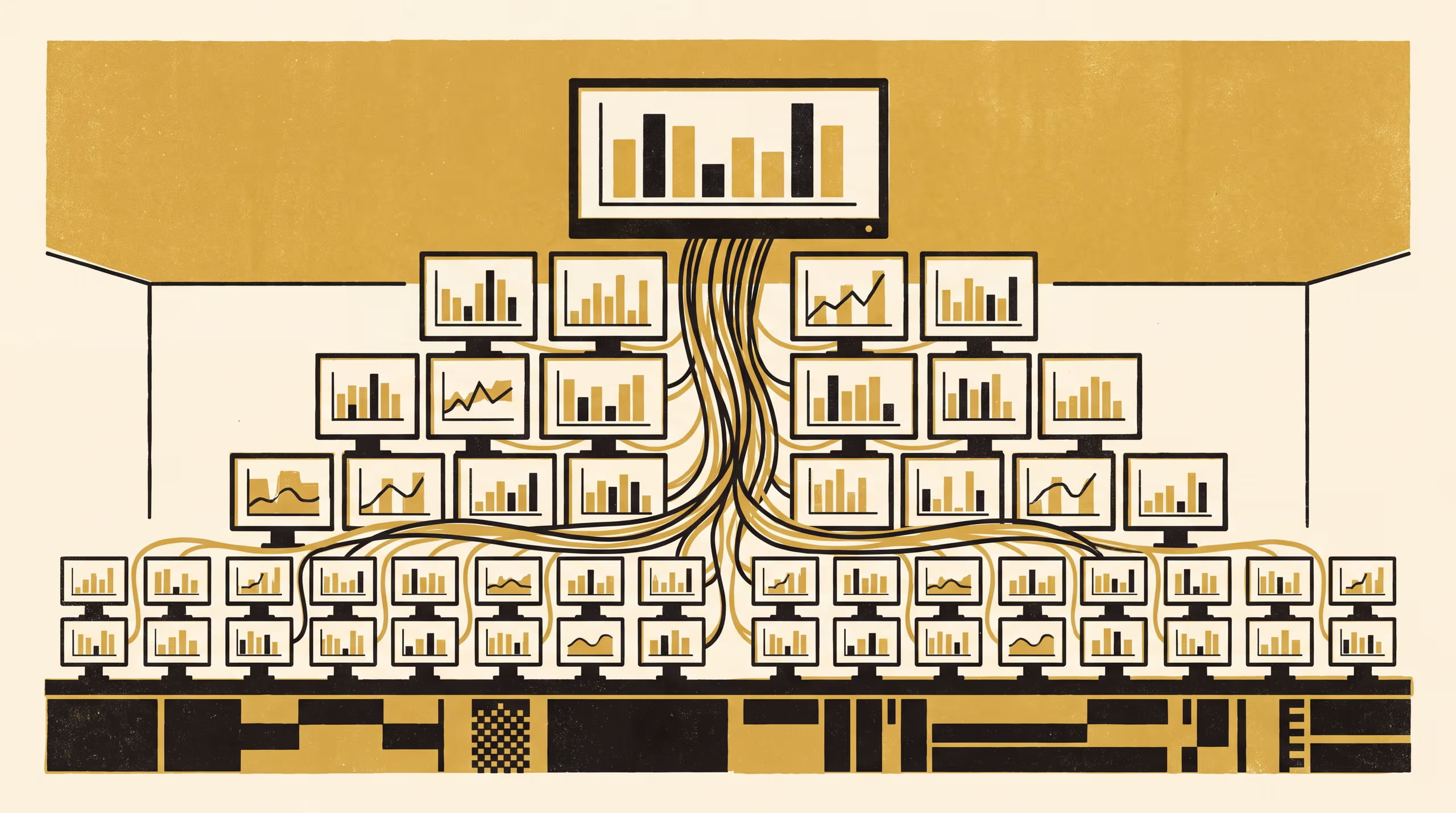
A new research poster from the School of Emergent Priorities borrows a framework from theoretical physics to ask which business-intelligence indicators survive the climb from team dashboard to executive summary.
A research poster follows indicators up the reporting lines of 23 organisations and finds the top-level summary set by the roll-up rule
Every organisation sends its numbers upstairs. It has been a privilege to follow them up the stairwell, and to find that physics had already drawn the floor plan.
— Ms Hedvig Anyanwu, Doctoral Candidate, School of Emergent Priorities
In Amber at the Fixed Point, Ms Anyanwu joins Dr Mirela Hanke, Postdoctoral Fellow and Deputy Convenor of the Living Dashboard in the School of Continuous Improvement, and Dr Ronja Oyelaran, Senior Lecturer and Deputy Convenor of the Strategic Drift Survey, to bring the renormalisation group, the toolkit theoretical physicists use to explain why very different materials behave alike at large scales, to the dashboards organisations use to report upward.
Across the reporting hierarchies of 23 organisations, the team finds that what appears at the top of a dashboard depends less on the activity at its base than on the arithmetic used to carry each figure up a tier. Totals gather strength as they rise, averages settle into calm, and a red-amber-green status rolled up by its worst case comes to rest, tier after tier, on amber.
Methodologically, the poster carries a framework long associated with magnets and critical points into the reporting line itself, treating each layer of review as a step of aggregation and asking which signals an organisation’s decision architecture amplifies and which it allows to fade.
“We will be thinking about what amber means for a good while yet,” said Dr Hanke.
The University regards the poster as a fine instance of theory travelling well: a body of ideas built for the physical world, put to work on the everyday business of running an organisation, and as a welcome meeting of the School of Emergent Priorities and the Living Dashboard.
The full poster is available from the University’s research repository under an open licence, doi:10.5555/slop.fze8e1.