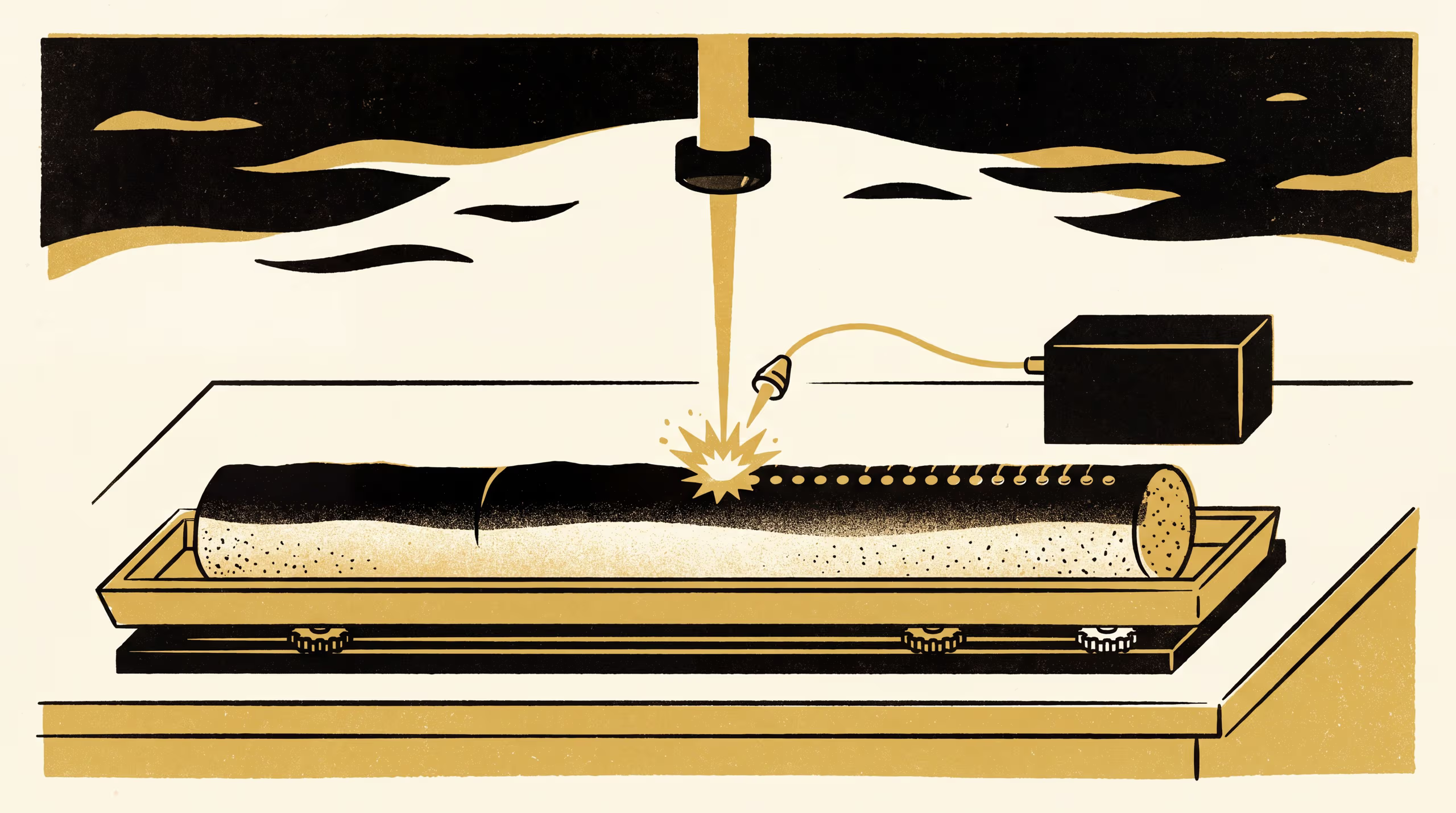
A new research poster scans one soil core with a laser a millimetre at a time and finds that eight elemental readings of the boundary between two soils agree only once the spark itself is measured at every shot.
A research poster from the School of Underlying Conditions on how a laser-made plasma redraws the edge between two soils in a single core
Eight readings of one boundary, and eight answers. That was the starting point for The Spark Moves First, a new research poster from the School of Underlying Conditions, which turns the University’s soil survey toward the instrument now being asked to read its cores.
The poster is by Dr Brynjar Obiora, Senior Research Fellow, with Associate Professor Ragnhild Uzoma, Lead of the Basement Relations Group, and Associate Professor Casimir Beng, Lead of the Adaptive Metrics Lab. The team brings field description, core logging and instrument practice into a single workflow, positioning the School’s survey capability at the interface between what the ground holds and what the laboratory reports. Once the instrument’s own behaviour is accounted for at every step, the eight readings settle on one depth.
Every soil I have mapped has had a line drawn through it by somebody. This is the first time the somebody has been a spark, and it turns out the spark has opinions of its own.
— Dr Brynjar Obiora, Senior Research Fellow, School of Underlying Conditions
The work sits within the School’s continuing programme on boundaries and the records made of them, and anticipates further scans of the same core under changed conditions. Associate Professor Beng said the study had given the Lab “a useful occasion to ask an instrument what it was doing before asking it what it found”.
The project adds a new strand to the School’s growing portfolio, and the University counts it among the clearer signs of how far its earth sciences have come in a short time.
The full poster is available from the University’s research repository under an open licence, doi:10.5555/slop.piykro.