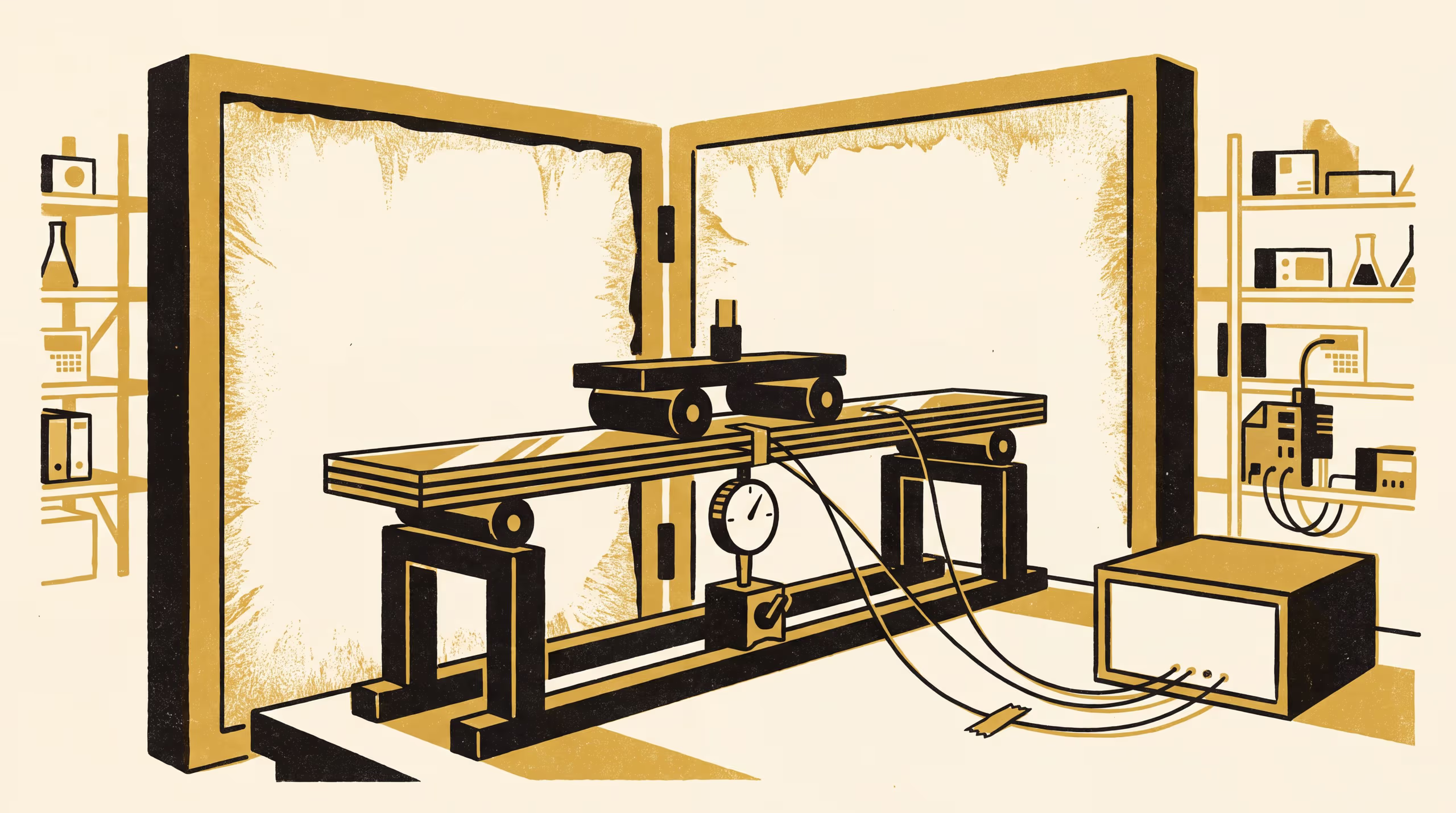
A research poster from the School of Underlying Conditions follows six laminated glass beams from 0 to 60 °C and finds no single temperature at which they stop behaving as one.
Six beams in a climate chamber place the layered and monolithic idealisations a band apart, not a line
The School of Underlying Conditions has spent most of its working life on what lies beneath the ground. Its newest research poster turns the same attention to what lies between two sheets of glass.
Where the Laminate Lets Go is by Dr Brynjar Obiora, Senior Research Fellow in the School of Underlying Conditions, with Associate Professor Ragnhild Uzoma, Lead of the Basement Relations Group, and Associate Professor Casimir Beng, Lead of the Adaptive Metrics Lab in the School of Continuous Improvement.
Every ground I have surveyed has eventually asked me where one thing stops and the next begins. I was glad to learn that glass asks it too, and asks it more politely.
— Dr Brynjar Obiora, Senior Research Fellow, School of Underlying Conditions
Working across a full sweep of laboratory temperatures, the team positions the bonded glass beam as a site of graded transition, bringing the School’s boundary-mapping expertise into dialogue with the established frameworks of structural assessment. The poster proposes that the passage between two familiar idealisations is best reported as a band, with its criteria stated alongside it.
For the University, the poster is further evidence that the instincts of the soil pit travel well beyond it. Associate Professor Beng said the climate chamber had “held every temperature we asked of it, which is more than most instruments will promise”.
The full poster is available from the University’s research repository under an open licence, doi:10.5555/slop.1jjvao.