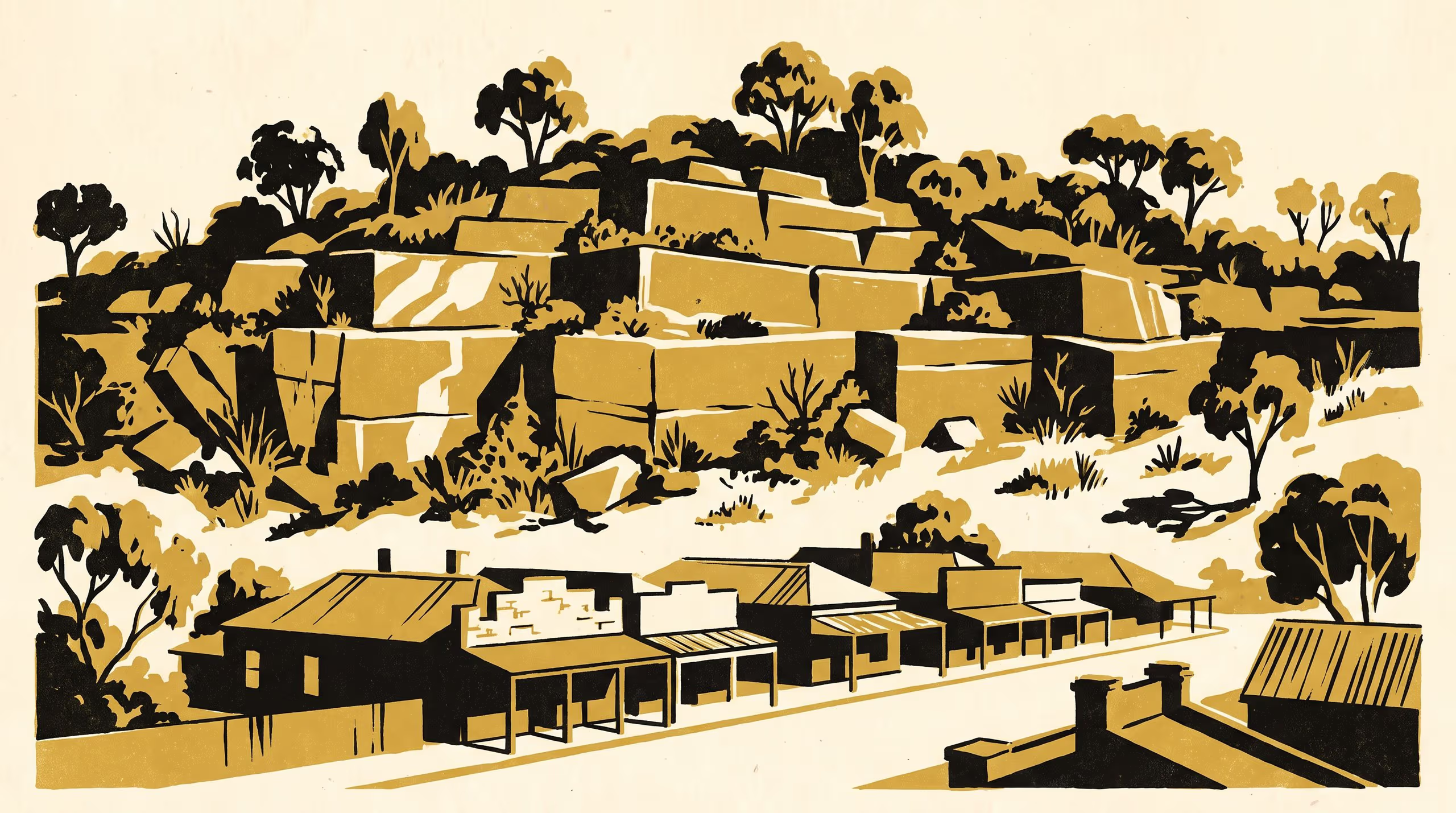
A new research poster finds that residents of a former sandstone-quarry town claim a main-street frontage as their own by its weathering rather than its source, so stone re-cut from the town's own quarry reads as brought in.
A research poster from the School of Underlying Conditions on how residents of a former quarry town tell their stone from stone brought in
The School of Underlying Conditions usually works beneath the surface. Its newest research poster, The Stone That Looks Like Ours, stays on it, and finds that a surface is where a town keeps much of what it knows about itself.
The poster is by Associate Professor Ragnhild Uzoma, Lead of the Basement Relations Group, with Dr Brynjar Obiora, Senior Research Fellow, and Ylva Onyekwere, Doctoral Candidate in the School of Emergent Priorities. Over a series of afternoons with 48 residents of a small town built from the hill behind it, the team set photographs of 22 main-street frontages alongside each stone’s documented origin. Residents claimed weathered stone as their own wherever it had been quarried, while frontages refaced from the town’s own sandstone in the last decade were mostly sorted as brought in.
We spend most of our working lives trying to get past the weathered rind to the fresh rock underneath. It has been a pleasure, and a little humbling, to learn how much of a town lives in the rind.
— Associate Professor Ragnhild Uzoma, Lead of the Basement Relations Group
The study brings field geology into conversation with the social sciences of place and belonging, enabling a richer account of how communities and their materials settle into one another over time. It sits comfortably within the University’s growing attention to the built surroundings its researchers pass every day.
“Everyone we walked with had something to show us,” said Ms Onyekwere. “I suspect there are a great many more streets with the same conversation waiting in them.”
The full poster is available from the University’s research repository under an open licence, doi:10.5555/slop.wo80bz.