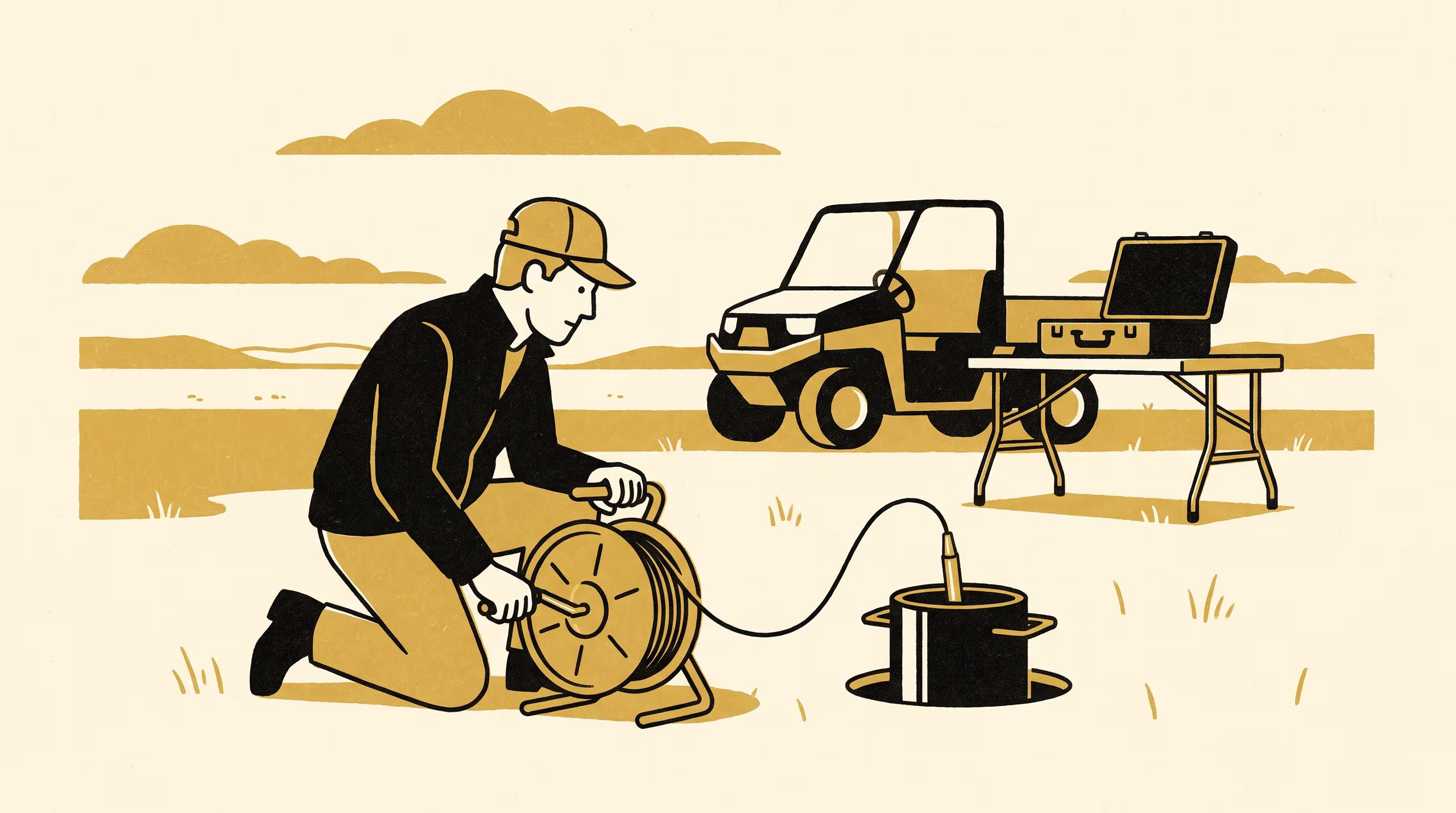
Slop University's Strategic Plan 2026-2031 takes downhole sensing as its subject, with a reference bore, a shared instrument pool and a new discipline for when a reading counts as final.
A five-year agenda builds a reference bore on campus and holds every downhole reading provisional until its instrument comes back up and is checked.
From the start of the new plan period, a reading taken at the bottom of a Slop University borehole will not be counted as final until the instrument that took it has been brought back to the surface and checked again.
That principle sits at the centre of Down the Hole and Back Again, the University’s Strategic Plan 2026–2031, prepared by Dr Vigdis Emenike, Senior Lecturer in the School of Underlying Conditions, with Associate Professor Ragnhild Uzoma, Lead of the Basement Relations Group, and Dr Torun Ezeigwe, Senior Lecturer and Director of the Master of Applied Measurement.
I am looking forward to the first morning we lower something into a hole of our own and already know what it should say when it comes back. There is a great deal of patience ahead of us, and the School is ready for it.
— Dr Vigdis Emenike, Senior Lecturer, School of Underlying Conditions
Across five focus areas, the Plan aligns research infrastructure, instrument stewardship and field education behind a single trajectory: from capable individual projects to a coherent, accountable capability in the deep subsurface. It anchors that work in a characterised reference bore on the University’s own estate, and extends it through a shared instrument pool, a candid record of gaps and silences, and an accreditation renewed rather than merely awarded.
The University sees in the Plan an honest measure of the care it means to bring to the parts of its work that happen out of sight. Dr Ezeigwe welcomed “the questions a plan like this will put to all of us, our Master’s students first among them”.
The full plan is available from the University’s research repository under an open licence, doi:10.5555/slop.yslmbd.