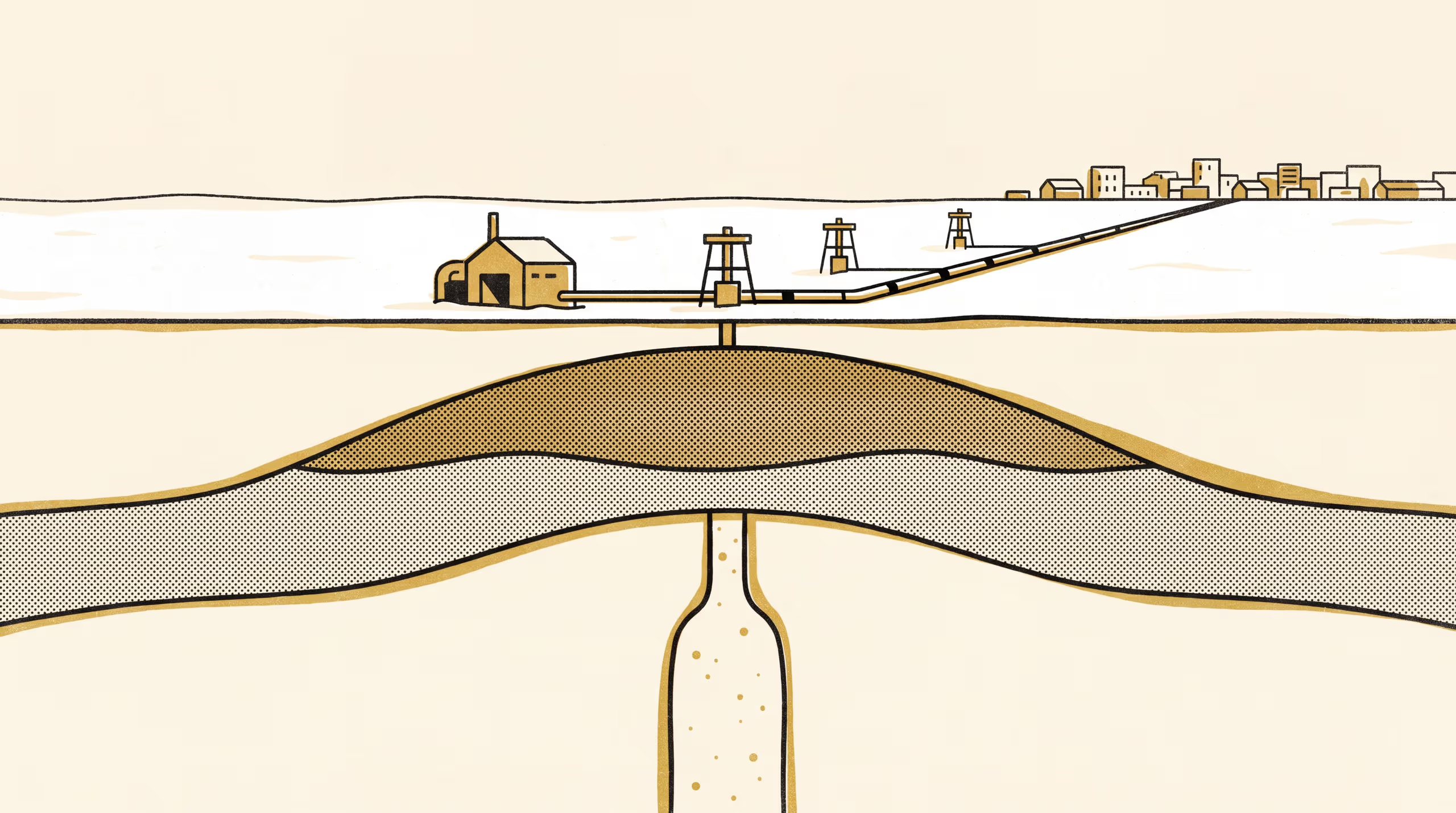
A new research poster from the School of Underlying Conditions finds that a region's late-winter gas supply depends less on how much it holds than on how quickly its smallest store can still deliver.
A stress test of three underground stores, and a hold-back rule for the last fortnight
Winter has always set the University’s timetable in ways the timetable does not admit. It was good to spend a few of them on a question that takes the season at its word.
— Dr Bram Ntuli, Lecturer and Convenor, Improvement Grand Rounds
Dr Ntuli is one of three authors of The Last Fortnight Comes Out of the Cavern, a new research poster led by Associate Professor Ragnhild Uzoma, Lead of the Basement Relations Group in the School of Underlying Conditions, with Dr Bram Ntuli of the School of Continuous Improvement and Associate Professor Kwame Lindqvist, Director of the Master of Priority Studies in the School of Emergent Priorities. It asks what keeps the gas flowing in an inland region when a hard cold spell arrives at the end of the season rather than the start.
Working from 41 reconstructed winters and the withdrawal records of three underground stores, the team placed a fourteen-day cold spell at each week of the season and followed the region’s supply through it. The approach brings geological, operational and policy perspectives into a single frame, and positions storage less as a quantity held than as a capability to be called on. Late shortfalls, the poster finds, arrive while a third of the gas is still underground, and the region’s small salt cavern carries much of the final week.
Associate Professor Uzoma said the cavern had “earned rather more of the School’s attention than its size would suggest”, and that the group’s next interest was in how such stores are kept in reserve.
The poster now forms part of the University’s unhurried record of the systems a community depends on without needing to look at them.
The full poster is available from the University’s research repository under an open licence, doi:10.5555/slop.pf89ex.