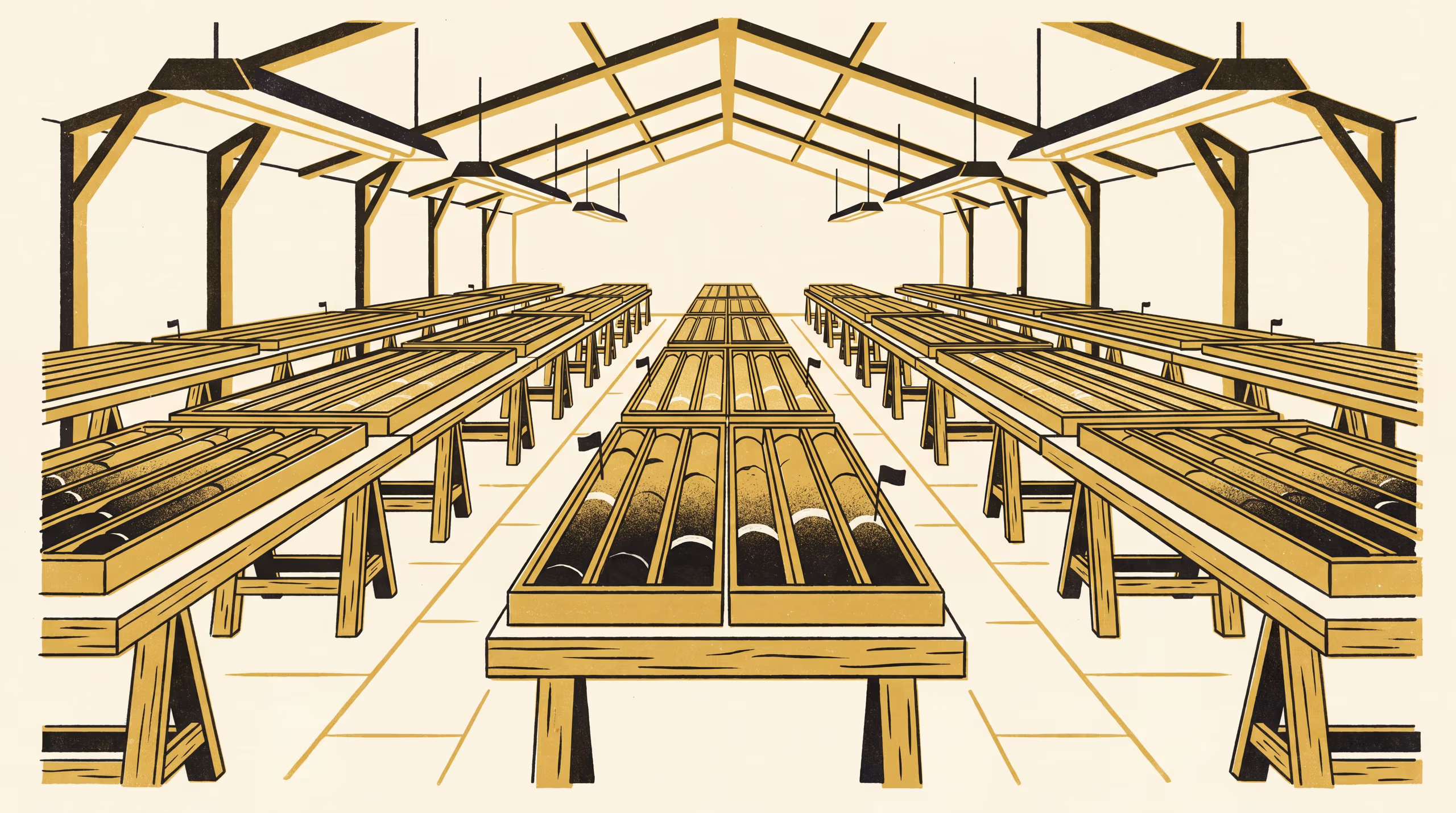
A new research poster from the School of Underlying Conditions uses one thin bed of volcanic ash to show that the base of a sandstone formation is older at a basin's margin than at its centre.
A single ash bed followed through eleven cored boreholes shows a sandstone's base rising as it crosses a basin
Slop University’s School of Underlying Conditions has added a research poster on the age of a rock formation’s lower edge to its growing body of work on where one thing ends and the next begins.
The Contact Climbs is by Dr Brynjar Obiora, Senior Research Fellow, with Associate Professor Ragnhild Uzoma, Lead of the Basement Relations Group, and Dr Vigdis Emenike, Senior Lecturer, all of the School of Underlying Conditions.
We spent a good part of this project agreeing on where to draw one line, and a good part of it discovering that each of us had been drawing it somewhere slightly different for years. The School is better for knowing that about itself.
— Dr Brynjar Obiora, Senior Research Fellow, School of Underlying Conditions
The team laid out core from eleven boreholes across an unnamed foreland basin and let a single pale band of volcanic ash serve as their shared reference point, aligning core description, wireline measurement and careful correlation behind one consistent reading of the rock. Measured against that band, the base of a deltaic sandstone sits below the ash near the basin’s edge and well above it towards the centre, which positions the formation as one body of rock laid down over a span of time rather than at a single moment.
“There is a great deal of ash in a great many core trays still waiting for someone to follow it,” said Associate Professor Uzoma. “We hope this is the first of many such walks.”
The University counts the poster among the steadier demonstrations of what patient attention to a single marker can make visible, and of the School’s standing commitment to the ground beneath its feet.
The full poster is available from the University’s research repository under an open licence, doi:10.5555/slop.dyxzuh.