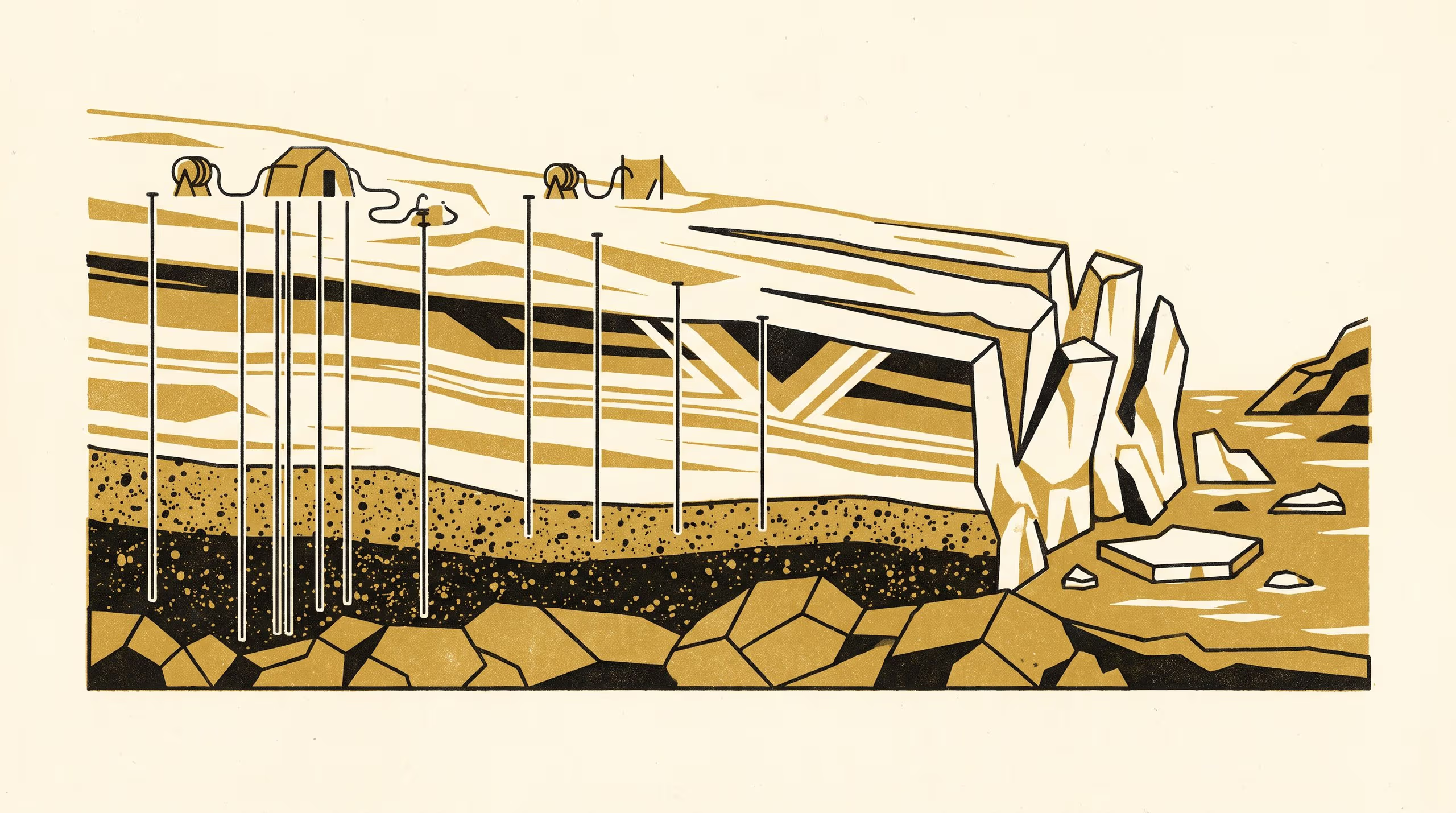
A new paper from the School of Underlying Conditions finds that the boreholes which stopped short of a glacier's bed were sitting on the patches of highest basal friction.
Four boreholes that never reached the bed of an Arctic outlet glacier mark the places it holds hardest
The School of Underlying Conditions keeps an unusual kind of field record. Beside everything its drills bring back, it writes down what they failed to reach, and a new paper shows that the second column can be the more informative one. Refusal at the Bed is by Associate Professor Ragnhild Uzoma, Lead of the Basement Relations Group, with Dr Vigdis Emenike, Senior Lecturer, both of the School of Underlying Conditions.
A borehole that does not arrive is usually written up as an apology. Our School has never been very good at apologising for missing intervals, and on this glacier that habit served us well.
— Associate Professor Ragnhild Uzoma, Lead, Basement Relations Group, School of Underlying Conditions
The study pairs a season of hot-water drilling on the lower trunk of a High Arctic tidewater glacier with a flow model that reads the glacier’s surface motion for the friction at its base, keeping the two lines of evidence apart until the end. Of fifteen holes, four stopped in dark, gravel-laden ice some metres above the bed. When the model’s picture was finally laid over the drilling log, all four sat in the three patches where the glacier grips its bed hardest, patches that cover a small part of the reach and carry a large share of its drag.
“The glacier has handed us a good many more questions than we took up there, and we are in no hurry to give any of them back,” said Dr Emenike.
The paper reflects the University’s steady commitment to reading the whole of the record, including the parts that stopped short.
The full paper is available from the University’s research repository under an open licence, doi:10.5555/slop.xqdpgb.