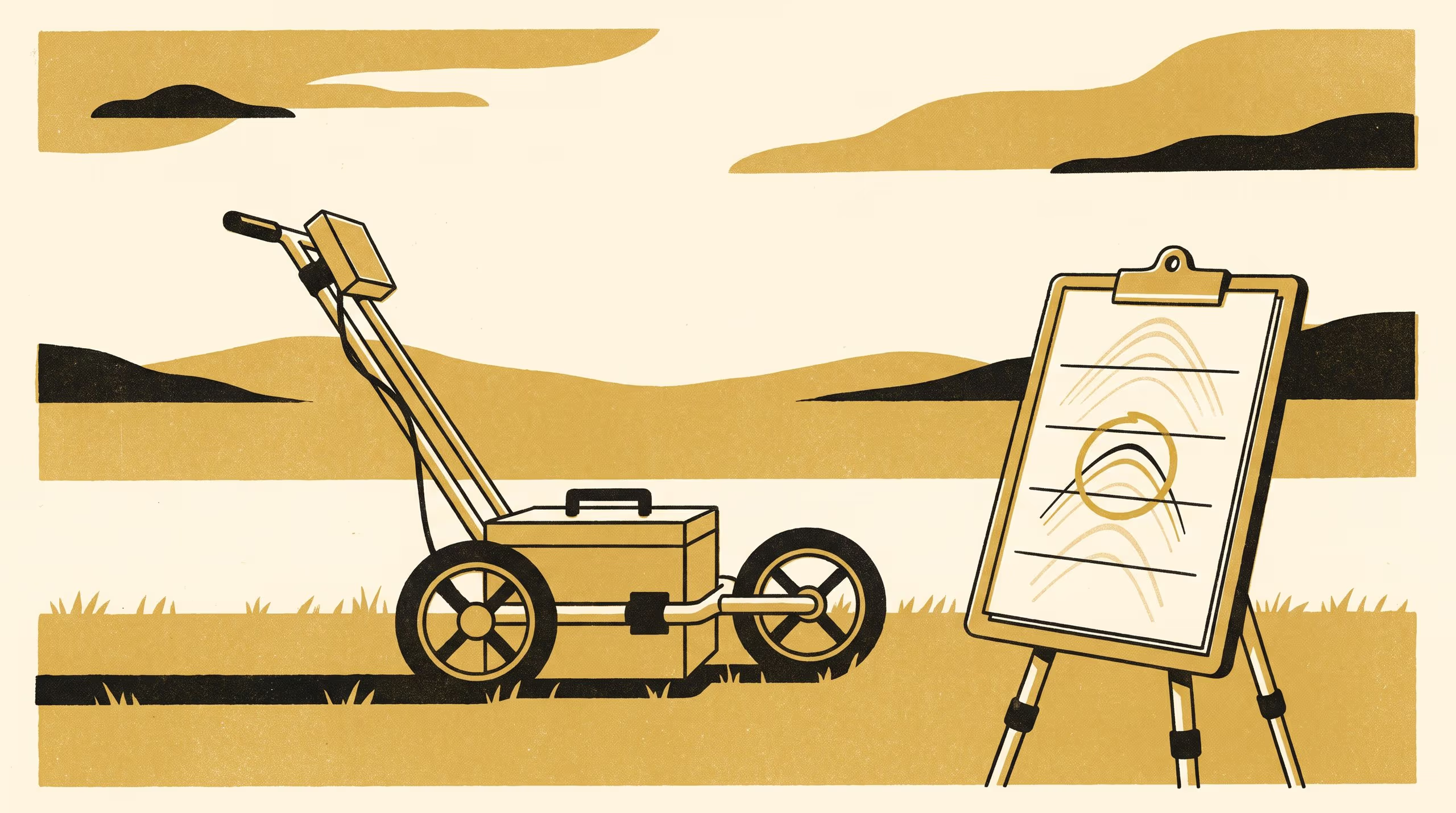
A new paper from the School of Emergent Priorities tests what a drawn utility record does to the people reading ground-penetrating radar, and finds it shapes where they report a service and when they stop looking.
Sixty-four interpreters, 180 simulated scans and a gold line that brings the search to a close
The School of Emergent Priorities has spent several years asking what an organisation has settled before it starts to look. Its newest paper carries that question below ground.
Found Where It Was Drawn is by Dr Ronja Oyelaran, Senior Lecturer and Deputy Convenor of the Strategic Drift Survey, with Associate Professor Ragnhild Uzoma, Lead of the Basement Relations Group in the School of Underlying Conditions, and Dr Bram Ntuli, Lecturer and Convenor of Improvement Grand Rounds in the School of Continuous Improvement.
None of this would exist without the locators who gave us their afternoons and their patience, and who scrolled through a great many scans that were never going to be dug. We owe the paper to them more than to any of its numbers.
— Dr Ronja Oyelaran, Senior Lecturer and Deputy Convenor, Strategic Drift Survey
The study brings experimental psychology’s signal-detection toolkit into dialogue with the interpretive practice of subsurface survey, positioning the drawn record as a site where expectation, attention and professional judgement converge. Across 64 participants and 180 simulated scans, it finds that a line drawn over the radar image makes readers readier to report a service beneath it, and less thorough everywhere else.
Dr Ntuli said the findings had “given Grand Rounds a good deal to sit with, which is the most a School can ask of a colleague’s paper”.
The paper sits among the University’s most deliberate crossings between schools to date, uniting three agendas around a single image on a single screen.
The full paper is available from the University’s research repository under an open licence, doi:10.5555/slop.zgp2ve.