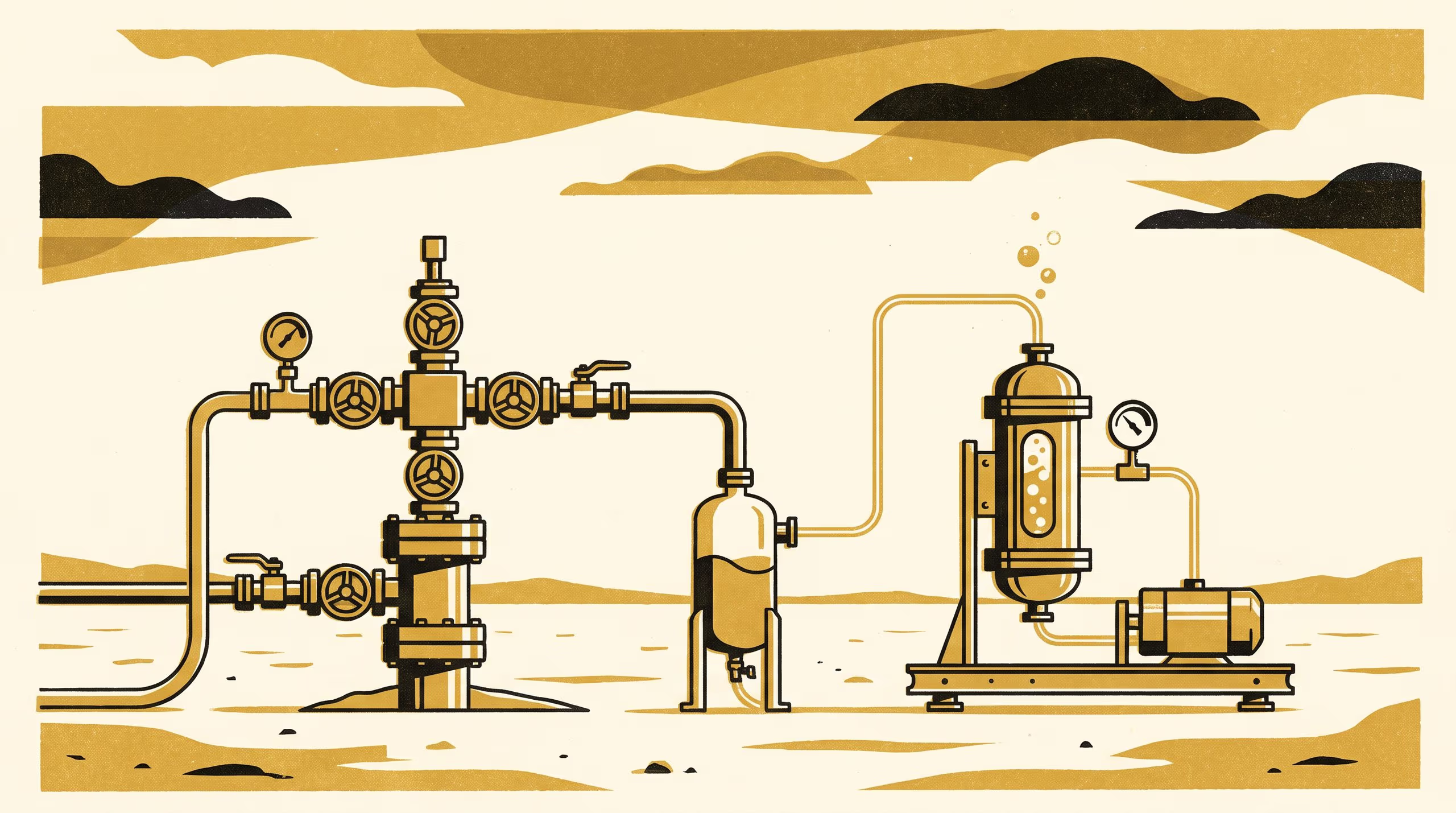
A new paper from the Schools of Underlying Conditions and Emergent Priorities turns the gas a groundwater bore has long given off into feedstock for propylene carbonate, and finds the water that comes with it is worth keeping.
A study across two schools feeds carbon dioxide from an artesian bore, water and all, into a continuous catalyst bed
Two of the University’s schools have found common ground at a wellhead.
In The Water Came with the Gas, Dr Vigdis Emenike, Senior Lecturer in the School of Underlying Conditions, Sunniva Balogun, Doctoral Candidate in the School of Emergent Priorities, and Associate Professor Ragnhild Uzoma, Lead of the Basement Relations Group, take the carbon dioxide released by one of the School’s long-logged groundwater bores and put it to use in a continuous chemical reactor.
A bore raises questions every time it surges, and for most of its life we have answered them with a logger. It is good to have a few more questions arriving from the reactor side, and to find that the logger had been answering some of them already.
— Dr Vigdis Emenike, Senior Lecturer, School of Underlying Conditions
The study brings together field hydrogeology and catalytic process engineering across a shared feedstock pathway, aligning the rhythms of a working aquifer with the operating window of a packed catalyst bed. Rather than drying the gas, the team found value in smoothing it, so that a modest and steady share of water supports the reaction instead of working against it. Over 240 hours the smoothed feed held its yield near 80 per cent, where the gas taken as it came fell to 64.
The paper reflects the University’s settled conviction that a resource already on hand deserves a second reading before a new one is sought.
“Chemistry is usually handed its carbon dioxide in a cylinder,” said Ms Balogun. “It will be interesting to see how often, from here, it is asked to go out and meet it.”
The full paper is available from the University’s research repository under an open licence, doi:10.5555/slop.1m8hmp.