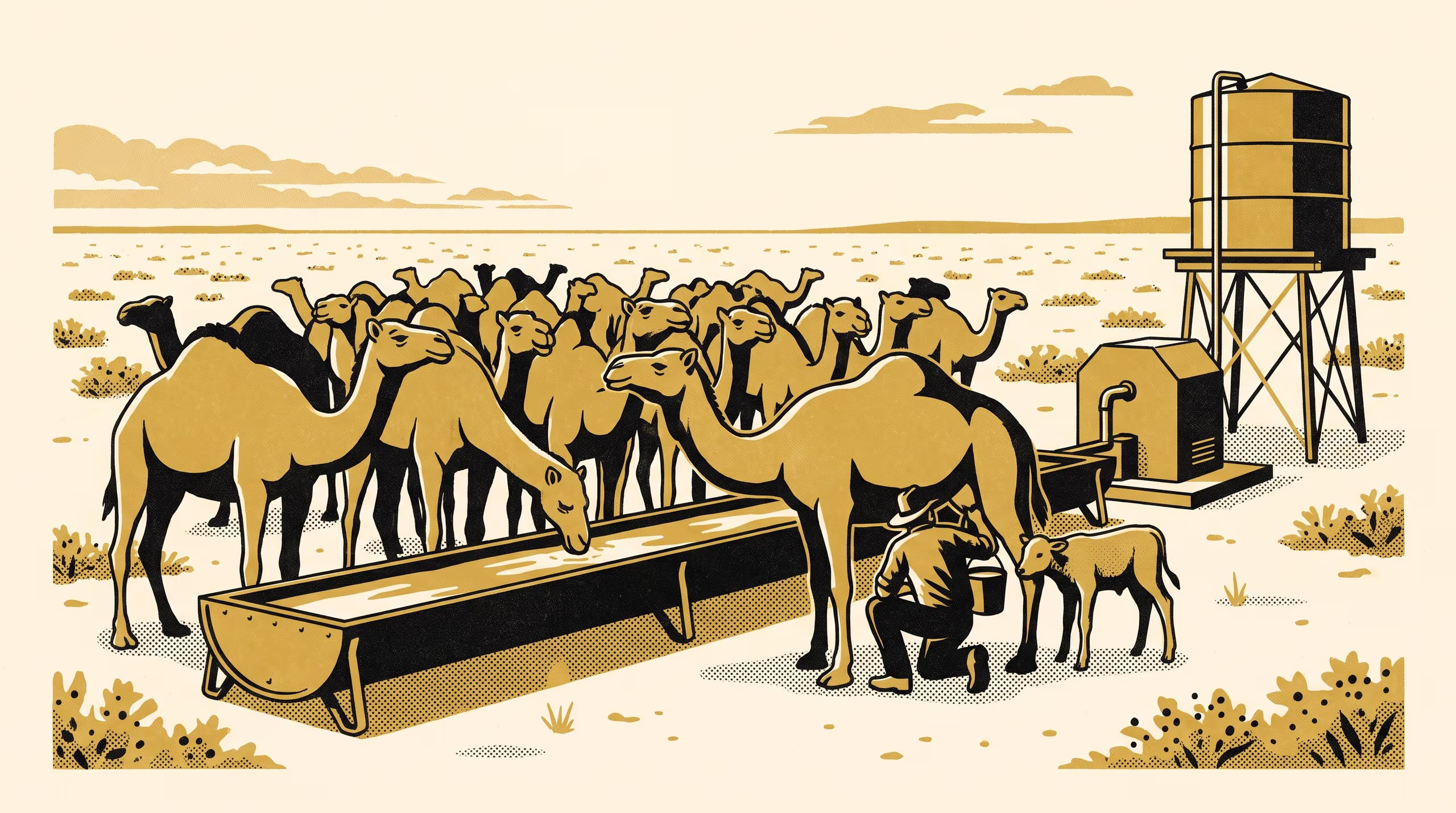
A new paper from the School of Underlying Conditions samples a pastoral camel herd's morning milk every day of a dry season, as the herd moves between three bores of differing salinity, and finds the milk holding its solids while taking on the salt of the trough.
A season of morning milk from a pastoral herd finds it saltier, not thinner, the longer the camels go between drinks
For one dry season, the morning milk on a pastoral station went to the laboratory before it went to the kitchen.
The result is Saltier, Not Thinner, a new paper by Dr Vigdis Emenike, Senior Lecturer, and Dr Brynjar Obiora, Senior Research Fellow, both of the School of Underlying Conditions. Following a camel herd as it moved between three bores, the authors report that the milk held its substance across the days between waterings, and carried more of each bore’s salt the longer the herd went without a drink.
A bore is a question somebody once asked of the ground. It has been a pleasure, this season, to follow one of those questions all the way to the breakfast table.
— Dr Vigdis Emenike, Senior Lecturer, School of Underlying Conditions
The paper brings daily milk sampling, water-quality monitoring at the trough and the working judgement of the station’s stockman into a single account of how a herd’s watering routine reaches its milk. It positions the bore, the trough and the milking yard as one continuous site of inquiry, and it gives a place in the findings to the stockman’s own morning tasting.
Dr Obiora credited the station’s hours. “A study on a working station keeps the station’s time,” he said. “We are better field scientists for every morning we were up before the camels.”
The University is pleased to see its research reach the yard and the milking pail, and counts the paper among the most patient of its School’s field studies.
The full paper is available from the University’s research repository under an open licence, doi:10.5555/slop.iwq2y2.