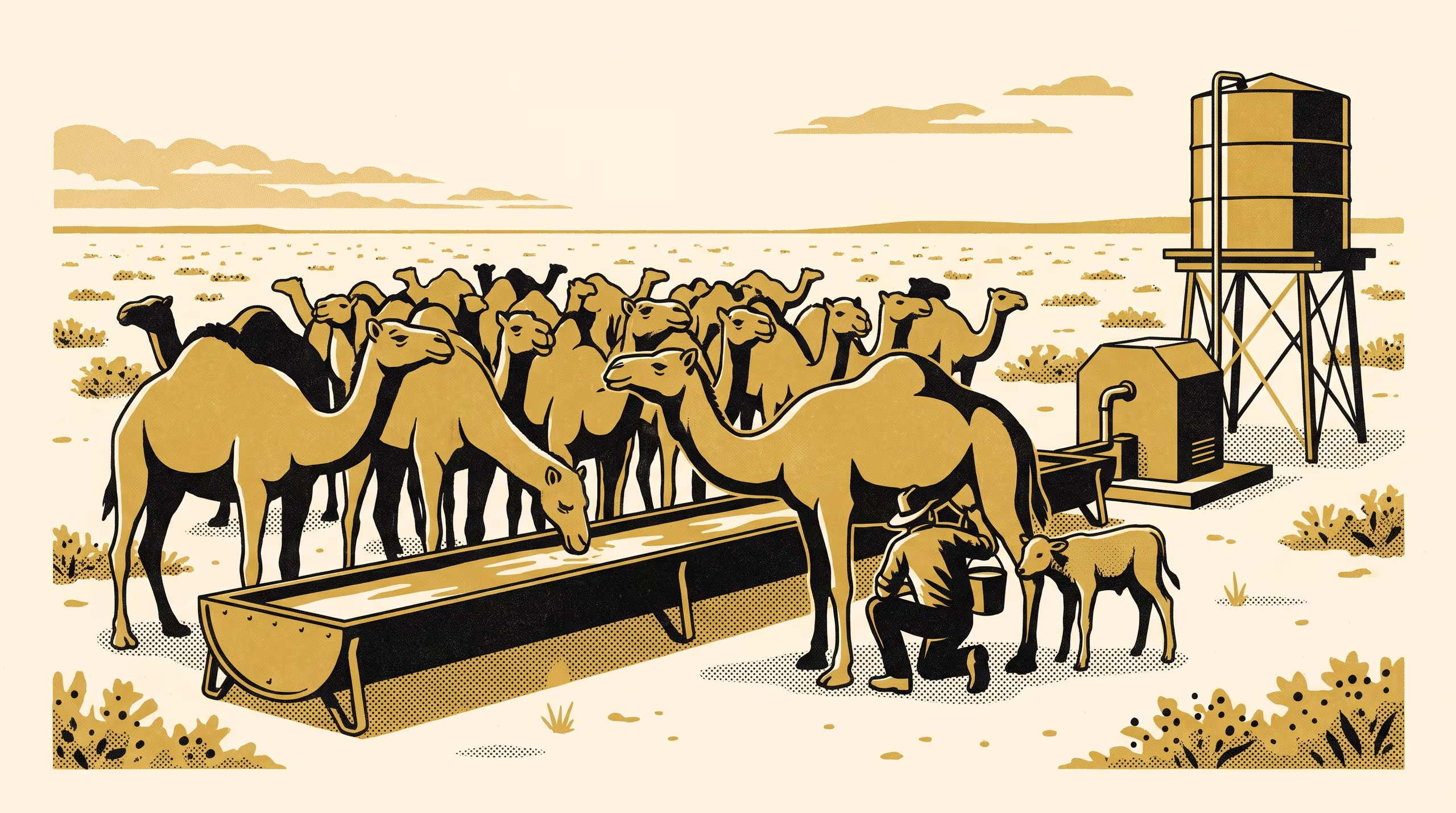
Watering Interval, Bore-Water Salinity and the Composition of Dromedary Milk in a Pastoral Herd Rotated Across Three Bores
A paper from the School of Underlying Conditions follows 34 hand-milked dromedary does in one pastoral herd through a 126-day late dry season, as the herd is rotated through three bores whose trough water runs from 1.4 to 8.9 dS/m and watered every two to six days. Total solids in the morning milk hold steady across the watering interval, while sodium, chloride and freezing-point depression rise with both the days since watering and the salinity of the trough, and the stockman's morning tasting of the bulked milk tracks its sodium closely.
| Authors | Vigdis Emenike , Brynjar Obiora |
|---|---|
| School | School of Underlying Conditions |
| Output type | Research paper |
| Published | |
| DOI | 10.5555/slop.iwq2y2 |
| Pages | 5 |
| Cited by | 1 output |
| Version | 1.0 |
| Licence | CC BY 4.0 |
Cites
Cited by
Cite as
@misc{slop_iwq2y2,
  author       = {Vigdis Emenike and Brynjar Obiora},
  title        = {Saltier, Not Thinner: Watering Interval, Bore-Water Salinity and the Composition of Dromedary Milk in a Pastoral Herd Rotated Across Three Bores},
  year         = {2026},
  publisher    = {Slop University},
  doi          = {10.5555/slop.iwq2y2},
  url          = {https://slop.university/outputs/slop-paper-watering-interval-and-iwq2y2/},
  version      = {1.0},
  note         = {Research paper},
}