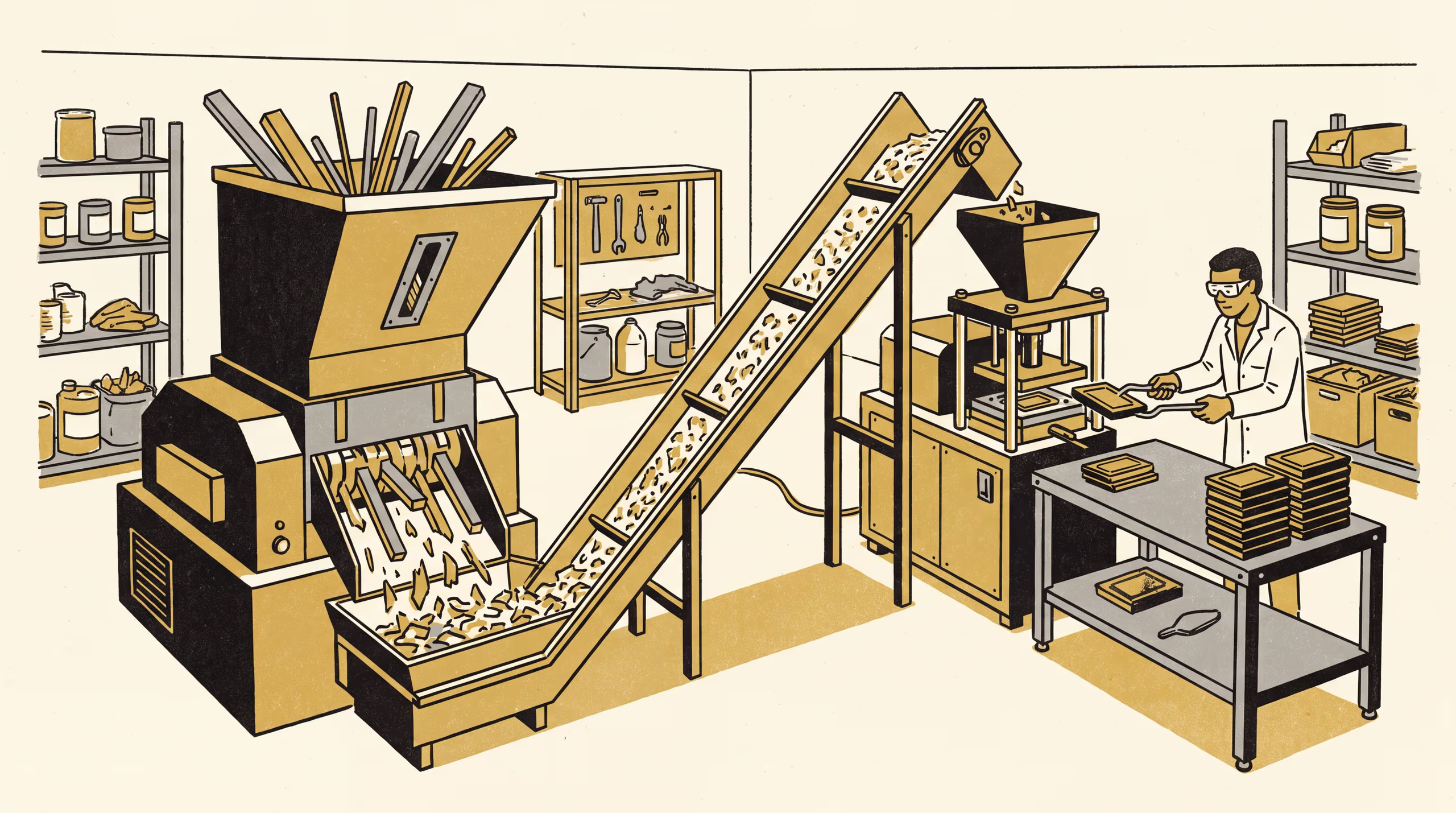
A new research poster from the School of Underlying Conditions grinds and remoulds one nanotube-filled plastic five times over, and finds that the grade nearest its threshold fails without warning at the third pass.
A reground nanotube compound keeps its conductivity for a while, then gives it up all at once
Five passes through a granulator, four recipes and a long bench of small grey plaques sit behind Five Times Through the Granulator, a new research poster from the School of Underlying Conditions.
The work is led by Dr Brynjar Obiora, Senior Research Fellow, with Associate Professor Ragnhild Uzoma, Lead of the Basement Relations Group, and Dr Bram Ntuli, Lecturer and Convenor of Improvement Grand Rounds in the School of Continuous Improvement.
Most of what the world makes, it makes more than once. It seemed only right that a little of our research should be made that way too.
— Dr Brynjar Obiora, Senior Research Fellow, School of Underlying Conditions
The poster situates the reuse of advanced materials within the School’s wider attention to what a process takes from its inputs, aligning a regrind-and-remould protocol with paired measurements of the material’s electrical behaviour and the condition of the nanotubes inside it. Across five passes the tubes lost more than half their length. The richest grade kept most of its conductivity throughout, while a leaner grade held steady for two passes and then lost it in one.
Associate Professor Uzoma found a quiet satisfaction in the repetition. “There is something steadying about returning to the same material and finding it still has something to tell you,” she said.
The University sees in the poster a timely contribution to the circular life of engineered materials, and a field in which it means to go on asking careful questions.
The full poster is available from the University’s research repository under an open licence, doi:10.5555/slop.qbf1qr.