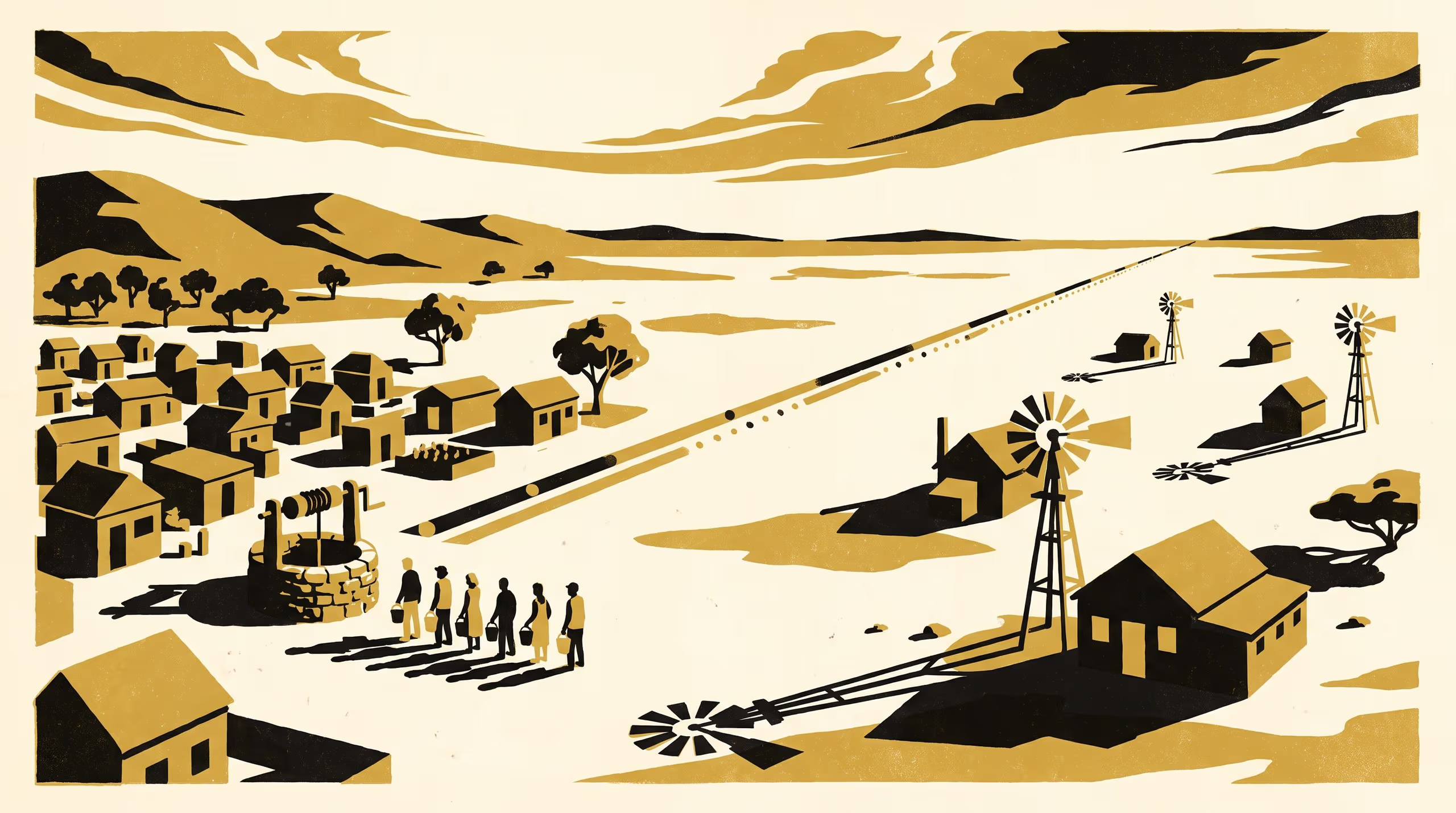
A new paper from the School of Underlying Conditions and the School of Emergent Priorities finds that households on the common-well side of an old survey line hold firmer views on keeping one's turn, and that the rosters which once ordered the wells still order other duties today.
Slop University researchers trace a roster that outlived the common wells it was written for
Where a basin once shared its wells, it still keeps its turns. That is the central finding of The Roster Outlived the Well, a new paper by Dr Vigdis Emenike, Senior Lecturer in the School of Underlying Conditions, and Ms Ylva Onyekwere, Doctoral Candidate in the School of Emergent Priorities.
The study brings together surviving well-committee minute books, a household values survey on both sides of a nineteenth-century survey line, and a census of the community rosters still in use nearby. Across these, the authors position the line as a lens on how a shared resource can leave behind a shared practice, long after the resource itself has been capped. Households on the side that once drew water in common hold a firmer sense that a turn, once allotted, should be kept, while trusting strangers no more and no less than their neighbours to the south.
For most of my career I have read what a single bore can tell us about the ground around it. Ylva showed me how to read a minute book in much the same way, as one record among many, kept by people whose reasons we can only partly recover.
— Dr Vigdis Emenike, Senior Lecturer, School of Underlying Conditions
Ms Onyekwere paid tribute to the record-keepers. “Someone sat at the end of a table every month for more than fifty years and wrote down whose turn it was,” she said. “This paper is, in a small way, their minute.”
The work is the kind of patient conversation between schools that the University has always hoped its disciplines would hold with one another.
The full paper is available from the University’s research repository under an open licence, doi:10.5555/slop.4bnlor.