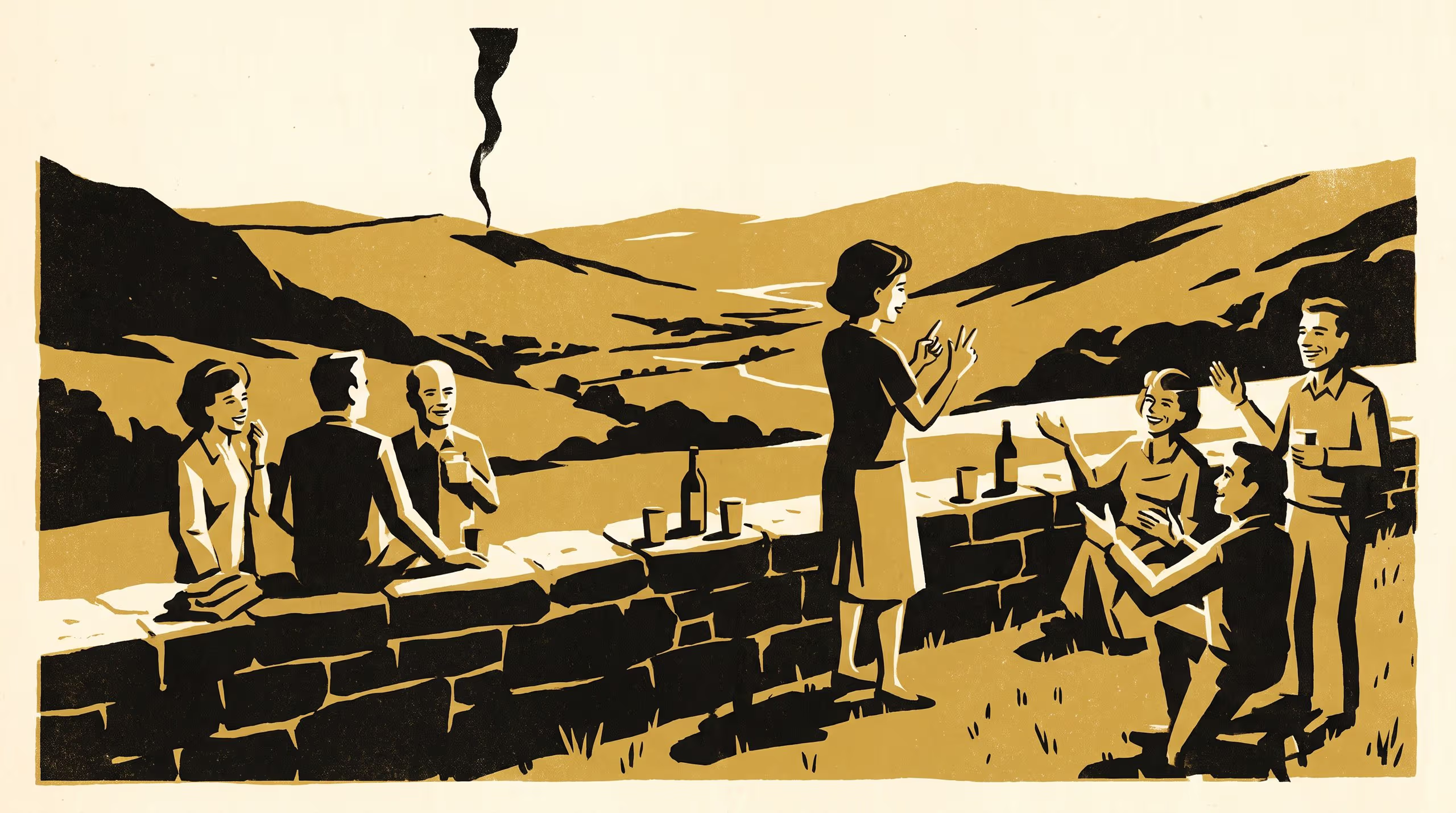
Smoke on the Hill, a new civic brochure, invites the district to reason with the University in the order of argument set down by India's Nyāya logicians.
A civic brochure reads the University's public life through the classical Nyāya manuals of debate
Five steps, said aloud: a claim, a reason, an example anyone can check, the bearing of that example on the case at hand, and only then a conclusion. That is the order of argument the logicians of classical India’s Nyāya school taught for persuading a neighbour, and it is now the order in which Slop University offers its public life to the district.
Smoke on the Hill is a new civic brochure by Associate Professor Ragnhild Uzoma, Lead of the Basement Relations Group in the School of Underlying Conditions, with Mr Eskil Nwabueze, Doctoral Candidate in the School of Continuous Improvement, and Dr Lindiwe Achterberg, Lecturer in the School of Emergent Priorities.
In Emergent Priorities we spend a good deal of our time on how decisions arrive. Working on this brochure reminded us that the people who live with a decision mostly want to know how it was reached, and that telling them is a courtesy we can extend far more often than we do.
— Dr Lindiwe Achterberg, Lecturer, School of Emergent Priorities
Across three features, the brochure situates the University’s earth-science, household and civic scholarship within a single framework of evidence-led public reasoning, aligning recovered-core practice, a return to the everyday examples underpinning the district’s working rules, and a standing preference for discussion over disputation. Six published outputs anchor its showcase.
The University regards the brochure as a fair account of how it hopes to be argued with, and is glad to place it in its neighbours’ hands.
Mr Nwabueze said the team would consider the brochure well received “if a reader brings it back with one of the five steps circled, and a note saying where we skipped it”.
The full brochure is available from the University’s research repository under an open licence, doi:10.5555/slop.m2lz62.