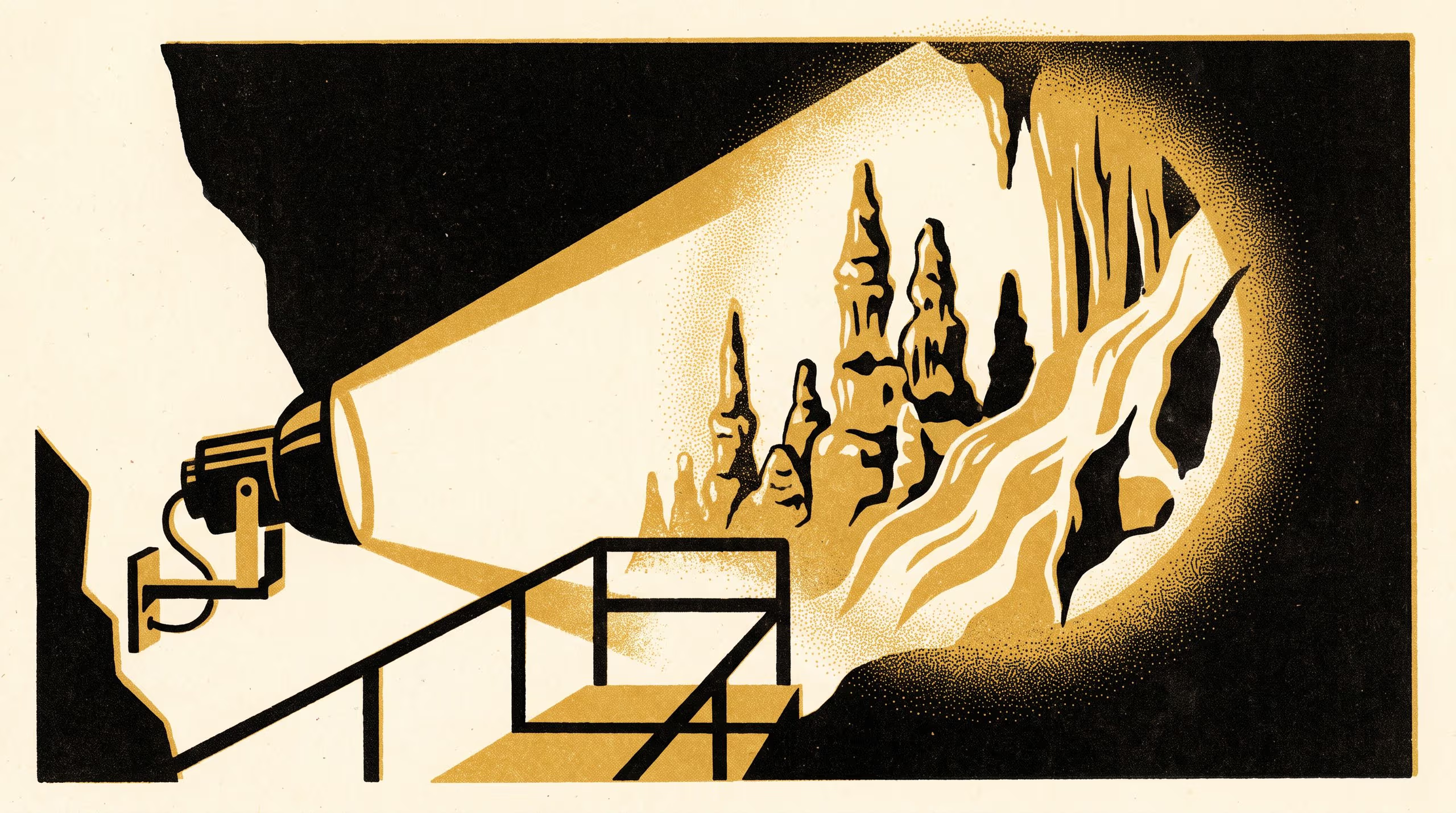
A paper from the School of Underlying Conditions finds that the green films on a show cave's formations track how long each zone of lights stays on, more closely than how bright the lamps are.
A new paper maps lampenflora across 58 retrofitted tour lamps in a limestone show cave against eighteen months of switching records
The School of Underlying Conditions has made its name on what lies beneath the surface. Its newest paper turns to what grows on top of it.
What the Switching Log Grows is by Associate Professor Ragnhild Uzoma, Lead of the Basement Relations Group, with Dr Brynjar Obiora, Senior Research Fellow, and Dr Vigdis Emenike, Senior Lecturer. It follows the green films that gather on stalagmites and flowstone under a show cave’s tour lighting, in the eighteen months after every lamp on the circuit was replaced with an LED.
We went underground expecting the rock to have the last word. It turns out the clock has a good deal to say as well, and the School is still getting used to listening to it.
— Associate Professor Ragnhild Uzoma, Lead, Basement Relations Group
By integrating quadrat-scale photometry, repeat imaging and the cave controller’s own switching records into a single dose-informed framework, the team offers a whole-of-circuit perspective on light, moisture and time at the rock face. Their analysis suggests the films are better explained by how long each zone of lights stays on than by how bright the new lamps are, and that a change to the controller’s timer made at commissioning carried much of the weight.
For the University, the paper extends an underground research agenda that now reaches from the air moving through a cave to the light falling inside one.
“Every lit surface is, in its way, a record,” said Dr Obiora. “There are a great many more of them waiting to be read.”
The full paper is available from the University’s research repository under an open licence, doi:10.5555/slop.z31c2z.