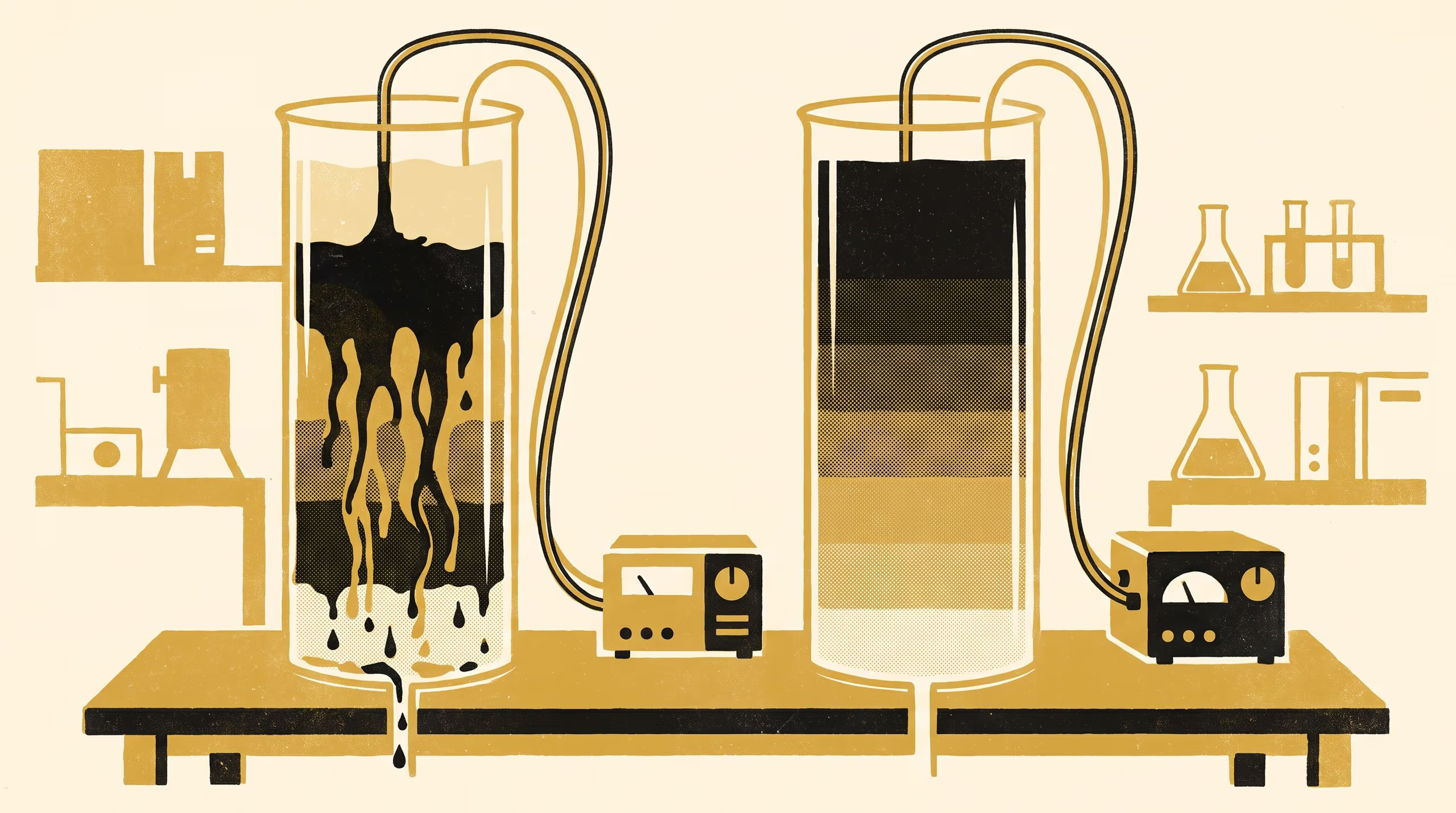
A new paper from the School of Underlying Conditions and the School of Continuous Improvement shows how stepping a rinse down in stages recovers a viscous solvent extract from packed soil columns faster and more completely.
Water pushed into a viscous extracting solvent splits into fingers, and three intermediate mixtures keep the front whole
Getting a solvent into a column of soil is the easy part. Getting it back out, with everything it has dissolved, is the question taken up by A Graded Rinse, a new paper by Dr Brynjar Obiora, Senior Research Fellow, and Dr Vigdis Emenike, Senior Lecturer, both of the School of Underlying Conditions, with Associate Professor Casimir Beng, Lead of the Adaptive Metrics Lab in the School of Continuous Improvement.
The team found that rinsing a thick extracting solvent out of a column with plain water sends the water through in fingers, leaving much of the extract behind. Stepping the rinse down through three intermediate mixtures held the front together, and brought back 94 per cent of the extract within a pore volume and a half, against 77 per cent for the best plain-water rinse.
It is not often that a control engineer is asked to write a recipe. We kept it to a handful of steps so that whoever is at the bench that week can follow it without asking anyone.
— Associate Professor Casimir Beng, Lead, Adaptive Metrics Lab, School of Continuous Improvement
Uniting packed-bed hydrodynamics, solvent design and the School’s long practice of reading soil profiles horizon by horizon, the paper aligns established displacement theory with the everyday realities of the extraction bench, enabling a programmable rinse schedule that travels readily between soils.
The work joins a growing body of University scholarship that finds its way from the field to the laboratory and back again, and the University counts it a fine example of two schools sharing a bench without first agreeing who owns it.
Dr Emenike said the columns had been “very patient teachers”, and that the School looked forward to “putting the same question to cores that have never been sieved”.
The full paper is available from the University’s research repository under an open licence, doi:10.5555/slop.3y1wn0.