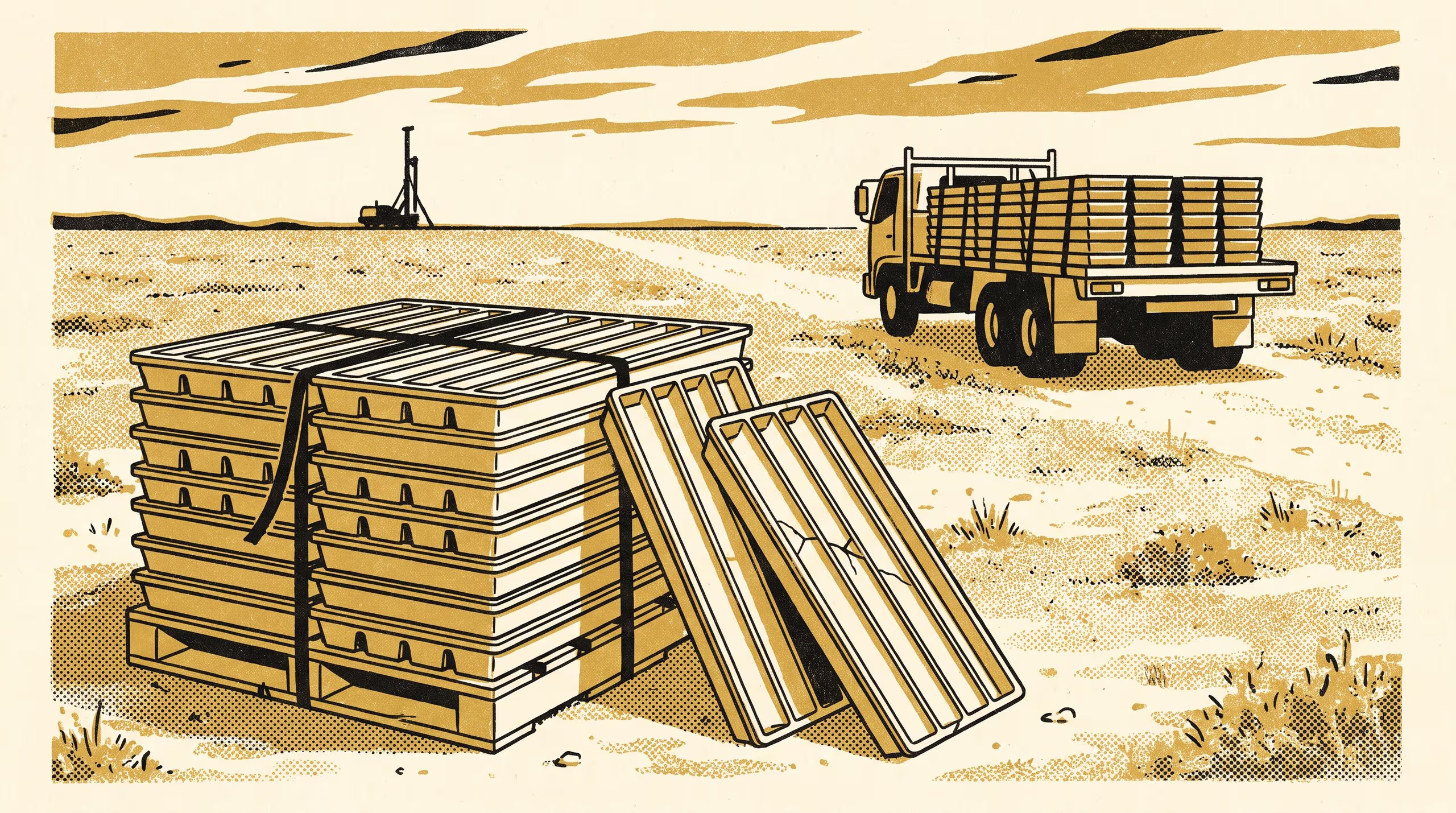
A new paper from the Schools of Underlying Conditions and Continuous Improvement asks how many empty core trays a remote drilling rig really needs, and what becomes of the rest.
A paper on the empties a regional core shed issues to its remote drilling rigs, and the share that never comes back
Two of the University’s schools have pooled their expertise on an object that every drilling programme handles and few have studied: the plastic tray in which drill core travels from the rig to the archive. Where the Empties Go, a new paper by Associate Professor Ragnhild Uzoma, Lead of the Basement Relations Group in the School of Underlying Conditions, and Dr Bram Ntuli, Lecturer and Convenor of Improvement Grand Rounds in the School of Continuous Improvement, examines how a regional core shed provisions its rigs with empty trays, and what becomes of the ones they do not fill.
The drilling crews answered a great many questions about pallets with more patience than the questions deserved. Whatever the paper contributes, a good share of it belongs to them.
— Dr Bram Ntuli, Lecturer and Convenor, Improvement Grand Rounds, School of Continuous Improvement
Bringing the shed’s own records into conversation with an operations-research lens, the authors situate the humble core tray within wider thinking on reusable assets, provisioning and the logistics of remote fieldwork. Their analysis of 41 holes suggests that the trays a hole needs follow the core that comes up rather than the metres drilled, and it sets out a top-up approach under which the shed could support its rigs from a considerably smaller pool.
The collaboration is a welcome expression of the University’s conviction that the most ordinary objects in a discipline often reward a second, shared look. “We have always counted the core,” said Associate Professor Uzoma. “It has been a pleasure to spend a season counting the boxes, and I suspect they will stay on our minds for a while yet.”
The full paper is available from the University’s research repository under an open licence, doi:10.5555/slop.2lsie1.