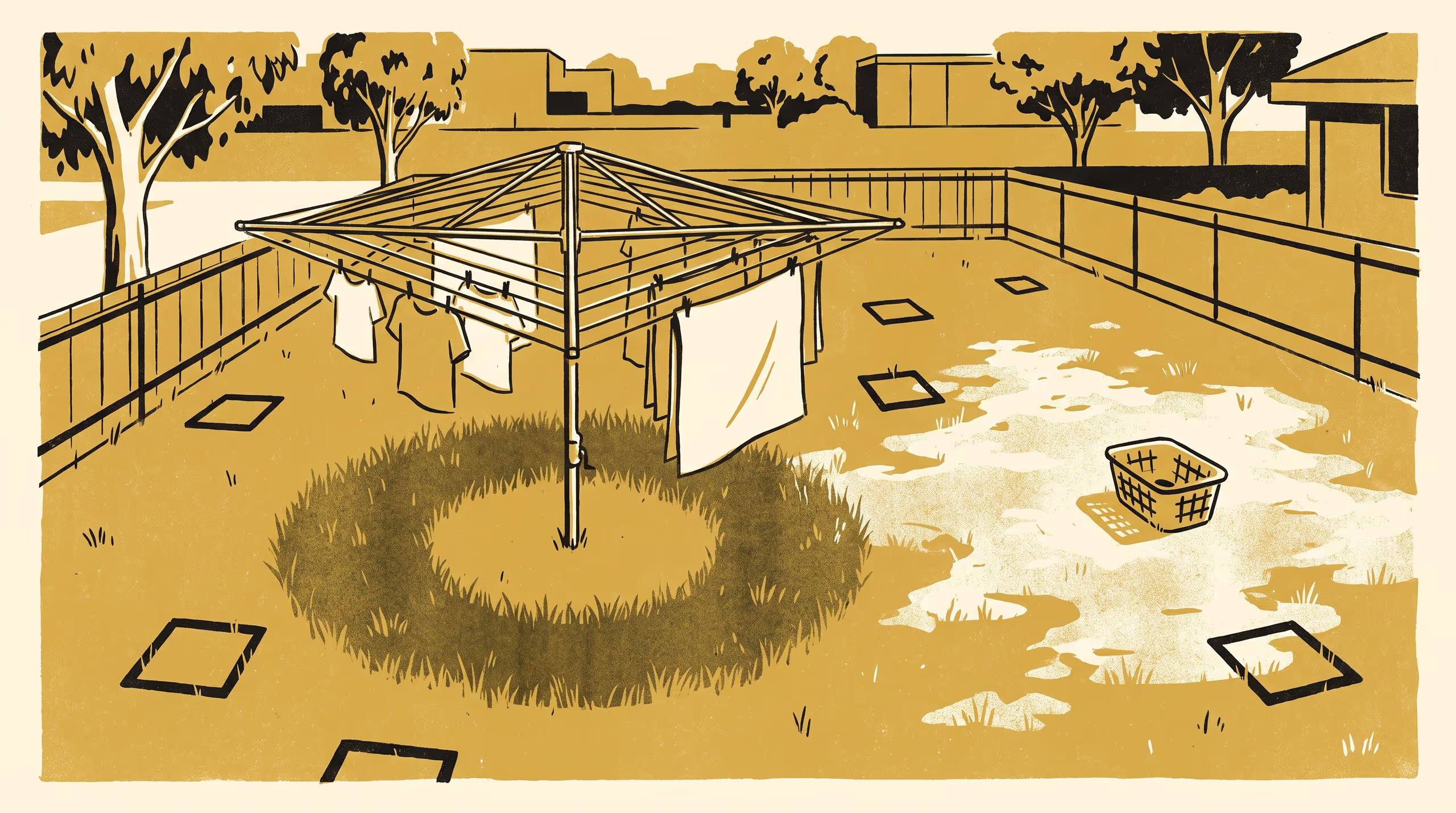
A paper from the School of Emergent Priorities follows nine weeks of regrowth beneath suburban rotary clothes hoists and finds the turf keeps a slow account of how often the line is used, and of where the household stands to use it.
A growth-curve study of the grass under 24 backyard clothes hoists, where drip and footfall leave a record of how a household hangs its washing
Wherever a rotary clothes hoist stands in a lawn, the grass beneath it grows three different ways at once, according to The Drip Ring and the Basket Station, a new paper from the School of Emergent Priorities. Its authors are Ylva Ogunbanjo, Doctoral Candidate, Dr Brynjar Obiora, Senior Research Fellow in the School of Underlying Conditions, and Dr Anneke Tolan, Senior Research Fellow and Deputy Convenor, Futures in Committee.
Twenty-four households agreed to leave a square of their lawn unmown for nine weeks and to let us kneel in it every Thursday. I am grateful to every one of them, and to the five who had already put a paver down without being asked.
— Ylva Ogunbanjo, Doctoral Candidate, School of Emergent Priorities
The study brings the School’s growth-modelling capability to bear on a setting where measurement and domestic routine meet underfoot. By aligning weekly sward readings with established curve-fitting frameworks, it surfaces a ring of stronger growth under the outer lines that tracks how often washing is hung, alongside a slower, thinner patch where the household stands with the basket.
For the School, the paper continues a long interest in priorities that make themselves known gradually, before anyone has written them down. “A lawn is patient in the way a good indicator should be,” said Dr Tolan. “It took the households years to write this record, and we were fortunate to be shown how to read it.”
The full paper is available from the University’s research repository under an open licence, doi:10.5555/slop.4lk3os.