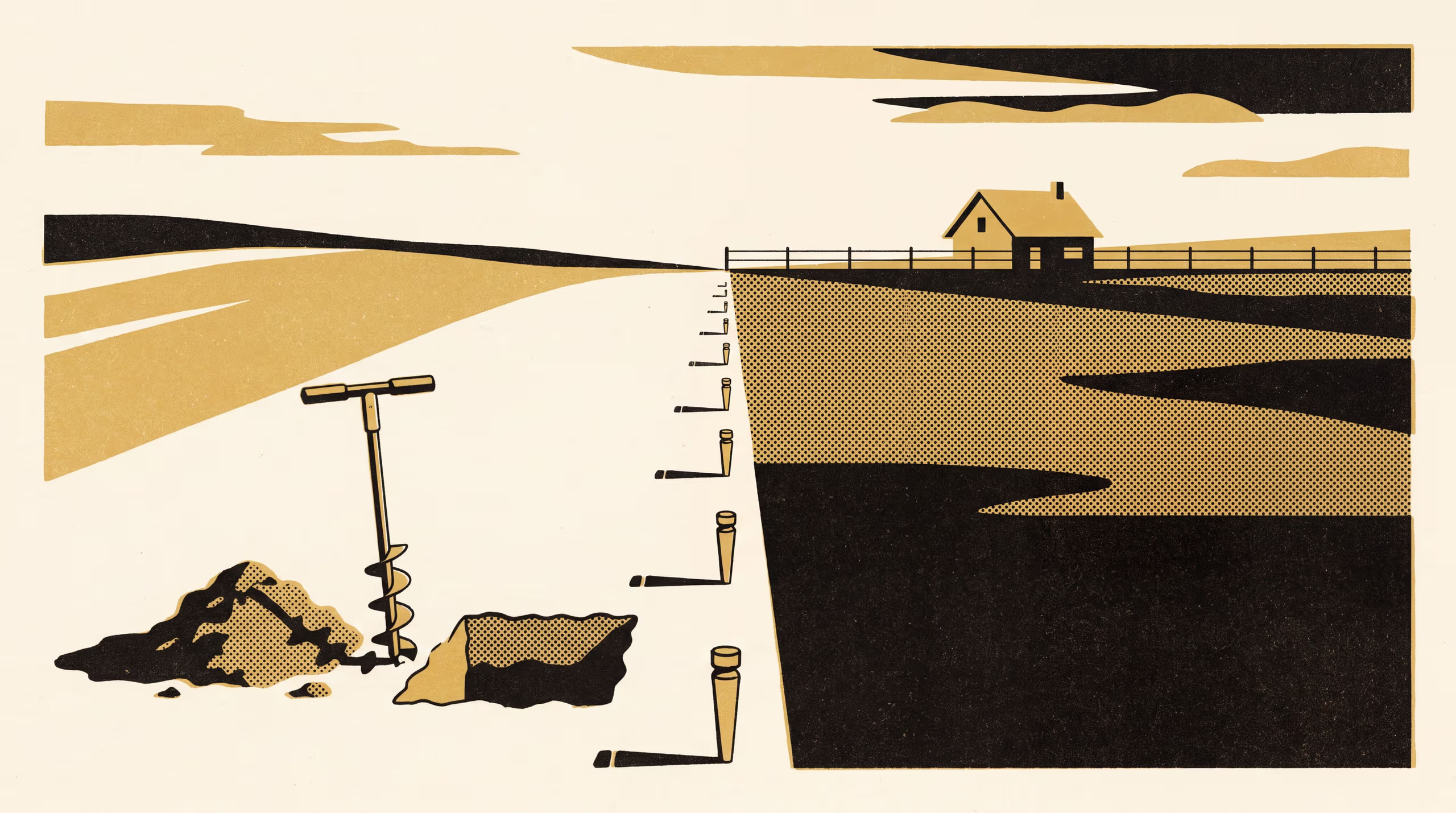
A new research poster from the School of Underlying Conditions follows a per-hectare soil-conservation payment across the lines on a soil map, and finds it carried into what farmland sells for rather than into how the land is worked.
Farmland sales either side of a mapped soil boundary find the conservation payment in the sale price rather than the paddock
Where does money paid to look after the soil end up? A new research poster from the School of Underlying Conditions answers by walking the lines of a soil map.
Paid at the Pencil Line is by Dr Brynjar Obiora, Senior Research Fellow, with Dr Runa Adegoke, Senior Lecturer and Convenor, Strategic Drift Survey, and Associate Professor Kwame Lindqvist, Director of the Master of Priority Studies. Across 1,214 farmland sales near the mapped boundaries that decide who receives a regional conservation payment, the team finds prices around 6% higher on the eligible side of the line, while the share of land under crop carries on across it unchanged.
Methodologically, the poster sets a spatial discontinuity design from the economist’s toolkit alongside 412 freshly augered soil descriptions, aligning the market’s reading of a boundary with the surveyor’s in a single integrated account of how policy settles into land.
The farmers who let us auger along their fence lines gave up a good many afternoons for this, and more than one of them could have shown us where the line ran before we had unfolded the map. We owe the poster to their patience.
— Dr Brynjar Obiora, Senior Research Fellow, School of Underlying Conditions
The work joins two schools that rarely share a field season, and the University regards it as the kind of crossing its corridors were built to encourage. “Anyone who designs a payment will find something here to think about,” said Associate Professor Lindqvist, “and the School of Emergent Priorities is glad to have had a hand in it.”
The full poster is available from the University’s research repository under an open licence, doi:10.5555/slop.mfug6n.