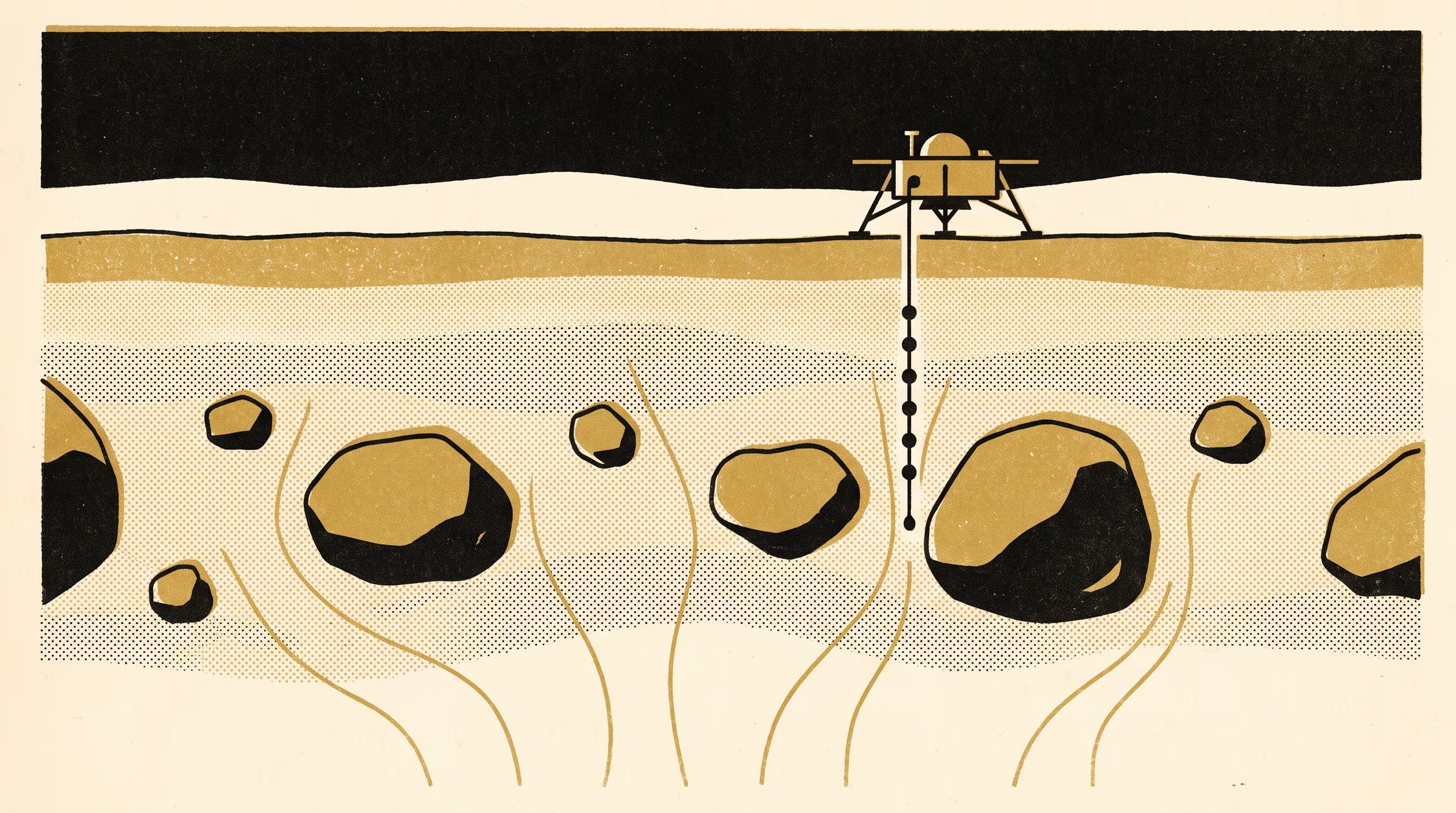
A School of Underlying Conditions paper asks how much of a planet's interior one heat-flow probe can speak for, and finds the answer is set less by how long the station records than by the ground beside the hole.
Simulated sections of planetary regolith show a lone heat-flow probe reading low beside buried rock, and why a longer record cannot put it right
A heat-flow station on another world reports for an entire interior from a hole a few metres deep. A new paper from the School of Underlying Conditions suggests that the ground beside that hole has more say in the answer than the hole itself.
How Far Does One Borehole See? is by Dr Vigdis Emenike, Senior Lecturer, and Dr Brynjar Obiora, Senior Research Fellow, and brings the School’s long acquaintance with monitoring bores and mapped soil boundaries to the regolith of an airless body.
The School has always worked one hole at a time. We owe a great deal to the colleagues across the University who kept asking, kindly and often, what lies under the ground somewhere else, and this paper is our first attempt at a reply.
— Dr Vigdis Emenike, Senior Lecturer, School of Underlying Conditions
Through fifteen hundred simulated sections of ground, the authors developed an integrated account of probe placement, buried rock and the years a station spends settling in, situating single-site measurement within a broader conversation about representativeness at every scale. The work identifies the lateral setting of a station as the leading term in its error budget, and offers practical pathways for planning stations that can see it.
Dr Obiora described the collaboration as “a natural meeting of the bore and the soil pit, at some distance from either”.
The University receives the paper as a measure of how far its earth sciences now reach, and of how readily the School’s field habits travel.
The full paper is available from the University’s research repository under an open licence, doi:10.5555/slop.h43iob.