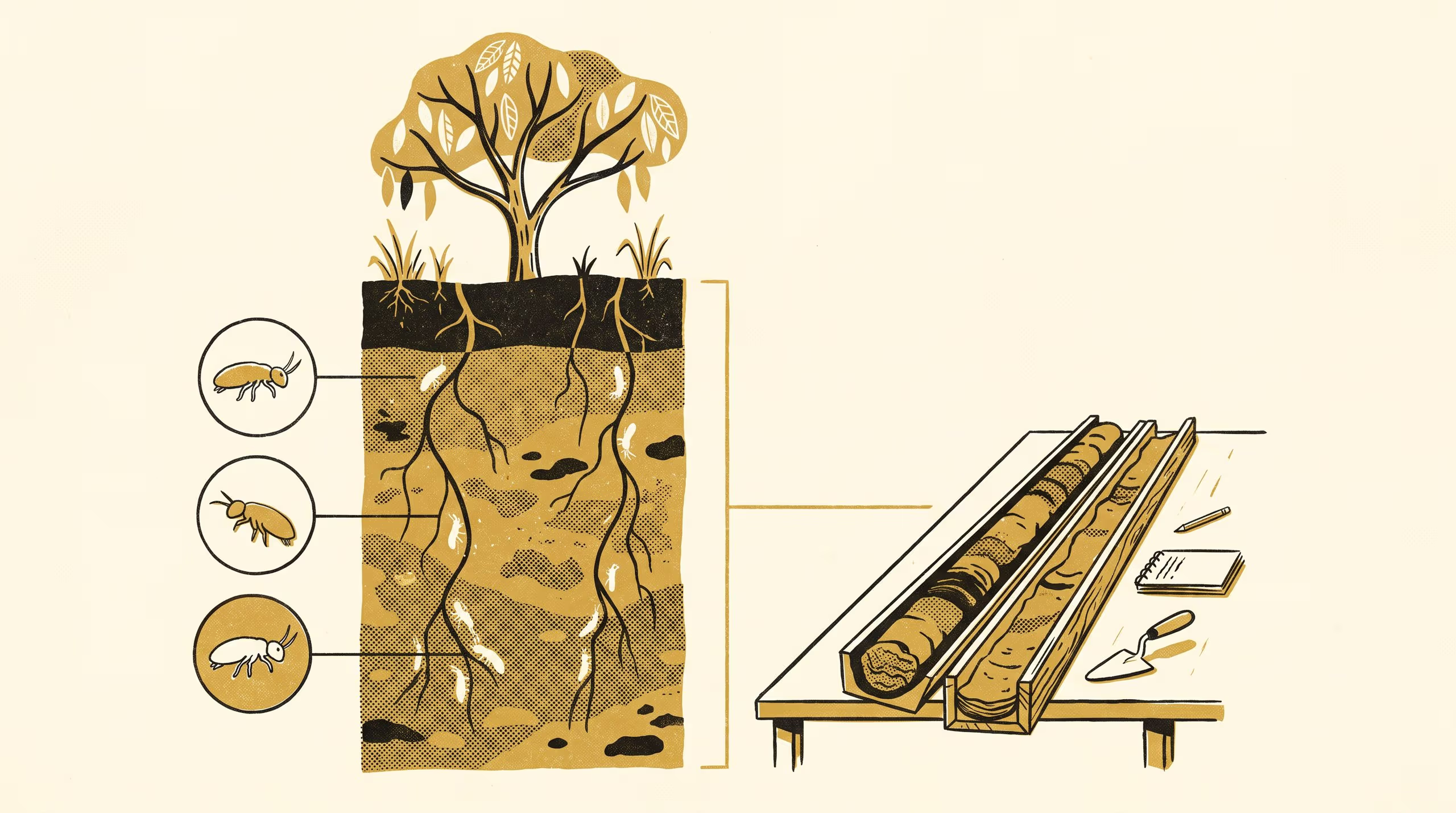
A new paper from the School of Underlying Conditions follows the soil's springtails below the reach of a spade, and finds most of the deep ones living along the channels that long-dead roots left behind.
Twelve three-metre cores through weathered granite show where the deep subsoil keeps its fauna
Twelve narrow cores, each driven three metres into deeply weathered granite, have given the School of Underlying Conditions an unusually close look at who lives beneath the rooting zone. Down the Old Root Channels is by Associate Professor Ragnhild Uzoma, Lead of the Basement Relations Group, and Dr Brynjar Obiora, Senior Research Fellow.
We went down expecting to count fewer and fewer of them, and we did. What we had not expected was to come back up with a better question than the one we took with us, and I am very glad to have it.
— Associate Professor Ragnhild Uzoma, Lead of the Basement Relations Group
Working segment by segment, the authors separated the material lining old root channels from the ground between them, and brought trait-based soil ecology into dialogue with the School’s established core-handling practice. Of the 3,184 springtails recovered, the few found below a metre were concentrated overwhelmingly along the channels, where they kept a livelier range of body forms than the dense subsoil around them allows.
Dr Obiora said that every soil pit he opens from now on “will be read with one eye on the holes the trees left, and a little more respect for whoever has moved into them”.
For the University, the paper is a timely reminder that some of its deepest work is also its most patient, and that the ground beneath its fieldwork is rarely as empty as it looks.
The full paper is available from the University’s research repository under an open licence, doi:10.5555/slop.eecb3o.