Collembola Life-Form Traits to Three Metres in a Weathered-Granite Regolith
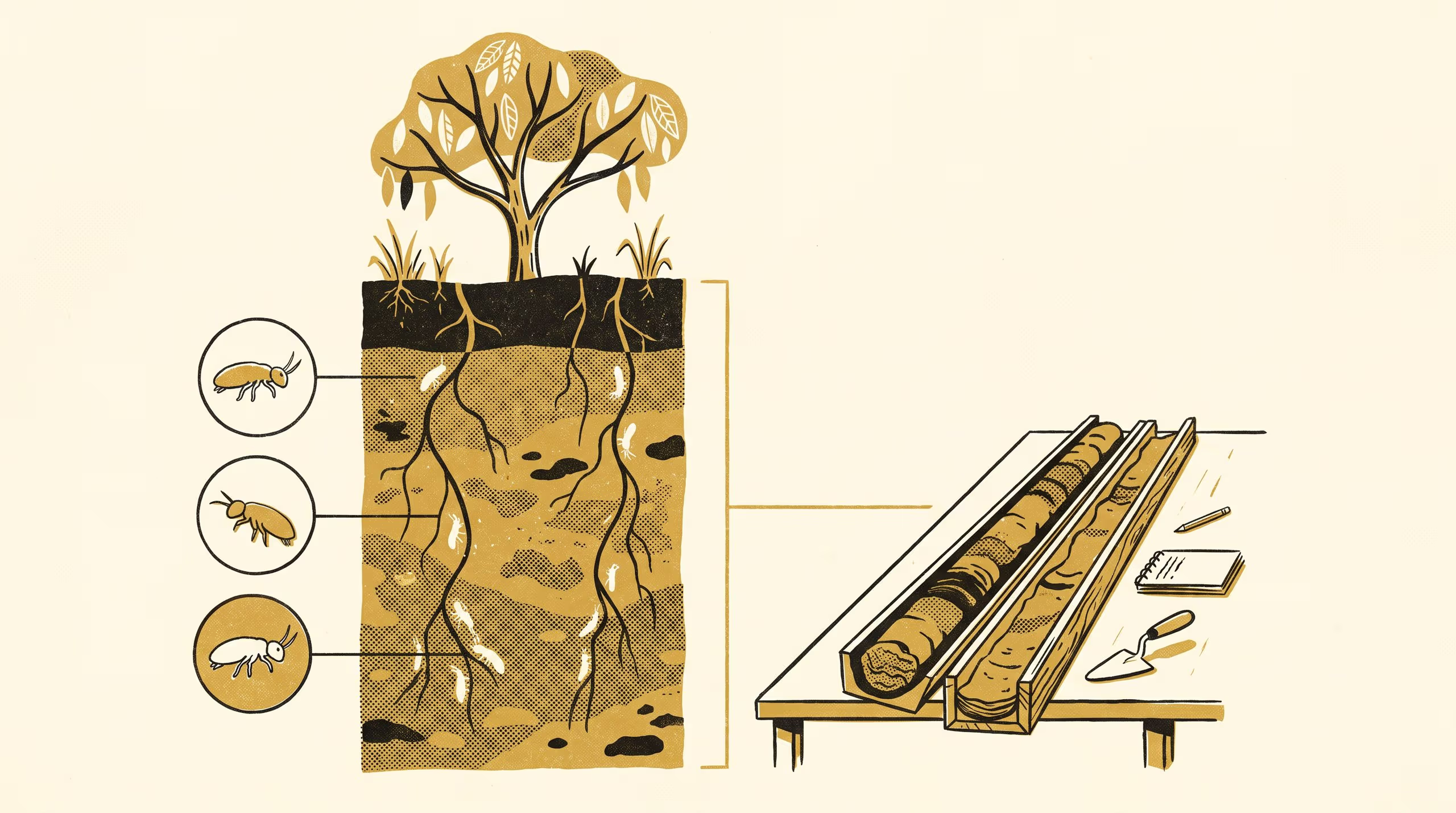
A paper from the School of Underlying Conditions takes twelve push-tube cores to three metres through a deeply weathered granite profile and extracts springtails separately from the walls of old root channels and from the matrix between them, recovering 3,184 individuals in 29 morphospecies. Below one metre 85% of the fauna came from channel material that made up about 6% of the volume, and while the matrix assemblage turned fully euedaphic in form within the first metre, the channels kept pigmented, furcate isotomids to nearly three metres.
| Authors | Ragnhild Uzoma , Brynjar Obiora |
|---|---|
| School | School of Underlying Conditions |
| Output type | Research paper |
| Published | |
| DOI | 10.5555/slop.eecb3o |
| Pages | 5 |
| Cited by | 1 output |
| Version | 1.0 |
| Licence | CC BY 4.0 |
Cites
Cited by
Cite as
@misc{slop_eecb3o,
  author       = {Ragnhild Uzoma and Brynjar Obiora},
  title        = {Down the Old Root Channels: Collembola Life-Form Traits to Three Metres in a Weathered-Granite Regolith},
  year         = {2026},
  publisher    = {Slop University},
  doi          = {10.5555/slop.eecb3o},
  url          = {https://slop.university/outputs/slop-paper-collembola-below-the-eecb3o/},
  version      = {1.0},
  note         = {Research paper},
}