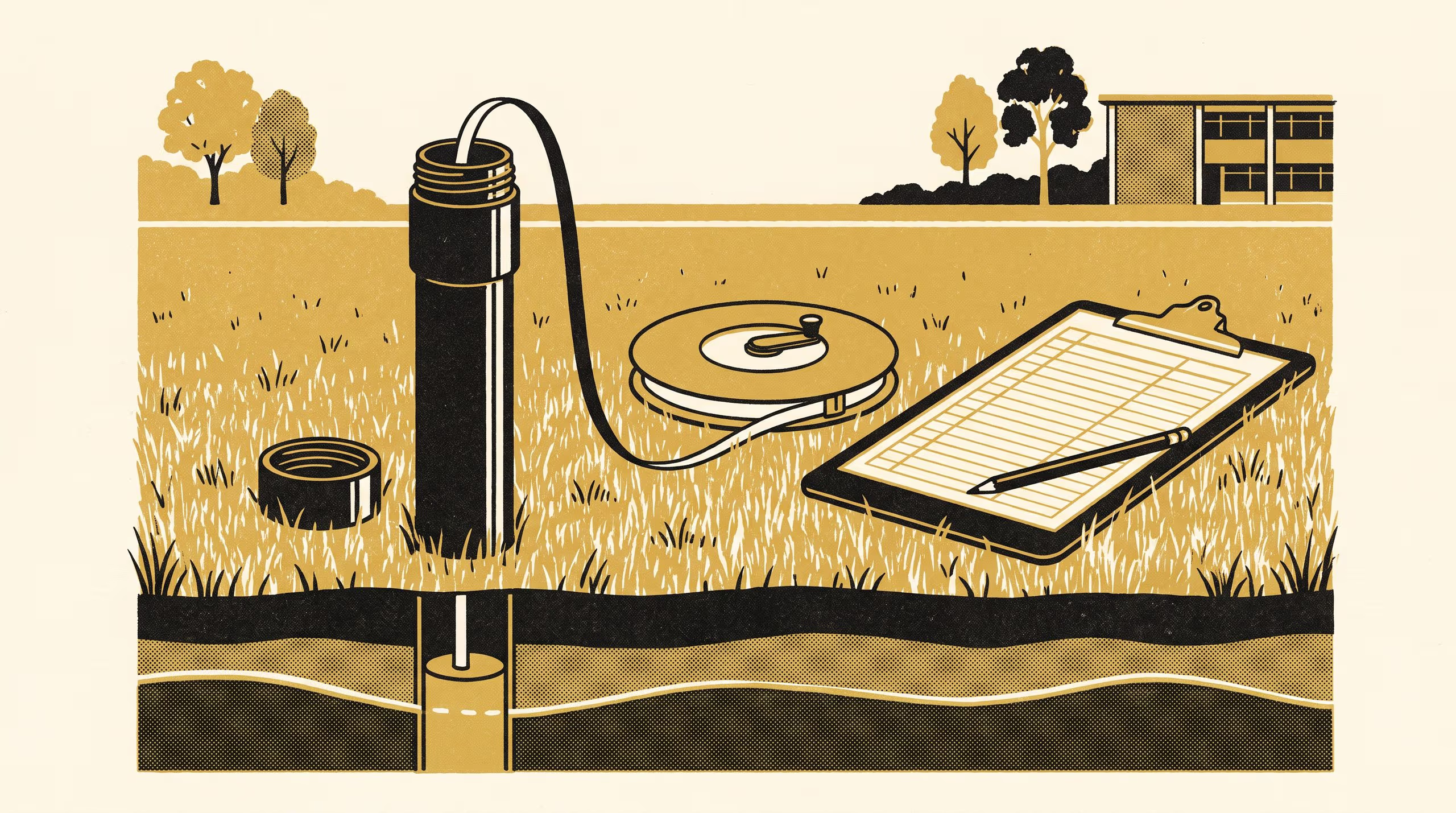
A paper from the School of Underlying Conditions and the School of Continuous Improvement follows three Year 9 classes through a term of weekly readings from a monitoring bore on their own school oval, and compares how they draw the ground beneath it before and after.
A term of dipping a schoolyard bore moves students' groundwater out of the underground lake, and teaches them something about a single reading besides
Ask a fourteen-year-old what lies beneath the school oval and the answer, more often than not, is a lake. The Lake Under the Oval, a new paper from the University, follows what happens to that lake once a class has spent a term measuring the water that is actually there.
The paper is by Dr Vigdis Emenike, Senior Lecturer in the School of Underlying Conditions, and Dr Torun Ezeigwe, Senior Lecturer and Director, Master of Applied Measurement in the School of Continuous Improvement. It brings the School’s groundwater fieldwork and its colleagues’ expertise in classroom assessment together around a single, long-forgotten bore at the edge of a regional school’s playing field.
Some of the drawings we collected in the last week were more careful than the cross-sections I was taught to make. I have been trying to work out ever since which of us was doing the teaching.
— Dr Vigdis Emenike, Senior Lecturer
Across ten weeks, students took ownership of the bore as a learning resource, building a shared record of the term and translating it, drawing by drawing, into an evolving picture of the subsurface. The study pays particular attention to how a single reading travels from the pipe into the imagination, and to the students whose drawings chose to stop where their evidence did.
Dr Ezeigwe said the coding scheme had needed “a category nobody had thought to include until the students supplied it”, and welcomed the paper as a reminder that an instrument can learn from the cohort it is applied to.
The work sits comfortably within the University’s growing habit of letting its schools borrow one another’s questions.
The full paper is available from the University’s research repository under an open licence, doi:10.5555/slop.4lukp2.