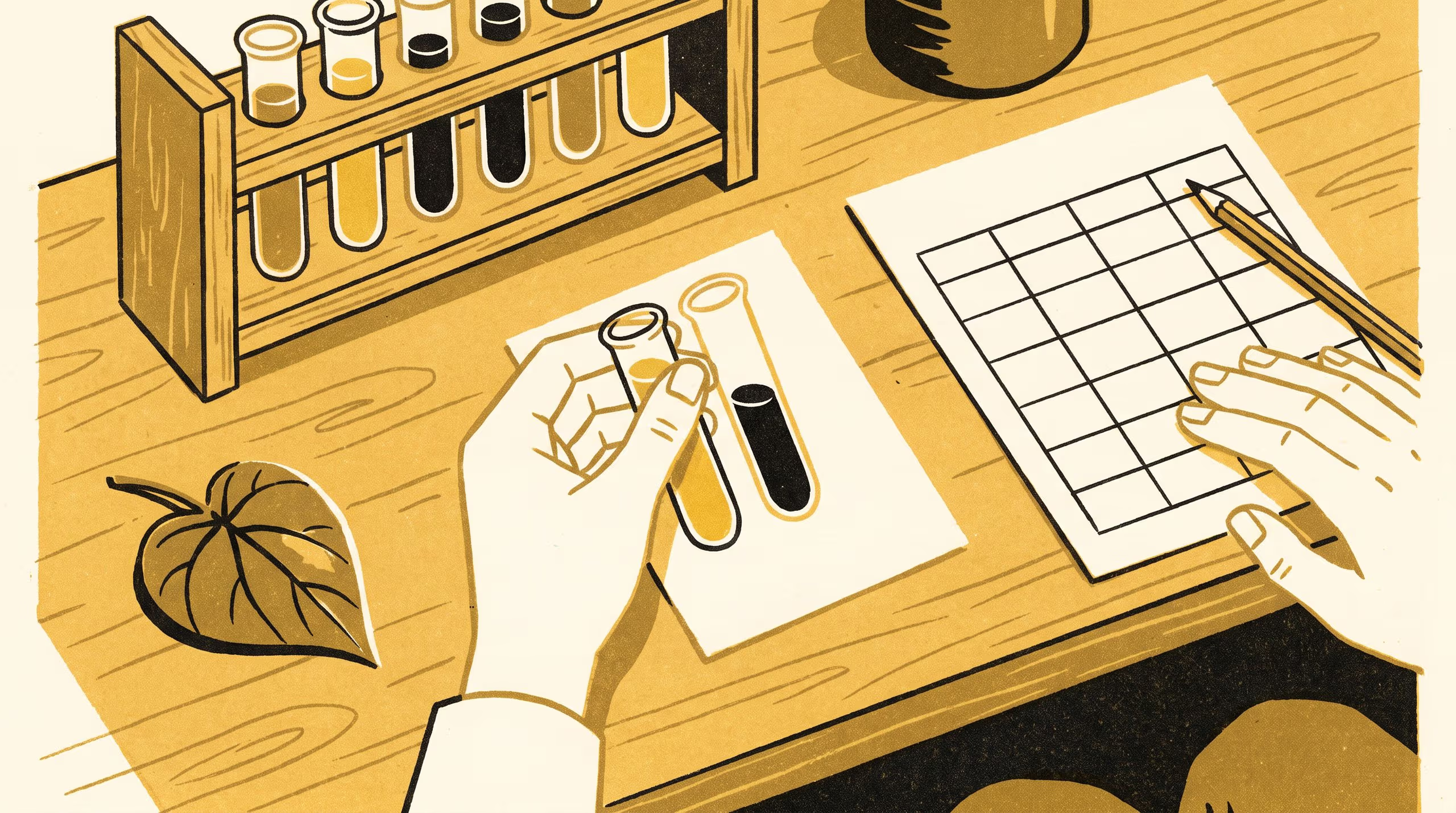
A paper from the School of Continuous Improvement records how second-year pharmacy students settle, in talk, whether a screening test has turned positive, and what changed when their handout stopped supplying the answer.
A paper from the School of Continuous Improvement follows how student pairs decide what a colour change means in a phytochemical screening practical
When two students cannot agree on a colour, they write “trace”. That small settlement sits at the centre of Put Trace, a new paper from the School of Continuous Improvement by Dr Torun Ezeigwe, Senior Lecturer and Director of the Master of Applied Measurement, and Signy Okpara, Doctoral Candidate.
We set out to watch students look at a test tube, and found ourselves watching them look at each other. That seems to us a very good place for the School to be standing.
— Dr Torun Ezeigwe, Senior Lecturer, School of Continuous Improvement
The study listened in on two cohorts of a second-year pharmacy practical, in which pairs run a panel of classical screening tests on a leaf extract and record each result as positive, negative or trace. Across 274 recorded decisions, the authors bring interaction analysis, laboratory pedagogy and the close study of everyday talk into a single account of how a shared observation is arrived at, and of how the design of a practical shapes the resources students reach for when they need one.
Ms Okpara described the project as “an education in how much two people can agree on in a word or two, and how carefully they choose which word”.
For the University, the paper is a welcome case of its research and its teaching meeting at the same bench, and of the School’s attention to process finding its way into the laboratory.
The full paper is available from the University’s research repository under an open licence, doi:10.5555/slop.jpq8h7.