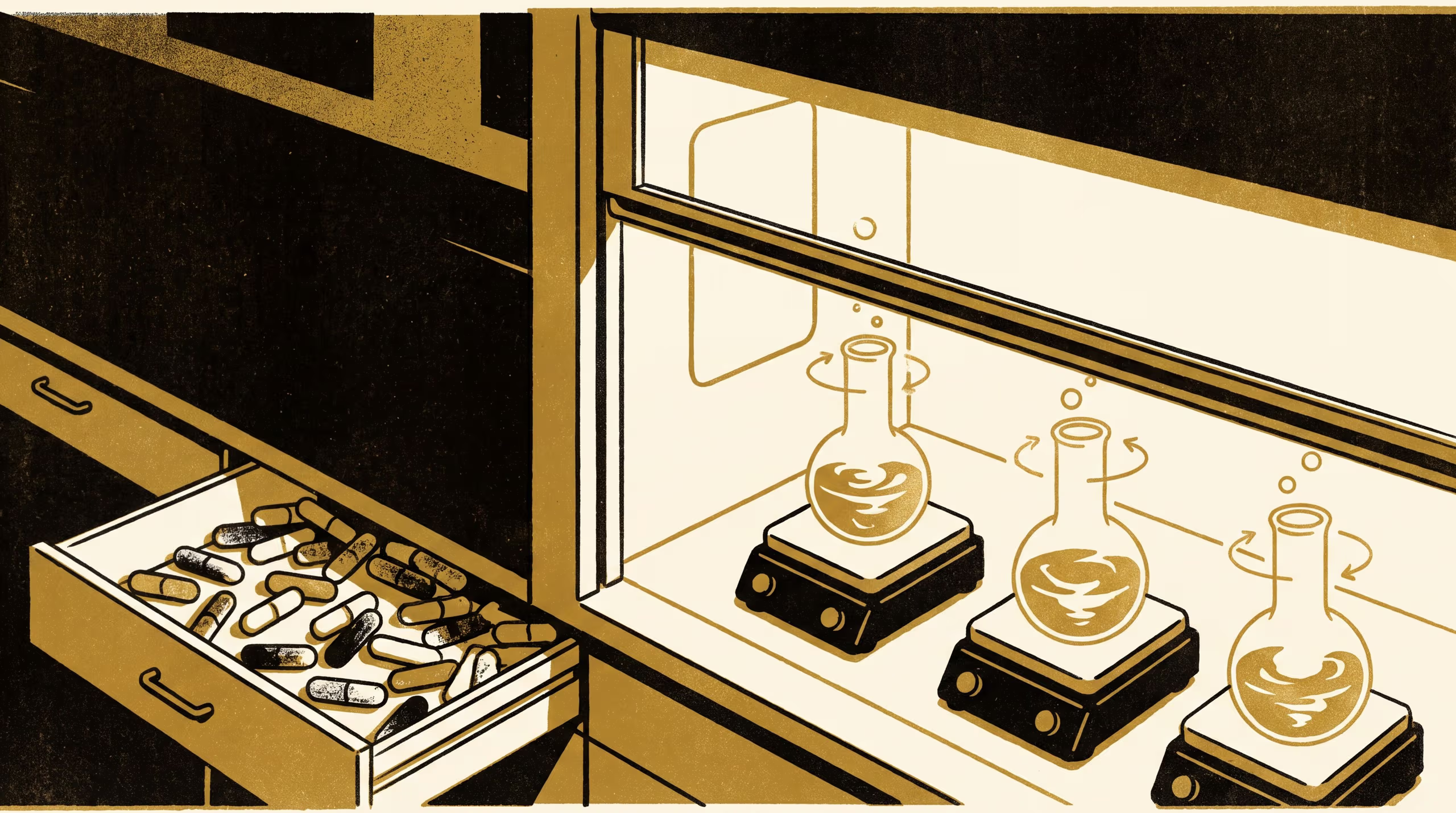
A new research poster reads one organometallic group's drawer of retired stir bars as a record of its chemistry, and finds that a third of its unexplained metal-free results reproduce only with the bar that stirred them.
A School of Underlying Conditions research poster assays 201 retired laboratory stir bars for the metals they carried from one reaction to the next
A third of one laboratory’s unexplained “metal-free” results can be reproduced, it turns out, only with the stir bar that was in the flask at the time. That is the central result of What the Stir Bars Kept, a new research poster from the School of Underlying Conditions by Dr Vigdis Emenike, Senior Lecturer, Dr Brynjar Obiora, Senior Research Fellow, and Associate Professor Ragnhild Uzoma, Lead of the Basement Relations Group.
I spent ten years taking one reading at a time down a bore. Opening the drawer felt very like that, except that this time every reading already had a number on it.
— Dr Vigdis Emenike, Senior Lecturer, School of Underlying Conditions
The team brought the School’s stratigraphic habits to an unfamiliar archive: ten years of retired bars from a single organometallic group, each etched with a number its notebooks record. Assaying every bar for the metals it still held, and aligning the results with the notebooks year by year, the authors recover the group’s movement from palladium to nickel to cobalt as a sequence of layers, then return a dozen anomalous control reactions to their original bars to see which of them were ever really free of metal.
Dr Obiora said the team had come away “with a great deal of respect for whoever etched those numbers, and a fresh supply of bars”.
The University counts the poster among the clearest recent examples of its research culture taking the unremarkable object seriously, and of an earth science school finding its methods at home on a chemistry bench.
The full poster is available from the University’s research repository under an open licence, doi:10.5555/slop.8gi2vp.