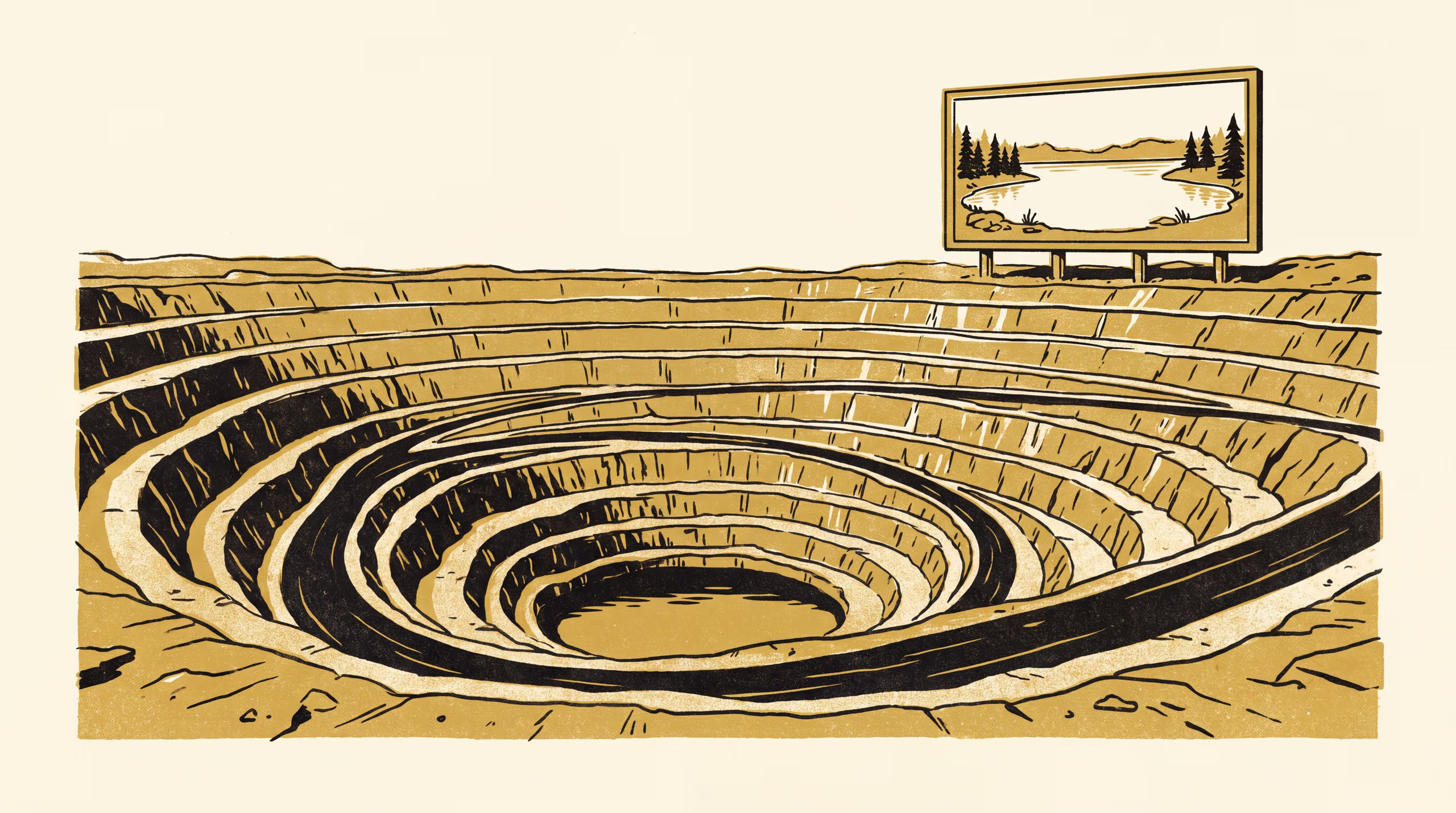
A research poster from the School of Underlying Conditions finds that the lakes and wetlands quarry operators promise for their worked-out pits change more often than the pits do, and that the accounts tend to anticipate the change.
A research poster reads fifteen years of quarry sustainability reports against the rehabilitation provisions in their accounts
The future of a hard-rock quarry is usually announced long before it arrives and, according to a research poster released today by the School of Underlying Conditions, announced again a little later each year. The Lake That Keeps Moving follows the wetlands, swimming lakes and parks that operators describe in their sustainability reports, and the closure dates attached to them, through fifteen years of publication.
The poster is led by Associate Professor Ragnhild Uzoma, Lead of the Basement Relations Group, with Dr Anouk Mensah, Postdoctoral Fellow in the School of Emergent Priorities, and Associate Professor Kwame Lindqvist, Director of the Master of Priority Studies.
Every quarry in the study is still working, and I expect each of them to hold water one day. The School is content to go on reading until one of them does.
— Associate Professor Ragnhild Uzoma, Lead, Basement Relations Group
The work sets the narrative and the ledger side by side. Across 38 quarries and 17 operators, the team aligns each promised end state with the rehabilitation provision carried in the same year’s notes to the accounts, situating corporate sustainability disclosure within the longer horizon of extractive land stewardship. Stated closure years receded at a median of 0.7 years per reporting year, and where the promised after-use changed it usually changed toward a more modest one, often after the provision had already made the move.
Dr Mensah thanked “the many report writers who set down, year after year and with real care, their plans for a hole in the ground”.
The poster is the School of Underlying Conditions’ first contribution to the study of corporate responsibility, and the University welcomes it to that literature with a quiet sense of arrival.
The full poster is available from the University’s research repository under an open licence, doi:10.5555/slop.6ewqt2.